Warning: Undefined variable $by_location in /home/odescxjtd641/public_html/beefound.in/bird-details.php on line 874

Sri Lanka Hill Myna
Gracula ptilogenys
Last update: 14 Jul 2026
Read in:
English
Español
Português
हिन्दी
বাংলা
தமிழ்
മലയാളം
मराठी
ગુજરાતી
తెలుగు
French
Deutsch
Русский
日本語
简体中文
Italiano
Tiếng Việt
العربية
ಕನ್ನಡ
ਪੰਜਾਬੀ
Sri Lanka Hill Myna Basic Information
| Scientific Name | Gracula ptilogenys |
|---|---|
| Status | NT Near Threatened |
| Size | 25-28 cm (10-11 inch) |
| Colors |
Black
Yellow
|
| Type |
Perching Birds

|
| Family | Starlings |
Introduction
The Sri Lanka Hill Myna, scientifically known as Gracula ptilogenys, is one of the most charismatic and sought-after avian species found on the island of Sri Lanka. As an endemic species, it holds a special place in the hearts of ornithologists and birdwatchers alike. Unlike its more widespread relatives, this particular species is restricted to the lush, mountainous regions of the country, making it a true specialty for those exploring the central highlands. Known for its distinct vocalizations and striking appearance, the Sri Lanka Hill Myna is a member of the Sturnidae family. These birds are highly intelligent, social creatures that play a vital role in their ecosystem, often acting as seed dispersers for various forest plants. Understanding the life cycle, behaviors, and specific environmental needs of the Gracula ptilogenys is essential for both conservation efforts and for enthusiasts aiming to document this beautiful perching bird in its natural, verdant habitat.
Physical Appearance
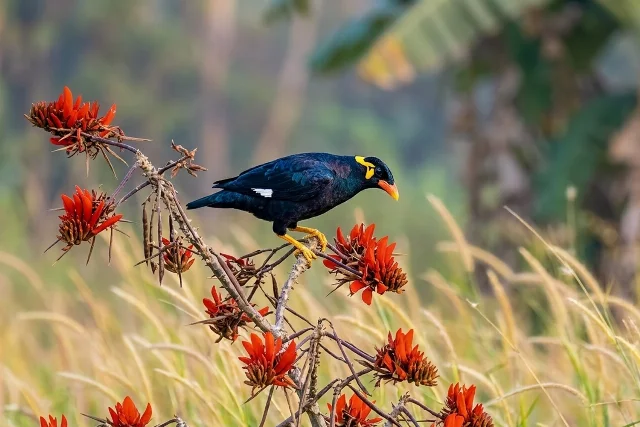
The Sri Lanka Hill Myna is a medium-sized perching bird, typically measuring between 25 and 28 centimeters in length. Its plumage is primarily a sleek, glossy black that exhibits a vibrant, oily iridescent sheen when caught in direct sunlight, reflecting hints of deep violet and blue. A defining characteristic of this species is the contrast provided by its bright yellow wattles and beak. The yellow fleshy skin patches, or wattles, are located on the sides of the head and nape, which distinguish it from other myna species. The bird possesses strong, sturdy legs and feet adapted for perching on thick branches within the forest canopy. Its bill is robust and sharp, perfectly evolved for handling fruits and insects. The wings are relatively broad, allowing for agile flight through dense forest foliage, and the tail is short and squared, giving the bird a compact and powerful silhouette when viewed in flight or at rest.
Habitat
The Sri Lanka Hill Myna is strictly endemic to the central highlands and the wet zone forests of Sri Lanka. They prefer dense, humid tropical evergreen forests, where they can find sufficient cover and food resources. These birds are typically found at altitudes ranging from 500 to 2,000 meters above sea level. They are rarely seen in open areas or urbanized environments, preferring the complex architecture of primary and secondary forests. Large trees with hollows are particularly important for their survival, as these provide necessary nesting sites. Their reliance on high-canopy habitats makes them vulnerable to habitat fragmentation, which is why protected forest reserves are critical for their long-term survival in the wild.
Diet
As an omnivorous species, the Sri Lanka Hill Myna relies on a diverse diet to meet its nutritional requirements. Their primary food source consists of a wide variety of wild fruits and berries found within the forest canopy. They are particularly fond of figs, which are abundant in their habitat and serve as a crucial energy source. In addition to fruit, they consume a significant amount of animal protein, including insects, larvae, and occasionally small reptiles or amphibians. This varied diet allows them to thrive in different forest strata. By feeding on various fruits, they perform a vital ecological service by dispersing seeds throughout the highland forests, thereby contributing to the regeneration of the local plant life.
Breeding and Nesting
The breeding season of the Sri Lanka Hill Myna is typically synchronized with the peak availability of food resources, often following the monsoon rains. These birds are cavity nesters, showing a strong preference for natural hollows located high up in large, mature trees. Unlike some other species, they do not usually excavate their own holes but instead rely on existing cavities created by decay or previous occupants. Both the male and female participate in the nesting process, which involves lining the cavity with twigs, leaves, and feathers to create a comfortable environment for their eggs. A typical clutch consists of two to three pale-colored eggs. Both parents are highly dedicated to their offspring, sharing the responsibilities of incubation and feeding the chicks until they are ready to fledge. This cooperative behavior ensures a higher survival rate for the young in the competitive forest environment.
Behavior
Sri Lanka Hill Mynas are highly social and are frequently observed in pairs or small family groups. They are known for their loud, melodious, and often complex vocalizations, which include a series of whistles, screeches, and mimicry sounds. They are particularly active during the early morning and late afternoon hours. During the day, they move through the canopy with agility, often leaping between branches rather than flying long distances. They are intelligent and exhibit curious behavior, often investigating their surroundings. While they can be bold when feeding, they remain cautious near potential predators, using their sharp calls to alert other members of the flock to any perceived danger in their territory.
Conservation Status - NT Near Threatened
The Sri Lanka Hill Myna is currently classified as Near Threatened by the IUCN. The primary threats to their population include habitat loss due to deforestation, the conversion of forest land for agriculture, and the illegal pet trade. Because they are highly sought after for their mimicry abilities, they have historically been targeted by poachers. Conservation efforts currently focus on protecting the remaining primary forest patches in the central highlands and raising public awareness about the importance of preserving these endemic birds in their natural environment to prevent further population decline.
Interesting Facts
- They are endemic to Sri Lanka, meaning they are found nowhere else on Earth.
- The bright yellow wattles on their head change shape slightly based on their mood.
- They play a crucial role as seed dispersers for many native tree species.
- They are renowned for their exceptional ability to mimic human speech and other sounds.
- They prefer to live in high-altitude, dense tropical forests.
- Unlike many other birds, they rely on natural tree cavities for nesting rather than building stick nests.
- They are highly social birds that stay in close-knit family groups.
Tips for Birdwatchers
For birdwatchers hoping to spot the Sri Lanka Hill Myna, the best strategy is to visit the central highland forests, such as those found in the Sinharaja Forest Reserve or the Knuckles Mountain Range. Because these birds are most active during the early morning hours, arriving at your location before sunrise is highly recommended. Use high-quality binoculars and look for movement in the mid-to-upper canopy levels, where they spend most of their time feeding. Listen carefully for their distinct, loud whistles, which often give away their presence before you actually see them. Patience is key, as they can be shy; staying quiet and blending into the environment will significantly increase your chances of witnessing their natural behaviors undisturbed.
Pro-Tip: To spot this bird in dense forest canopy, a 8x42 binoculars or telescope is highly recommended.
- [Check out our top recommended gear here]
Conclusion
The Sri Lanka Hill Myna (Gracula ptilogenys) is a true icon of the island's biodiversity. Its striking black and yellow appearance, combined with its intelligent nature and complex social behaviors, makes it a fascinating subject for any bird enthusiast. As an endemic species, it serves as a living testament to the unique evolutionary history of Sri Lanka's highlands. However, the future of this beautiful bird remains tied to the health of the forests it calls home. Continued habitat preservation, strict enforcement of anti-poaching laws, and ongoing scientific research are vital to ensure that future generations can enjoy the sight and sound of the Hill Myna in the wild. By supporting conservation initiatives and practicing ethical birdwatching, we can all contribute to the protection of this magnificent avian species. Whether you are a casual observer or a dedicated ornithologist, the Sri Lanka Hill Myna offers a rewarding glimpse into the intricate beauty of the natural world, reminding us of our responsibility to protect the fragile ecosystems that sustain such remarkable life.
Tag:

200 Follower
is a writer who draws. He’s the Bestselling author of “Number of The Year”. Donec vitae tortor efficitur, convallis lelobortis elit.
Recent Posts




Subscribe For Daily Newsletter