
Alajuela, Costa Rica

Belted Kingfisher
Megaceryle alcyon
Last update: 18 May 2026
Read in:
English
Español
Português
हिन्दी
বাংলা
தமிழ்
മലയാളം
मराठी
ગુજરાતી
తెలుగు
French
Deutsch
Русский
日本語
简体中文
Italiano
Tiếng Việt
العربية
ಕನ್ನಡ
ਪੰਜਾਬੀ
Belted Kingfisher Basic Information
| Scientific Name | Megaceryle alcyon |
|---|---|
| Status | LC Least Concern |
| Size | 28-35 cm (11-14 inch) |
| Colors |
Blue
White
|
| Type |
Perching Birds

|
| Family | Kingfishers |
Introduction
The Belted Kingfisher (Megaceryle alcyon) is one of the most recognizable and charismatic birds found across North America. Often spotted perched prominently on branches or utility wires overlooking water, this bird is a master of the aquatic environment. Unlike many other perching birds, the Belted Kingfisher has evolved to become a specialized hunter, relying almost exclusively on its ability to dive into rivers, lakes, and coastal waters to secure its next meal. Its distinctive silhouette, coupled with its loud, rattling call, makes it a favorite among birders and casual observers alike. This robust bird plays a crucial role in its ecosystem, acting as a top predator for small fish. Throughout this guide, we will explore the fascinating life cycle, physical characteristics, and behavioral adaptations that allow the Belted Kingfisher to thrive in diverse environments, from the frozen streams of the north to the sun-drenched bays of the southern United States.
Physical Appearance
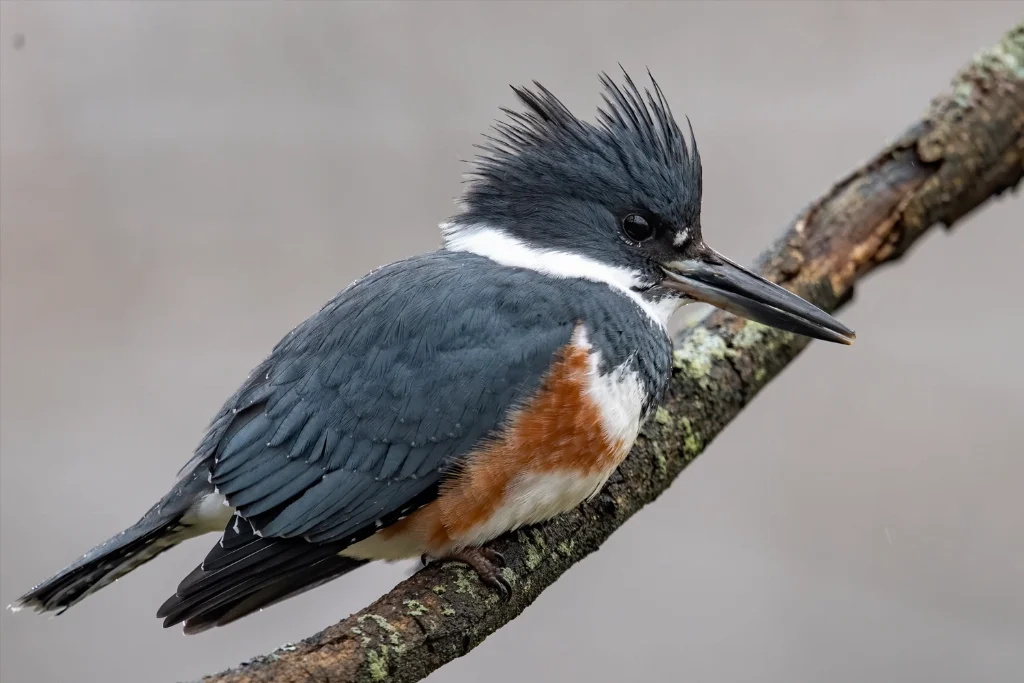
The Belted Kingfisher is a medium-sized bird, measuring approximately 28 to 35 cm in length with a stocky build and a large, crested head. Its plumage is primarily a slate-blue color, which provides excellent camouflage against the sky and water. The underparts are crisp white, featuring a distinct 'belt' across the chest that gives the species its common name. Males display a single blue band across the white chest, while females are more vibrantly marked with an additional chestnut-colored band across the belly and flanks, making this a sexually dimorphic species. They possess a long, heavy, black bill that is perfectly adapted for grasping slippery prey. Their legs are short, and their feet are syndactyl, meaning the third and fourth toes are fused at the base. This specialized foot structure is an adaptation for digging nesting burrows into earthen banks. When in flight, their wings are broad and rounded, and their tail is relatively short, allowing for rapid, agile movement as they scan the water surface for movement.
Habitat
The Belted Kingfisher is almost never found far from water. They inhabit a wide variety of aquatic ecosystems including rivers, streams, lakes, ponds, and protected coastal estuaries. A key requirement for their habitat is the presence of clear water, which allows them to spot fish, and steep, vertical earthen banks where they can excavate their tunnels. They are highly territorial, and individuals often patrol a specific stretch of a waterway. While they are resilient birds, they typically migrate away from areas where water bodies freeze over during the winter months, moving toward open water where they can continue to hunt throughout the year.
Diet
As a specialized piscivore, the Belted Kingfisher subsists primarily on a diet of small fish. They hunt by perching silently on an overhanging branch or hovering mid-air before plunging head-first into the water to snatch prey with their sharp, dagger-like bills. Once a fish is caught, they return to a perch and beat the prey against a hard surface to stun or kill it before swallowing it head-first. While fish are their main food source, their diet is occasionally supplemented by crustaceans, amphibians, insects, and, in rare instances, small reptiles or berries, especially when fish are scarce.
Breeding and Nesting
Breeding for the Belted Kingfisher is a unique process that revolves around excavation. Unlike many birds that build nests out of twigs in trees, these kingfishers dig horizontal tunnels into the sides of steep dirt banks. Both the male and female work together to dig a tunnel that can span between one and eight feet in length, typically ending in a rounded nesting chamber. They do not add lining to the nest, though it often becomes lined with fish bones and scales from regurgitated pellets as the chicks grow. A typical clutch consists of five to eight white eggs, which are incubated by both parents for approximately three weeks. Once hatched, the chicks remain in the dark burrow for about four weeks before they are ready to fledge and begin learning the complex art of fishing.
Behavior
The Belted Kingfisher is a solitary and highly territorial bird. They are well-known for their loud, rattling call, which they use to announce their presence and defend their hunting grounds from intruders. Their flight is direct and undulating, often accompanied by their characteristic call. When hunting, they exhibit remarkable patience, sitting motionless for long periods before suddenly diving. They are also known to hover over the water, flapping their wings rapidly to maintain a fixed position while they target a fish below. They are wary birds and will quickly fly away if they sense danger, often diving into the water or retreating to dense cover to escape predators.
Conservation Status - LC Least Concern
The Belted Kingfisher is currently classified as a species of Least Concern by the IUCN. Their populations are generally stable, thanks to their wide distribution and adaptability to various water bodies. However, they remain vulnerable to habitat degradation, particularly the loss of clean, clear water and the destruction of the steep, earthen banks they require for nesting. Pollution that reduces water clarity can significantly impact their hunting efficiency, making the preservation of high-quality riparian habitats vital for their continued success and long-term survival in North America.
Interesting Facts
- The female is more colorful than the male, which is the opposite of many other bird species.
- They have specialized 'syndactyl' feet, which are fused together to help them dig burrows.
- They can dive into the water at high speeds to catch fish.
- The rattling call of the Belted Kingfisher is a signature sound of North American waterways.
- They often regurgitate undigested fish bones and scales in the form of pellets.
- They are capable of hovering mid-air while hunting, similar to a kestrel or hummingbird.
- They are highly territorial and will defend their fishing spot aggressively against other kingfishers.
Tips for Birdwatchers
To spot a Belted Kingfisher, patience is your greatest asset. Focus your search on water bodies with clear visibility and overhanging branches, as these are preferred hunting perches. Use high-quality binoculars to scan the edges of ponds or rivers; often, you will see their blue silhouette before you hear them. If you hear a loud, mechanical rattling sound, quickly scan the nearby trees or utility lines, as they are likely nearby. Avoid approaching too closely, as they are skittish and will fly away if disturbed. Early morning or late afternoon are the best times to observe their most active hunting behaviors. Always keep a respectful distance to avoid interrupting their feeding or nesting activities, and consider using a telephoto lens if you wish to capture photographs of their impressive diving skills.
Pro-Tip: To spot this bird in dense forest canopy, a 8x42 binoculars or telescope is highly recommended.
- [Check out our top recommended gear here]
Pro-Tip: To capture the stunning beauty of this bird, a high-quality wildlife camera and lens are highly recommended.
- [Check out best wildlife cameras here]
Conclusion
The Belted Kingfisher is a true marvel of the avian world, perfectly adapted for life along the water's edge. From their stunning slate-blue plumage and crest to their specialized hunting techniques and unique nesting habits, they offer birdwatchers and nature enthusiasts endless opportunities for observation. As a top predator in their aquatic habitats, they serve as an indicator of the health of our rivers and lakes. Protecting these vibrant birds means protecting the water quality and riparian habitats that they depend upon. Whether you are an experienced ornithologist or a beginner looking to learn more about the wildlife in your area, the Belted Kingfisher is a rewarding subject of study. By understanding their behavior, diet, and habitat needs, we can better appreciate the complex ecological roles they fill. We encourage everyone to head out to their local waterway, keep an ear out for that iconic rattle, and enjoy the beauty of this remarkable perching bird in its natural environment. Their presence is a reminder of the intricate connections within our ecosystems, and observing them is a wonderful way to connect with the natural world.

Tag:

200 Follower
is a writer who draws. He’s the Bestselling author of “Number of The Year”. Donec vitae tortor efficitur, convallis lelobortis elit.
Recent Posts



Subscribe For Daily Newsletter