Wrentit Basic Information
| Scientific Name |
Chamaea fasciata
|
| Status |
LC
Least Concern
|
| Size |
14-16 cm (6-6 inch)
|
| Colors |
|
| Type |
|
| Family |
Parrotbills and allies |
Introduction
The Wrentit (Chamaea fasciata) is one of the most enigmatic and specialized songbirds native to the western coast of North America. Often heard far more frequently than it is seen, this small, nondescript perching bird is the only representative of its entire family in the New World. Despite its common name, it is not actually a wren nor a tit, but rather a unique species that has adapted perfectly to the dense, tangled shrublands of the Pacific coast. Its distinct, accelerating song is a hallmark of the California chaparral, acting as the soundtrack for many coastal hikes. Because it is highly sedentary and rarely travels long distances, the Wrentit has evolved into a master of its specific micro-habitat. Understanding this bird requires patience and a keen ear, as its shy nature keeps it tucked deep within thick vegetation. For birders and ornithologists alike, the Wrentit remains a fascinating subject of study, representing the incredible specialization that can occur within isolated, stable ecosystems like those found along the California coastline.
Physical Appearance
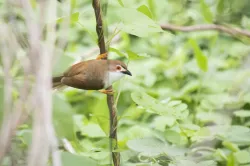
At a size of 14-16 cm, the Wrentit is a small, compact bird with a distinctive silhouette that makes identification easier once you know what to look for. Its plumage is primarily a rich, earth-toned brown, which provides excellent camouflage within the dry, woody stems of its chaparral environment. The underparts often transition into a subtle grey or buff, creating a muted, monochromatic appearance that blends seamlessly with the shadows of thick brush. One of its most notable physical features is its disproportionately long, rounded tail, which it often holds cocked upward, similar to a wren. Its eyes are a striking, pale yellow, providing a sharp contrast to its otherwise plain, brownish head. The bill is short, stout, and dark, perfectly designed for foraging among twigs and leaves. Because they are not built for long-distance flight, their wings are short and rounded, reinforcing their behavior of fluttering short distances between dense patches of cover rather than soaring through open spaces. Their overall build is stocky, which helps them maneuver through the dense, thorny labyrinths of their native shrubland habitats.
Habitat
The Wrentit is a classic specialist of the coastal shrublands and chaparral ecosystems of western North America, ranging from Oregon down through California. It strictly requires dense, impenetrable vegetation for protection and nesting. You will typically find them in areas dominated by manzanita, ceanothus, poison oak, and coastal sage scrub. They avoid open grasslands or tall, mature forests, preferring the tangled, low-growing thickets where they can hide from predators. Their sedentary nature means that a single pair may spend their entire life within a very small territory, rarely venturing more than a few hundred meters from where they were hatched, provided the habitat remains undisturbed and thick enough to support their secretive lifestyle.
Diet
As a primarily insectivorous bird, the Wrentit spends the vast majority of its day foraging for food within the lower branches of shrubs. Its diet consists largely of small insects, spiders, and other arthropods that it gleans from the surface of leaves, twigs, and bark. They are particularly adept at moving through the dense foliage to find hidden prey that larger birds might miss. During the winter months, or when insect populations are lower, they will supplement their diet with small berries and seeds found within the chaparral. They are constant foragers, rarely staying in one spot for more than a few seconds, which makes observing their feeding habits a challenging but rewarding experience for patient birdwatchers.
Breeding and Nesting
Breeding for the Wrentit is a highly territorial affair, with pairs maintaining their domain year-round. During the spring, the male performs elaborate vocal displays to defend his territory and attract a mate. Once a pair is formed, they work together to construct a well-hidden, cup-shaped nest. The nest is meticulously built from spiderwebs, bark strips, grasses, and fine rootlets, usually placed deep within a dense shrub or poison oak patch to ensure maximum security from predators. The female typically lays a clutch of three to five pale, bluish-green eggs. Both parents share the responsibilities of incubation and feeding the chicks. Due to the high risk of predation in the chaparral, the parents are incredibly cautious, often approaching the nest through a series of short, indirect flights to avoid revealing its exact location to potential intruders.
Behavior
The behavior of the Wrentit is defined by its extreme shyness and sedentary nature. They are notoriously difficult to spot, as they spend almost their entire lives deep within the cover of thick bushes. When they do move, it is usually in short, fluttering bursts of flight, quickly diving back into the shadows. Their most famous behavior is their song: a series of staccato notes that speed up like a ping-pong ball bouncing on a table. They are highly social with their mates, often seen moving in pairs, but they are fiercely territorial toward other Wrentits, using their calls to establish boundaries that they defend throughout the entire year.
Conservation Status
-
LC
Least Concern
The Wrentit is currently listed as a species of Least Concern by the IUCN. However, their long-term survival is intrinsically linked to the health of the coastal chaparral ecosystem. Because they are so sedentary and do not migrate, they are highly vulnerable to habitat fragmentation and loss due to urban development and frequent, intense wildfires. While they are currently common within their limited range, the destruction of the dense, low-growing brush they require for nesting and protection poses a significant threat. Conservation efforts focused on preserving large, continuous tracts of native shrubland are essential for maintaining stable Wrentit populations into the future.
Interesting Facts
- The Wrentit's song is often described as a 'bouncing ball' due to its accelerating rhythm.
- Despite their name, they are not closely related to wrens or tits.
- They are one of the most sedentary birds in North America, rarely traveling far.
- Their eyes are a brilliant, piercing pale yellow.
- They are known to be 'monogamous for life,' staying with the same mate for years.
- They are almost never found outside of dense, tangled shrublands.
- They are the only member of the family Paradoxornithidae found in the New World.
Tips for Birdwatchers
If you want to spot a Wrentit, do not look for movement in the trees; instead, focus your attention on the base of thick, tangled shrubs. The best way to find them is by ear. Learn their 'bouncing ball' song before you head out, as you will likely hear them long before you see them. Once you hear the song, stand perfectly still and wait. Because they are curious but shy, they may eventually pop up onto an exposed twig to investigate you. Use high-quality binoculars to scan the shadows of the brush. Early morning is the best time for activity, as the birds are most vocal and active while foraging for insects in the cool air.
Conclusion
The Wrentit is a remarkable example of evolutionary adaptation, perfectly suited to the unique, dense environments of the Pacific coast. While it may lack the vibrant colors of migratory songbirds, its role as a permanent resident of the chaparral makes it an essential part of the ecosystem's health. For those who take the time to learn its song and understand its secretive ways, the Wrentit offers a rewarding challenge that defines the experience of birding in California. Its persistence in the face of habitat change serves as a reminder of the importance of protecting our native landscapes. Whether you are a seasoned ornithologist or a casual nature enthusiast, encountering a Wrentit is a special moment that connects you deeply to the wild, tangled heart of the western coastal scrub. By respecting their need for dense cover and observing from a distance, we can ensure that these fascinating, bouncing-ball singers continue to thrive for generations to come. Their presence is a testament to the resilience of nature and the beauty found in the most unassuming of creatures, proving that you do not need bright feathers to leave a lasting impression on those who know where to look.
Wrentit Distribution Map & Range
The distribution map for this species will be available soon.
We are working with our official data partners to update this information.