
Warning: Undefined variable $by_location in /home/odescxjtd641/public_html/beefound.in/bird-details.php on line 874
Common Starling
Sturnus vulgaris
Last update: 29 Jul 2026
Read in:
English
Español
Português
हिन्दी
বাংলা
தமிழ்
മലയാളം
मराठी
ગુજરાતી
తెలుగు
French
Deutsch
Русский
日本語
简体中文
Italiano
Tiếng Việt
العربية
ಕನ್ನಡ
ਪੰਜਾਬੀ
Common Starling Basic Information
| Scientific Name | Sturnus vulgaris |
|---|---|
| Status | LC Least Concern |
| Size | 20-23 cm (8-9 inch) |
| Colors |
Black
White
|
| Type |
Perching Birds

|
| Family | Starlings |
Introduction
The Common Starling (Sturnus vulgaris), often simply referred to as the European starling, is one of the most recognizable and widespread perching birds globally. Originally native to Europe, Asia, and North Africa, this highly adaptable species has successfully colonized almost every continent, making it a familiar sight in urban, suburban, and agricultural landscapes. Known for its complex vocalizations, impressive murmuration flight patterns, and resilient nature, the Common Starling holds a significant place in the study of ornithology. While often viewed as an invasive species in regions like North America, its intelligence and social structure are truly remarkable. These birds are highly gregarious, frequently seen in large flocks that can number in the thousands, creating a spectacle in the sky. Understanding the Common Starling requires looking past its reputation as a pest and appreciating its biological success, evolutionary adaptations, and the fascinating ways it interacts with human-altered environments across the globe.
Physical Appearance
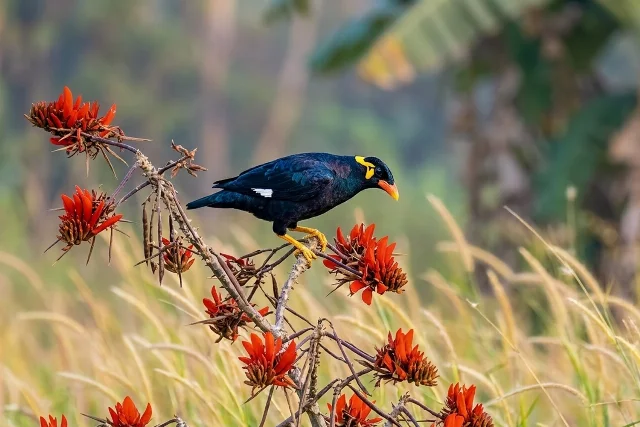
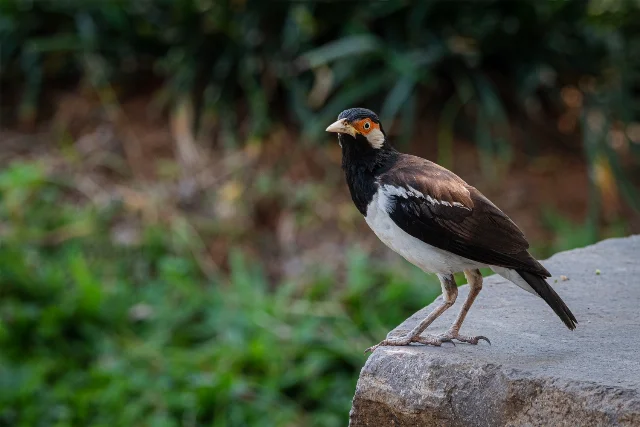
The Common Starling is a medium-sized perching bird, typically measuring between 20 and 23 centimeters in length. Its physical appearance undergoes dramatic seasonal changes, which can often confuse novice birdwatchers. During the winter months, the adult starling's plumage is predominantly black with a distinct iridescent sheen that displays purple and green highlights under direct sunlight. Furthermore, their feathers are heavily tipped with white or buff spots, giving them a speckled appearance. As the breeding season approaches in spring, these white tips wear away, revealing the solid, glossy black plumage underneath. Both males and females look relatively similar, although males often possess longer throat feathers and a more vibrant metallic luster. Their bills also change color throughout the year; they are dark during the winter and transition to a bright, vibrant yellow during the breeding season. The legs are a pinkish-brown color, and their wings are relatively short and pointed, contributing to their swift, direct flight style. Juveniles are distinct from adults, sporting a uniform, dull brown or grayish-brown color until their first molt, which helps them blend into their surroundings while they are still developing.
Habitat
The Common Starling is an incredibly versatile species, capable of thriving in a vast array of habitats. While they are originally forest-edge birds that nested in natural tree cavities, they have rapidly adapted to human-altered landscapes. Today, they are most frequently encountered in urban areas, suburban gardens, parks, and large agricultural fields. Their ability to exploit human structures, such as building crevices, eaves, and nesting boxes, has allowed them to expand their range significantly. They generally avoid deep, dense forests, preferring open areas with short grass where they can easily forage for insects on the ground. Throughout the year, they seek out communal roosting sites in trees, reed beds, or on man-made structures, where they gather in massive numbers for protection and heat.
Diet
As an omnivorous species, the Common Starling maintains a highly varied and opportunistic diet. They are skilled foragers that spend a significant portion of their time walking or running on the ground, probing the soil with their bills to extract invertebrates. Their diet consists largely of insects, including beetles, caterpillars, spiders, and earthworms, which are particularly important during the breeding season to provide protein for growing chicks. In addition to animal matter, they consume a wide variety of plant material. This includes fruits, berries, seeds, and grains, often making them a nuisance in orchards or agricultural crops. Their ability to switch food sources based on seasonal availability is a key factor in their widespread success as a species.
Breeding and Nesting
Breeding for the Common Starling is a communal and often competitive affair. They are cavity nesters, preferring to build their nests in holes in trees, cliffs, or man-made structures like birdhouses, vents, or building crevices. The male starling is responsible for initiating the nest construction, often bringing colorful items like flowers or feathers to entice a female. Once a pair bond is formed, the female completes the nest lining with softer materials such as grass, moss, and feathers. A typical clutch consists of four to six pale blue or greenish eggs, which are incubated by both parents for approximately two weeks. Starlings are known to be prolific breeders, often raising two broods in a single season. The chicks are altricial, meaning they are born blind and helpless, and require intensive care and feeding from both adults until they fledge, which usually occurs around three weeks after hatching.
Behavior
The behavior of the Common Starling is characterized by its high level of sociality and intelligence. They are best known for their spectacular "murmurations," where thousands of starlings fly in tight, fluid formations that shift and turn in unison, appearing as a massive, dark cloud in the sky. This behavior is believed to be a defense mechanism against predators like falcons. Starlings are also exceptional mimics, capable of imitating the calls of other bird species, mechanical noises, and even human speech. They are highly aggressive when competing for nesting sites, often displacing native birds from cavities. Their social structure is complex, with individuals maintaining strong bonds within their flocks throughout the year.
Conservation Status - LC Least Concern
According to the IUCN Red List, the Common Starling is classified as a species of Least Concern. Due to its massive global population and incredible ability to adapt to nearly any environment, the species is not currently facing any threat of extinction. In many parts of its introduced range, such as North America, it is actually managed as a pest species because it competes with native birds for resources and can damage agricultural crops. Despite local efforts to control their numbers, the Common Starling remains one of the most successful and populous birds on the planet.
Interesting Facts
- Common Starlings are master mimics and can copy sounds from chainsaws to other birds.
- Their flight formations, known as murmurations, can involve thousands of birds moving in perfect unison.
- They were introduced to New York City's Central Park in the 1890s by a man who wanted all birds mentioned in Shakespeare's plays to live in America.
- The color of their beak changes from dark in winter to bright yellow during the breeding season.
- They are highly aggressive and often take over nesting sites from native woodpeckers and bluebirds.
- Starlings are omnivores and can eat their own body weight in insects during the summer months.
- They have a unique way of foraging called "open-bill probing," where they insert their closed bill into the ground and open it to create a hole.
Tips for Birdwatchers
For birdwatchers, the Common Starling offers a great opportunity to observe complex social behaviors and seasonal plumage changes. To get the best view, look for them in open fields or park lawns where they forage on the ground. If you want to witness a murmuration, visit large open areas near roosting sites like reed beds or city centers just before dusk during the winter months. Because they are so common, they are excellent subjects for practicing identification skills, particularly in noting the differences between juvenile brown plumage and the iridescent adult plumage. If you are using a camera, try to capture their iridescent feathers by positioning yourself so the sun hits them at an angle, highlighting the metallic purple and green colors. While they are often overlooked due to their abundance, observing their interactions and mimicry can be a deeply rewarding experience for any dedicated birder.
Pro-Tip: To capture the stunning beauty of this bird, a high-quality wildlife camera and lens are highly recommended.
- [Check out best wildlife cameras here]
Conclusion
In conclusion, the Common Starling (Sturnus vulgaris) stands as a testament to the power of biological adaptation and resilience. From its humble origins to its current status as a ubiquitous global species, the starling has navigated the challenges of changing landscapes with remarkable success. While their tendency to outcompete native species and impact agriculture has earned them a controversial reputation, they remain an essential subject of study for ornithologists and a fascinating spectacle for birdwatchers. Their complex social structures, mesmerizing aerial displays, and impressive vocal mimicry provide endless opportunities for observation and appreciation. As we continue to study these birds, we gain valuable insights into how species interact with human-dominated ecosystems and the factors that contribute to ecological dominance. Ultimately, the Common Starling reminds us that even the most abundant birds possess unique traits and behaviors that deserve our attention. Whether you view them as a nuisance or an object of wonder, there is no denying the profound impact and presence of the Common Starling in our natural world. By understanding their biology and behavior, we can better appreciate the intricate balance of the ecosystems they inhabit and the complex relationship between humans and the avian world.
Tag:

200 Follower
is a writer who draws. He’s the Bestselling author of “Number of The Year”. Donec vitae tortor efficitur, convallis lelobortis elit.
Recent Posts




Subscribe For Daily Newsletter