
Not available
Great Myna
Acridotheres grandis
Last update: 11 Mar 2026
Read in:
English
Español
Português
हिन्दी
বাংলা
தமிழ்
മലയാളം
मराठी
ગુજરાતી
తెలుగు
French
Deutsch
Русский
日本語
简体中文
Italiano
Tiếng Việt
العربية
ಕನ್ನಡ
ਪੰਜਾਬੀ
Great Myna Basic Information
| Scientific Name | Acridotheres grandis |
|---|---|
| Status | LC Least Concern |
| Size | 24-27 cm (9-11 inch) |
| Colors |
Black
White
|
| Type |
Perching Birds

|
| Family | Starlings |
Introduction
The Great Myna, scientifically known as Acridotheres grandis, is a fascinating member of the Sturnidae family, which includes starlings and other mynas. Recognized for its bold personality and striking appearance, this perching bird is a common sight across much of Southeast Asia. Often found in proximity to human settlements, the Great Myna is known for its intelligence, adaptability, and vocal nature. Unlike some more elusive species, the Great Myna is relatively easy to observe, making it an excellent subject for both amateur birdwatchers and serious ornithologists. As a species that has successfully adapted to human-altered landscapes, it plays a significant role in its ecosystem by controlling insect populations and dispersing seeds. Understanding the Great Myna provides valuable insights into how certain avian species thrive in changing environments, offering a glimpse into the complex relationships between wildlife and urban expansion. This guide explores the intricate details of the Great Myna, from its physical characteristics to its unique behavioral patterns.
Physical Appearance
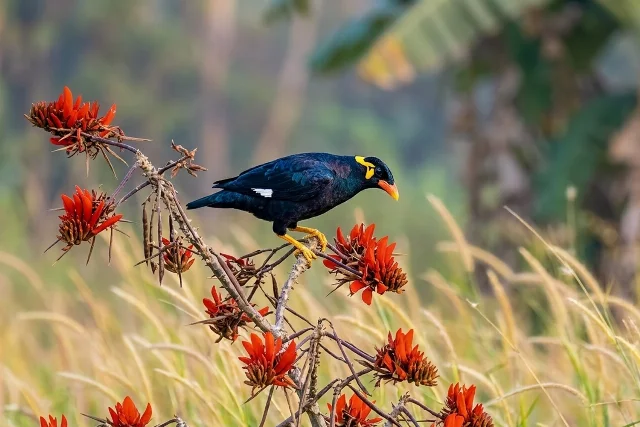
The Great Myna is a medium-sized perching bird, typically measuring between 24 and 27 centimeters in length. Its plumage is predominantly a deep, glossy black, which provides a stark contrast against its secondary colors. A distinguishing feature of this species is the presence of white patches on the wings, which are most prominent when the bird is in flight. Furthermore, they possess a distinct, prominent yellow-orange bill and legs, which stand out against their dark bodies. The Great Myna also features a noticeable crest of feathers on its forehead, which can be raised when the bird is agitated or during mating displays. Sexual dimorphism is not highly pronounced in this species, meaning males and females look largely identical to the casual observer. Their sturdy, strong legs are perfectly adapted for their perching lifestyle, allowing them to navigate branches and walk confidently on the ground while foraging for food. The combination of their sleek black feathers, bright bill, and white wing patches makes them easily identifiable in their natural habitat.
Habitat
The Great Myna is highly adaptable, thriving in a wide variety of habitats across Southeast Asia. Its range spans from northeastern India and Bangladesh eastward through Myanmar, Thailand, Laos, Vietnam, and parts of southern China. They are frequently found in open woodland, cultivated areas, agricultural fields, and increasingly, in suburban and urban environments. They prefer areas that offer a mix of trees for nesting and open ground for foraging. Their ability to exploit human-altered landscapes, such as parks, gardens, and rice paddies, has allowed them to maintain stable populations. They are generally not found in dense, primary rainforests, preferring the more fragmented and open habitats where they can easily find food and nesting sites.
Diet
The Great Myna is an omnivorous opportunistic feeder, which is a key factor in its successful survival across diverse landscapes. Its diet consists of a wide variety of food sources, including insects, fruits, nectar, and small vertebrates. They are frequently observed foraging on the ground, walking with a confident gait to hunt for beetles, grasshoppers, and caterpillars, which makes them beneficial to farmers as they help control agricultural pests. In addition to insects, they readily consume various fruits and berries, often playing a role in seed dispersal. Their opportunistic nature also means they will scavenge for food scraps near human settlements, further demonstrating their adaptability and close association with human activity.
Breeding and Nesting
The breeding season for the Great Myna typically coincides with the warmer months, varying slightly by geographic location. These birds are cavity nesters, preferring to build their nests in tree hollows, abandoned woodpecker holes, or even crevices in man-made structures like buildings and bridges. Both the male and female participate in the construction of the nest, which is often lined with twigs, grass, feathers, and sometimes man-made debris like plastic or paper. A typical clutch consists of 3 to 5 pale blue or greenish-blue eggs. Both parents are actively involved in the incubation process, which lasts for approximately two weeks. After hatching, the chicks are fed by both parents, receiving a high-protein diet of insects to support their rapid growth before they fledge the nest.
Behavior
Great Mynas are highly social and intelligent birds, frequently seen in pairs or small groups. They are known for their loud, vocal nature, communicating with a complex array of calls, whistles, and mimicry. They are quite aggressive when defending their territory, especially during the breeding season, and will not hesitate to chase away other birds or even larger animals that venture too close to their nest. Their intelligence is demonstrated by their problem-solving abilities when foraging and their quick adaptation to new food sources. They are active during the day and often gather in larger communal roosts in trees at night, creating quite a spectacle with their collective noise.
Conservation Status - LC Least Concern
Currently, the Great Myna is classified as a species of Least Concern by the IUCN. Their population is considered stable, and in many areas, they are actually increasing in number due to their ability to adapt to human-modified environments. Unlike many other bird species that face threats from habitat loss, the Great Myna has successfully exploited the expansion of agricultural and urban areas. While they do not face immediate risks, they are still vulnerable to localized threats such as pesticide use in agricultural areas and potential competition with invasive species in certain parts of their range.
Interesting Facts
- The Great Myna is known to be highly intelligent and capable of complex social interactions.
- They are skilled mimics and can imitate various sounds, including other bird species and ambient noises.
- These birds often utilize man-made structures for nesting, showing incredible adaptability.
- They play a crucial role in agriculture by consuming large quantities of pest insects.
- The Great Myna can often be seen walking on the ground, a behavior that contrasts with many other perching birds.
- They are very protective parents and will aggressively defend their nests from intruders.
Tips for Birdwatchers
For birdwatchers hoping to spot the Great Myna, the best approach is to visit open areas near human settlements, such as public parks, agricultural fields, or even suburban gardens. Because they are not shy, they are relatively easy to observe with the naked eye or binoculars. Keep an eye on the ground, as they spend a significant amount of time foraging there. Their distinctive black plumage, white wing patches, and bright yellow bill make them easy to identify, even from a distance. If you hear loud, chaotic chattering in a tree or on a rooftop, there is a high probability that a group of Great Mynas is nearby. Early morning and late afternoon are the most active times for these birds, making these the ideal periods for observation and photography.
Pro-Tip: To spot this bird in dense forest canopy, a 8x42 binoculars or telescope is highly recommended.
- [Check out our top recommended gear here]
Pro-Tip: To capture the stunning beauty of this bird, a high-quality wildlife camera and lens are highly recommended.
- [Check out best wildlife cameras here]
Conclusion
In conclusion, the Great Myna (Acridotheres grandis) is a remarkable example of an avian species that has successfully navigated the challenges of living alongside humans. With its bold personality, distinct physical features, and highly adaptable nature, it remains a common and vibrant part of the Southeast Asian landscape. From its role as a natural pest controller in agricultural settings to its intriguing social behaviors, the Great Myna offers much to admire for both casual observers and dedicated ornithologists. While it currently enjoys a stable conservation status, it is important to continue monitoring these populations to ensure they remain a fixture in our ecosystems. By appreciating the adaptability of the Great Myna, we gain a deeper understanding of the dynamics of urban ecology and the resilience of wildlife in the face of environmental change. We encourage bird enthusiasts to take the time to observe these fascinating birds, as they truly exemplify the complex and evolving relationship between the avian world and human civilization.
Tag:

200 Follower
is a writer who draws. He’s the Bestselling author of “Number of The Year”. Donec vitae tortor efficitur, convallis lelobortis elit.
Recent Posts





Subscribe For Daily Newsletter