Eared Dove Basic Information
| Scientific Name |
Zenaida auriculata
|
| Status |
LC
Least Concern
|
| Size |
22-26 cm (9-10 inch)
|
| Colors |
|
| Type |
|
| Family |
Pigeons, Doves |
Introduction
The Eared Dove (Zenaida auriculata) is a fascinating species of bird belonging to the Columbidae family. Widely recognized as one of the most prolific and common upland ground birds across South America, this dove has successfully adapted to a variety of environments ranging from rural agricultural landscapes to dense urban centers. Its resilience and high reproductive rate have allowed it to thrive across a massive geographical range, stretching from the Caribbean islands down to the southern tips of Argentina and Chile. Often confused with its North American relative, the Mourning Dove, the Eared Dove possesses distinct characteristics that set it apart, particularly regarding its vocalizations and localized habitat preferences. As an essential component of its ecosystem, it plays a vital role in seed dispersal, contributing to the health of the grasslands and scrublands it inhabits. For enthusiasts of ornithology, understanding the Eared Dove provides a window into the evolutionary success of Columbids in the neotropics.
Physical Appearance
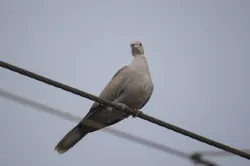
Measuring approximately 22 to 26 cm in length, the Eared Dove is a medium-sized bird characterized by its sleek and streamlined silhouette. Its plumage is primarily a soft brown, which serves as an excellent camouflage against the soil and dry vegetation of its natural habitat. This base color is complemented by subtle grey accents, particularly on the wings and the back, which create a sophisticated, mottled appearance. A defining feature that gives the bird its common name is the distinct blackish auricular patch—a stripe-like mark located on the side of the head, behind the eye, resembling an 'ear'. The wings are pointed, facilitating rapid and agile flight, while the tail is relatively short and square-ended compared to other dove species. Their bills are dark and slender, perfectly suited for picking up seeds from the ground. Both sexes are relatively similar in appearance, though males may exhibit slightly more vibrant iridescent patches on the neck, which are often displayed during mating rituals.
Habitat
The Eared Dove is remarkably versatile when it comes to its living environment. While it is classified as an upland ground bird, it is by no means restricted to a single biome. These birds are frequently found in open and semi-open landscapes, including agricultural fields, scrublands, savanna-like regions, and even suburban gardens. They are highly adaptable to human-altered landscapes, often thriving in areas where intensive farming provides a steady supply of spilled grain. While they prefer areas with scattered trees or bushes for nesting and resting, they are highly mobile and will travel significant distances in search of water and abundant food sources, making them a common sight across diverse South American terrains.
Diet
Primarily granivorous, the Eared Dove relies heavily on a diet consisting of seeds, grains, and occasionally small fruits. Because they spend a significant amount of time foraging on the ground, they are exceptionally efficient at locating fallen seeds from grasses, weeds, and agricultural crops like corn, wheat, and sorghum. Their digestive system is well-adapted to process these tough, dry items. In agricultural regions, they are sometimes considered pests due to their tendency to congregate in large flocks and consume significant quantities of spilled harvest grains. They also require regular access to water sources, often visiting ponds or troughs at dawn and dusk to drink, which is a key time for observers to spot them.
Breeding and Nesting
The breeding behavior of the Eared Dove is notable for its intensity and frequency. Unlike many other bird species that may only nest once or twice a year, the Eared Dove is capable of multiple broods within a single season, provided the food supply remains abundant. Their nests are typically simple, flimsy platforms constructed from twigs, straw, and rootlets, usually placed in the fork of a tree or a dense shrub. The female typically lays two white eggs, which both parents take turns incubating for approximately two weeks. The chicks are altricial and are fed 'crop milk'—a protein-rich secretion produced by both parents—before transitioning to a diet of regurgitated seeds. This rapid reproductive cycle is a primary reason for their immense population numbers across their native range.
Behavior
Eared Doves are highly social creatures, frequently observed in large, nomadic flocks when they are not actively nesting. Their flight is fast and direct, characterized by a distinct whistling sound produced by their wings, which is a hallmark of the species. They are generally ground-foragers, walking with a bobbing head motion as they search for food. While they can be somewhat wary of humans, their presence in urban environments has made them quite accustomed to light human activity. During the breeding season, males perform elaborate courtship displays, including bowing, cooing, and short, circular flight displays to attract potential mates and defend their immediate nesting territory.
Conservation Status
-
LC
Least Concern
Currently, the Eared Dove is classified as Least Concern by the IUCN. Their population is considered stable and, in many regions, is actually increasing due to the expansion of agricultural activities which provide them with year-round food sources. They are not currently threatened by habitat loss in the same way as more specialized species, as they have successfully integrated into human-modified landscapes. However, in some countries, they are subject to hunting pressure, though their high reproductive rate ensures that their numbers remain robust and widespread across their entire South American distribution.
Interesting Facts
- The Eared Dove is the South American ecological equivalent of the North American Mourning Dove.
- They are known to travel vast distances in search of optimal feeding grounds, often covering hundreds of kilometers.
- Their wings produce a unique, audible 'whistle' during takeoff that helps alert the flock to potential danger.
- Both parents produce 'crop milk' to feed their young, a rare trait among birds.
- In some parts of their range, they are so numerous that they are considered a major agricultural nuisance.
- They are highly social and rarely venture alone, preferring the safety of a large flock.
Tips for Birdwatchers
For birdwatchers looking to spot the Eared Dove, the best strategy is to visit open agricultural fields or parklands during the early morning or late afternoon hours. These are the times when the birds are most active and likely to be found foraging on the ground. Listen for their rhythmic, low-frequency cooing, which is distinct once you become familiar with it. When approaching, move slowly and keep a low profile, as these birds can be skittish if they detect sudden movements. Using binoculars is essential, as their brown and grey plumage provides excellent camouflage, making them difficult to spot against dry soil or stubble. If you are in an area with a water source, such as a cattle trough, simply waiting nearby is often the most effective way to observe a large gathering of them.
Conclusion
In conclusion, the Eared Dove (Zenaida auriculata) stands as a testament to the adaptability and evolutionary success of the Columbidae family. With its unassuming brown and grey plumage and its preference for open, upland habitats, it might initially seem like an unremarkable species. However, a closer look at its social structure, its rapid reproductive cycles, and its impressive ability to thrive in both wild and human-dominated environments reveals a bird of significant biological interest. Whether one is a seasoned ornithologist or a casual backyard birdwatcher, the Eared Dove offers a rewarding subject for study. By understanding their dietary needs, their nesting habits, and their social behaviors, we gain a deeper appreciation for the biodiversity that persists in our agricultural and suburban landscapes. As they continue to expand their presence, they remain a vital, albeit sometimes misunderstood, component of the South American avian community. Protecting the habitats they rely on, even within agricultural sectors, ensures that this resilient and fascinating species will continue to flourish for generations to come. Their presence is a reminder that nature often finds a way to adapt and thrive, even in the most rapidly changing environments on the planet.
Eared Dove Distribution Map & Range
The distribution map for this species will be available soon.
We are working with our official data partners to update this information.