Not available
Jungle Prinia
Prinia sylvatica
Last update: 09 Mar 2026
Read in:
English
Español
Português
हिन्दी
বাংলা
தமிழ்
മലയാളം
मराठी
ગુજરાતી
తెలుగు
French
Deutsch
Русский
日本語
简体中文
Italiano
Tiếng Việt
العربية
ಕನ್ನಡ
ਪੰਜਾਬੀ
Jungle Prinia Basic Information
| Scientific Name | Prinia sylvatica |
|---|---|
| Status | LC Least Concern |
| Size | 15-18 cm (6-7 inch) |
| Colors |
Brown
Buff
|
| Type |
Perching Birds

|
| Family | Cisticolas and allies |
Introduction
The Jungle Prinia (Prinia sylvatica) is a small but highly active member of the Cisticolidae family, often recognized by its restless nature and distinctive vocalizations. As a quintessential perching bird, it inhabits a variety of landscapes across South Asia, ranging from open scrublands to the fringes of dense forests. Though its size is modest, its presence is significant within its ecosystem, acting as a vital insect controller. Ornithologists often find this species fascinating due to its complex plumage variations across its different geographical subspecies. Unlike some of its more elusive cousins, the Jungle Prinia is relatively adaptable to human-modified environments, provided there is sufficient vegetation cover. Its life cycle is deeply intertwined with the seasonal changes of its environment, making it a key subject for those interested in avian ecology. Whether you are a casual nature enthusiast or a seasoned ornithologist, understanding the Jungle Prinia offers a rewarding glimpse into the intricate biodiversity of Asian scrubland habitats.
Physical Appearance
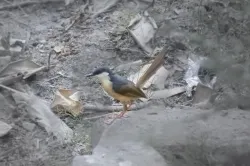
Measuring approximately 15 to 18 cm in length, the Jungle Prinia is characterized by its slender build and long, graduated tail, which it frequently flicks. The primary color of this bird is a soft, earthy brown, which provides excellent camouflage against the dry grasses and twigs it frequents. This brown plumage is typically darker on the upper parts, while the underparts feature a warmer, buff or pale cream coloration. During the breeding season, some individuals may display a slightly more vibrant plumage, though sexual dimorphism is generally subtle. One of its most notable features is the bill, which is thin and black, perfectly adapted for gleaning small insects from foliage. Its legs are a pale, flesh-toned pink, providing a stark contrast to its darker body. The wings are short and rounded, suited for short, darting flights rather than long-distance migration. When in flight, the tail often appears disproportionately long, and the bird exhibits a fluttering, undulating motion that is diagnostic of the genus Prinia.
Habitat
The Jungle Prinia is predominantly found in open, dry country, scrubby hillsides, and the edges of tropical deciduous forests. It shows a strong preference for areas with scattered bushes, tall grasses, and secondary growth. Unlike forest-interior species, it thrives in environments that offer a mosaic of cover and open ground. It is frequently observed in agricultural fields, forest clearings, and even suburban gardens that maintain a wild, unkempt appearance. This species is highly dependent on the availability of dense, low-lying vegetation for both nesting and protection from predators. Its habitat range extends across much of the Indian subcontinent, where it adapts to the varying climates of the region, provided the vegetation remains sufficiently arid or semi-arid to support its nesting requirements.
Diet
The Jungle Prinia is an insectivorous bird, feeding almost exclusively on a wide variety of small arthropods. Its diet includes tiny beetles, spiders, caterpillars, wasps, and various types of flies. It is a highly active forager, spending much of its day scanning leaves, stems, and the ground for movement. It employs a "gleaning" technique, where it moves rapidly through the foliage, picking insects off the surface of leaves with its precision-built bill. Occasionally, it will launch into short, agile sallies to catch flying insects in mid-air. Because it relies heavily on insects, the presence of the Jungle Prinia is often a positive indicator of a healthy, diverse insect population in its immediate environment.
Breeding and Nesting
The breeding season of the Jungle Prinia typically coincides with the monsoon or the period immediately following it, when food resources are at their peak. These birds are master architects, constructing a deep, cup-shaped nest that is cleverly hidden within dense foliage, often stitched together using large leaves or grasses. The nest is lined with soft plant down, spider webs, and fine fibers to ensure the comfort and safety of the brood. A typical clutch consists of three to four eggs, which are often glossy and marked with reddish-brown spots. Both the male and female participate in the construction of the nest and the subsequent feeding of the chicks. The incubation period is relatively short, and the fledglings leave the nest quickly to avoid detection by predators, maintaining the high survival strategy typical of small perching birds.
Behavior
The behavior of the Jungle Prinia is defined by its ceaseless energy and vocal activity. It is a nervous, restless bird, rarely sitting still for more than a few seconds. When perched, it is known for its habit of flicking its long tail, a motion that helps it maintain balance while navigating thin, swaying branches. It is highly territorial, with males often singing from the tops of bushes to defend their chosen patch of scrub. Its song is a repetitive, rhythmic series of notes that can be heard from a distance. Despite its bold vocalizations, it is surprisingly adept at disappearing into the undergrowth when it detects a threat, making it a challenging subject for photographers.
Conservation Status - LC Least Concern
Currently, the Jungle Prinia is classified as a species of Least Concern by the IUCN. Its wide distribution across the Indian subcontinent and its ability to adapt to human-modified landscapes, such as rural gardens and agricultural fringes, contribute to its stable population numbers. However, like many scrub-dwelling birds, it faces potential threats from habitat fragmentation and the loss of natural scrublands to intensive development. Protecting the native vegetation and maintaining corridors of wild, unmanaged growth are essential strategies for ensuring the long-term conservation of this resilient and ecologically important species.
Interesting Facts
- The Jungle Prinia is known for its distinct, repetitive 'tink-tink' call.
- It is a master of camouflage, using its brown and buff plumage to blend into dry grass.
- They often stitch living leaves together using spider silk to reinforce their nests.
- This bird is a vital natural pest controller in agricultural environments.
- The long tail of the Jungle Prinia serves as a rudder during its erratic, fluttering flight.
- It is highly social during the non-breeding season but becomes very territorial once nesting begins.
Tips for Birdwatchers
To successfully spot the Jungle Prinia, patience is your greatest asset. Focus your efforts on early morning or late afternoon, when the birds are most active and vocal. Look for them in areas with tall, dry grass and scattered bushes, rather than deep forests. Use a pair of high-quality binoculars to scan the tops of shrubs where males often perch to sing. Because they are shy and move quickly, avoid sudden movements. Learning their repetitive, rhythmic call is the most effective way to locate them, as the sound often betrays their presence long before you see them. Persistence will eventually reveal this shy, energetic bird in its natural environment.
Pro-Tip: To spot this bird in dense forest canopy, a 8x42 binoculars or telescope is highly recommended.
- [Check out our top recommended gear here]
Conclusion
In conclusion, the Jungle Prinia (Prinia sylvatica) is a fascinating example of how small, specialized birds can thrive in diverse environments. With its distinct brown and buff coloration and its energetic, restless behavior, it adds a dynamic element to the scrublands and forest fringes it calls home. From its clever nest-building techniques to its role as a dedicated insect hunter, the Jungle Prinia is a testament to the complexity of avian life. For birdwatchers, this species offers a delightful challenge, rewarding the patient observer with glimpses of its rapid movements and constant activity. As we continue to modify our natural landscapes, it remains vital to preserve the wild, unkempt spaces that these birds depend upon. By appreciating the presence of the Jungle Prinia, we gain a deeper respect for the small but essential creatures that keep our ecosystems balanced and vibrant. Whether you are observing them in a rural field or a protected sanctuary, the Jungle Prinia serves as a reminder of the beauty found in the details of the natural world.
Tag:

200 Follower
is a writer who draws. He’s the Bestselling author of “Number of The Year”. Donec vitae tortor efficitur, convallis lelobortis elit.
Recent Posts






Subscribe For Daily Newsletter