
Ahmedabad, Gujarat, India

red necked falcon
Falco chicquera
Last update: 12 Feb 2026
Read in:
English
Español
Português
हिन्दी
বাংলা
தமிழ்
മലയാളം
मराठी
ગુજરાતી
తెలుగు
French
Deutsch
Русский
日本語
简体中文
Italiano
Tiếng Việt
العربية
ಕನ್ನಡ
ਪੰਜਾਬੀ
Red Necked Falcon Basic Information
| Scientific Name | Falco chicquera |
|---|---|
| Status | NT Near Threatened |
| Size | 30-36 cm (12-14 inch) |
| Colors |
Grey
Chestnut
|
| Type |
Birds of Prey

|
| Family | Falcons, Caracaras |
Introduction
The Red-necked Falcon (Falco chicquera), also known as the Red-headed Merlin, is a strikingly beautiful bird of prey found across parts of Africa and the Indian subcontinent. Known for its agility and speed, this medium-sized falcon is a favorite among birdwatchers for its vibrant plumage and predatory prowess.
Physical Appearance
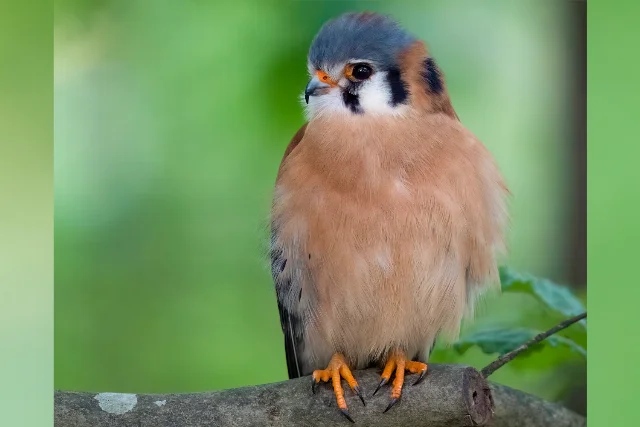
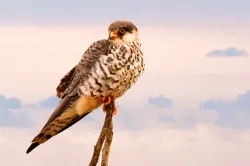
The Red-necked Falcon typically measures between 31 and 36 cm in length. It is easily identified by its distinctive rufous (reddish) crown, nape, and neck sides. Its upperparts are a cool blue-grey, while the underparts are white with fine black barring. It has a long tail and pointed wings, characteristic of the Falco genus.
Habitat
This species prefers open country with scattered trees, semi-desert regions, and savannas. They are particularly fond of areas with Borassus palms, which they often use for nesting and roosting. While they avoid dense forests, they are frequently seen near water sources in arid environments.
Diet
The diet of the Red-necked Falcon consists primarily of small birds, which it captures mid-air with incredible speed. Common prey includes sparrows, larks, and swifts. They also supplement their diet with large insects, small bats, and occasionally lizards or rodents.
Breeding and Nesting
Red-necked Falcons often do not build their own nests. Instead, they frequently take over old stick nests built by crows or other raptors. In some regions, they prefer nesting in the crowns of tall palm trees. A typical clutch consists of 3 to 5 eggs, which are incubated by both parents.
Behavior
These falcons are highly diurnal and active hunters. They are often seen hunting in pairs, where one bird flushes out the prey while the other strikes. They are known for their low, fast flight patterns and can be quite vocal during the breeding season with high-pitched chattering calls.
Conservation Status - NT Near Threatened
The Red-necked Falcon is currently listed as Near Threatened on the IUCN Red List. While they have a wide distribution, populations are declining in some areas due to habitat loss, pesticides, and the clearing of palm groves which serve as vital nesting sites.
Interesting Facts
- It is also known as the Red-headed Merlin due to its similar size and shape to the Merlin.
- Unlike many other falcons, they are known to hunt cooperatively in pairs.
- They are extremely loyal to their nesting sites, often returning to the same tree for many years.
- There are three distinct subspecies found across Africa and Asia.
Tips for Birdwatchers
- Look for them in open savannas or near palm plantations.
- Scan the tops of dead trees or palm fronds where they like to perch and scan for prey.
- Listen for their distinctive 'ki-ki-ki-ki' call during the early morning.
- Use high-quality binoculars to spot the rufous neck from a distance.
Pro-Tip: To spot this bird in dense forest canopy, a 8x42 binoculars or telescope is highly recommended.
- [Check out our top recommended gear here]
Conclusion
The Red-necked Falcon is a remarkable raptor that showcases the diversity and beauty of the falcon family. Protecting its natural habitat, especially the palm groves it relies on, is essential for ensuring that this swift predator continues to thrive in the wild.



200 Follower
is a writer who draws. He’s the Bestselling author of “Number of The Year”. Donec vitae tortor efficitur, convallis lelobortis elit.
Recent Posts




Subscribe For Daily Newsletter