Warning: Undefined variable $by_location in /home/odescxjtd641/public_html/beefound.in/bird-details.php on line 874

Sri Lanka Grey Hornbill
Ocyceros gingalensis
Last update: 26 Jul 2026
Read in:
English
Español
Português
हिन्दी
বাংলা
தமிழ்
മലയാളം
मराठी
ગુજરાતી
తెలుగు
French
Deutsch
Русский
日本語
简体中文
Italiano
Tiếng Việt
العربية
ಕನ್ನಡ
ਪੰਜਾਬੀ
Sri Lanka Grey Hornbill Basic Information
| Scientific Name | Ocyceros gingalensis |
|---|---|
| Status | LC Least Concern |
| Size | 45-50 cm (18-20 inch) |
| Colors |
Grey
White
|
| Type |
Perching Birds

|
| Family | Hornbills |
Introduction
The Sri Lanka Grey Hornbill (Ocyceros gingalensis) is an enchanting member of the Bucerotidae family and stands as one of the most iconic avian residents of the island nation of Sri Lanka. As an endemic species, it holds a special place in the hearts of local birdwatchers and international ornithologists alike. Unlike many of its larger, more colorful relatives found in Africa or Southeast Asia, this hornbill possesses a subtle, understated elegance that perfectly matches the lush, verdant canopy of its native environment. Thriving primarily in the dense forests and wooded regions of Sri Lanka, this medium-sized perching bird plays a vital role in the ecosystem, particularly as a seed disperser. Its presence is often heralded by a distinct, far-reaching call that echoes through the trees, signaling its activity to others. Understanding the life cycle, dietary preferences, and behavioral nuances of the Sri Lanka Grey Hornbill provides deep insights into the island's unique biodiversity. This guide explores every facet of this remarkable bird, offering a comprehensive look at what makes this species a true gem of Sri Lankan wildlife.
Physical Appearance
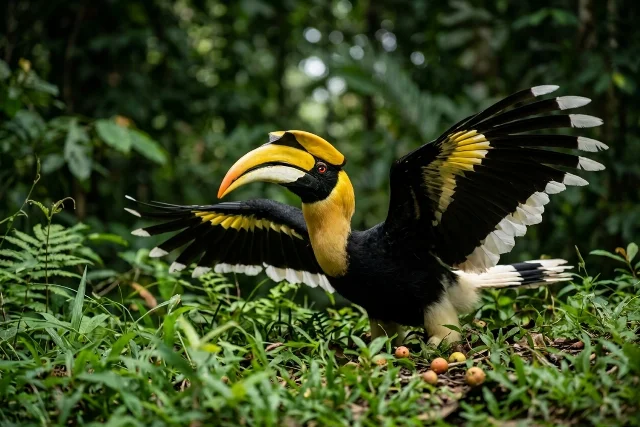
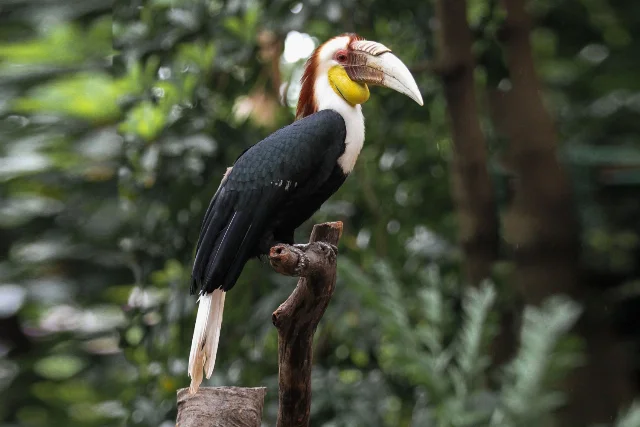
Standing at a modest size of 45-50 cm, the Sri Lanka Grey Hornbill is distinguished by its monochromatic yet sophisticated plumage. Its primary color is a soft, slate-grey that covers the majority of its body, blending seamlessly with the shadows and tree barks of its forest home. This is elegantly contrasted by secondary white markings, most notably seen on the underparts and the tips of the tail feathers, which become particularly visible during flight. The bird possesses a strong, curved beak, which is a hallmark feature of the hornbill family. In the Sri Lanka Grey Hornbill, the bill color varies from a creamy yellow to a brownish-grey, often lacking the heavy casque found in larger hornbill species. Its eyes are typically a bright, piercing color that contrasts against the grey feathers, giving it a sharp, alert appearance. The feet are sturdy, adapted for its lifestyle as a perching bird, allowing it to navigate complex branch structures with ease. The combination of its streamlined silhouette and muted color palette makes it a master of camouflage, often appearing as nothing more than a patch of bark until it decides to take flight.
Habitat
The Sri Lanka Grey Hornbill is primarily found within the moist evergreen forests of the island, ranging from the lowlands up to the foothills of the central highlands. It displays a remarkable adaptability, frequently venturing into secondary forests, rubber plantations, and even large home gardens that feature fruit-bearing trees. Unlike some more reclusive species, this bird is not strictly restricted to deep, untouched primary jungles. It prefers areas with a dense canopy that provides both protection from predators and a consistent supply of food. The bird is rarely seen on the ground, as it prefers the safety and resources found in the middle and upper levels of the forest strata.
Diet
As an omnivorous species, the Sri Lanka Grey Hornbill has a diet that is largely dominated by fruit. It is an avid frugivore, showing a particular fondness for wild figs (Ficus species), which are abundant in its tropical habitat. In addition to figs, it consumes a variety of other forest berries and fruits, acting as a crucial agent for seed dispersal across the landscape. When fruit is scarce or during the breeding season, the hornbill supplements its diet with protein-rich food sources. This includes small insects, caterpillars, lizards, and occasionally the eggs or nestlings of smaller bird species, showcasing its opportunistic feeding behavior.
Breeding and Nesting
The breeding biology of the Sri Lanka Grey Hornbill is one of the most fascinating aspects of its life cycle. Like many hornbills, they exhibit a unique nesting habit where the female seals herself inside a natural tree hollow. The entrance is plastered shut using a mixture of mud, droppings, and fruit pulp, leaving only a narrow slit through which the male provides food. This protective measure shields the female and the developing chicks from predators such as snakes or monkeys. The male works tirelessly during this period, bringing food to the nest several times a day. Once the chicks are sufficiently developed, the female breaks out of the cavity, and the young may help reseal the entrance to continue their protection until they are ready to fledge.
Behavior
The Sri Lanka Grey Hornbill is generally a social bird, often seen in pairs or small family groups. They are not highly migratory, preferring to remain within a specific territory throughout the year. Their movement through the forest is characterized by a series of undulating flights, where they alternate between rapid wingbeats and short glides. They are highly vocal creatures, often communicating with each other through a series of cackles, whistles, and shrieks. While they can be shy, they are also curious and may investigate disturbances in their environment, provided they feel they have a quick escape route to the dense canopy.
Conservation Status - LC Least Concern
Currently, the Sri Lanka Grey Hornbill is classified as a species of Least Concern by the IUCN. However, this does not mean it is entirely safe from threats. Its primary challenge remains the fragmentation and loss of natural forest habitats due to human expansion and agricultural development. Because it relies heavily on large, mature trees for nesting hollows, the removal of old-growth timber poses a long-term risk to its population stability. Continued conservation efforts focused on maintaining forest corridors and protecting nesting sites are essential to ensure this endemic species continues to thrive across the island.
Interesting Facts
- The Sri Lanka Grey Hornbill is entirely endemic, meaning it is found nowhere else on Earth but Sri Lanka.
- The female seals herself inside a tree hollow during nesting for protection against predators.
- They play a critical role in the ecosystem by dispersing seeds of various forest trees.
- They possess a unique, undulating flight pattern that makes them easy to identify once spotted.
- Despite their size, they are remarkably agile when moving through dense, tangled tree branches.
- Their diet is primarily frugivorous, with a specific preference for wild figs.
Tips for Birdwatchers
If you are planning a trip to spot the Sri Lanka Grey Hornbill, your best chance of success is to visit the island’s wet zone or the mid-country forests. Early mornings are the most productive time for birdwatching, as the birds are highly active while foraging for their first meal of the day. Listen for their distinct, laughing-like calls, which often give away their location long before you see them. Bringing a pair of high-quality binoculars is essential, as these birds often remain high in the canopy. Patience is key; find a fruiting tree, sit quietly, and wait for them to arrive. Avoid sudden movements, as their keen eyesight allows them to detect threats from a significant distance.
Pro-Tip: To spot this bird in dense forest canopy, a 8x42 binoculars or telescope is highly recommended.
- [Check out our top recommended gear here]
Conclusion
The Sri Lanka Grey Hornbill is a testament to the unique evolutionary path taken by the wildlife of this beautiful island. As an endemic species, it serves as a living symbol of Sri Lanka’s rich natural heritage. From its clever nesting strategies to its vital role as a seed disperser, this bird is far more than just a beautiful sight in the canopy; it is a fundamental component of the forest ecosystem. While it currently faces fewer immediate threats than some of its more endangered counterparts, the future of the Sri Lanka Grey Hornbill remains tethered to the protection of its forest habitats. For bird enthusiasts and nature lovers, encountering this species in the wild is a deeply rewarding experience that highlights the importance of preserving the wild spaces of Sri Lanka. By understanding its needs and supporting conservation initiatives, we can ensure that future generations will continue to hear the characteristic calls of these grey-feathered wonders echoing through the tropical trees. Whether you are an expert ornithologist or a casual visitor, taking the time to appreciate the Sri Lanka Grey Hornbill is a perfect way to connect with the island's vibrant and diverse natural world.
Tag:

200 Follower
is a writer who draws. He’s the Bestselling author of “Number of The Year”. Donec vitae tortor efficitur, convallis lelobortis elit.
Recent Posts






Subscribe For Daily Newsletter