White-fronted Manakin Distribution Map & Range
The distribution map for this species will be available soon.
We are working with our official data partners to update this information.

Sign in with your Google account to access all features

| Scientific Name | Lepidothrix serena |
|---|---|
| Status | LC Least Concern |
| Size | 9-10 cm (4-4 inch) |
| Colors |
Green
White
|
| Type |
Perching Birds

|
| Family | Manakins |
The White-fronted Manakin, scientifically known as Lepidothrix serena, is a captivating member of the Pipridae family, commonly referred to as manakins. These small, energetic perching birds are renowned for their striking plumage and elaborate courtship displays that define their social structure within the dense tropical forests of South America. Primarily found in the Guiana Shield region, this species has adapted to life in the understory of humid lowland forests. As a bird enthusiast, encountering the White-fronted Manakin is often a highlight of any expedition, thanks to their active nature and the unique, high-pitched vocalizations that echo through the canopy. Understanding this species requires a deep dive into their ecological niche, where they serve as vital seed dispersers, contributing significantly to the health and regeneration of their forest homes. Throughout this guide, we will explore the intricate details that make the White-fronted Manakin a fascinating subject for both ornithologists and casual birdwatchers alike, shedding light on their biology, behavior, and the conservation challenges they currently face in their native range.
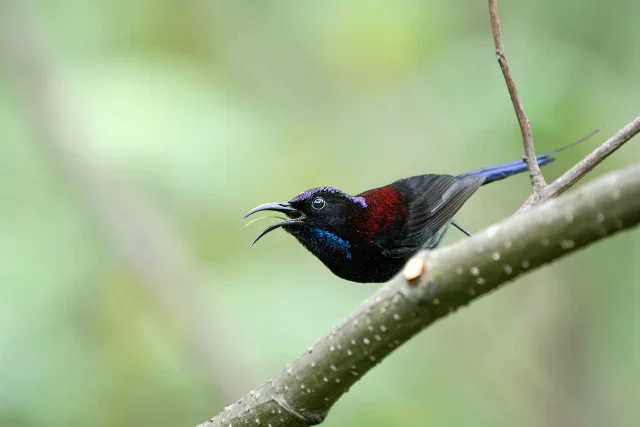
Standing at a modest 9-10 cm in length, the White-fronted Manakin is a compact and visually distinct bird. Their primary coloration is a rich, vibrant green, which provides excellent camouflage against the lush foliage of the rainforest. The most defining characteristic, from which they derive their common name, is the brilliant white patch found on their forehead. This stark contrast against their green crown creates a striking visual impact, especially during the male's active courtship displays. The undersides of the bird often exhibit a lighter, yellowish-green hue, while the wings and tail remain darker to support their agile flight patterns. Sexual dimorphism is present in this species, with males typically displaying more intense coloration and the signature white frontal patch, while females tend to be more uniformly green, allowing them to blend seamlessly into their nesting environments. Their beak is short and stout, perfectly adapted for a diet consisting primarily of small fruits and berries. The overall anatomical structure of the White-fronted Manakin is designed for agility, allowing them to navigate the dense understory with remarkable speed and precision.
The White-fronted Manakin is primarily restricted to the humid lowland forests of the Guiana Shield, encompassing parts of Guyana, Suriname, French Guiana, and northern Brazil. They are quintessential understory birds, preferring the shaded, dense vegetation of primary rainforests. They are rarely seen in open areas, as they rely heavily on the cover of the canopy and mid-story to avoid predators. These birds are most active in areas with high fruit-bearing tree density, which dictates their movement patterns throughout the year. As forest-dependent species, they are highly sensitive to habitat fragmentation and deforestation, which threaten to isolate their populations in an increasingly changing landscape.
The diet of the White-fronted Manakin is specialized and primarily frugivorous. They feed predominantly on a wide variety of small, forest-grown fruits and berries. Their feeding behavior is highly efficient; they often perform quick, acrobatic maneuvers to pluck fruit while remaining on the wing. This method of feeding not only secures their nutrition but also makes them essential pollinators and seed dispersers for many plant species within their forest ecosystem. Occasionally, they will supplement their fruit-based diet with small insects and spiders, particularly during the breeding season when the need for protein-rich food is critical for the development of their young.
Breeding in White-fronted Manakins is characterized by the famous lekking behavior common to the manakin family. Males gather in small clearings or specific perches within the forest to perform intricate, high-energy courtship displays to attract females. These displays involve rapid movements, wing-snapping sounds, and vocalizations that showcase the male's fitness. Once a female selects a mate, she is solely responsible for all nesting duties. The nest is typically a small, cup-shaped structure built from fine plant fibers and spider silk, carefully hidden in the dense understory vegetation. The female lays a small clutch of eggs, usually two, and incubates them alone. The chicks are altricial, requiring constant care and feeding from the mother until they are ready to fledge, which happens after a few weeks of intensive development.
Behaviorally, the White-fronted Manakin is an exceptionally active and alert bird. They are constantly on the move, flitting between branches in search of food or engaging in social interactions. While they are generally solitary outside of the breeding season, they are known for their social complexity when gathered at leks. They possess a suite of sharp, metallic vocalizations that are used to maintain territory and communicate with other members of the species. Their flight is rapid and direct, showing a mastery of maneuverability that allows them to escape threats in the cluttered environment of the rainforest floor. They are highly territorial during the breeding season, with males fiercely defending their chosen display perches.
Currently, the White-fronted Manakin is classified as a species of Least Concern by the IUCN, primarily due to its relatively large range and stable population density within protected forest areas. However, this status does not imply that they are immune to threats. Like many tropical birds, they face significant risks from habitat loss due to logging, agricultural expansion, and climate change. Maintaining the integrity of their forest corridors is essential for their long-term survival. Conservation efforts focusing on preserving large tracts of primary rainforest are vital to ensuring these vibrant birds continue to thrive in their natural habitats.
Birdwatching for the White-fronted Manakin requires patience and a good knowledge of their habitat. The best strategy is to locate active fruiting trees in the early morning, as this is when they are most active and visible. Utilizing a high-quality pair of binoculars and being able to recognize their unique high-pitched calls will significantly increase your chances of a successful sighting. Move slowly and quietly through the understory, as these birds are easily startled by sudden movements. If you happen upon a lekking area, remain still and observe from a distance to avoid disrupting their delicate courtship rituals. Recording their vocalizations can also be a rewarding way to document your encounter with this elusive and beautiful species.
In conclusion, the White-fronted Manakin (Lepidothrix serena) is an extraordinary example of the evolutionary marvels found within the tropical rainforests of South America. From their vibrant green plumage and the iconic white forehead to their complex social behaviors and vital role as seed dispersers, they embody the intricate balance of their ecosystem. As we have explored, their survival is intrinsically linked to the health of the primary forests they inhabit. Protecting these birds means protecting the vast, interconnected habitats that support thousands of other species. For birdwatchers, the opportunity to witness the energy and beauty of a White-fronted Manakin in the wild is a testament to the wonders of nature. By fostering a deeper understanding of their biology and advocating for the preservation of their environment, we can ensure that these remarkable perching birds continue to grace the understory of the Guiana Shield for generations to come. Whether through scientific study or mindful observation, the White-fronted Manakin serves as an enduring reminder of the importance of biodiversity and the need for dedicated conservation efforts in our changing world.
We are working with our official data partners to update this information.
Tag:



Birds have their own beautiful world, we should not interfere in it. We should enjoy this beauty. Its beauty should be captured in the camera but be careful not to disturb them.
Tap a language to switch instantly.
Tap a language to switch instantly.