Great-tailed Grackle Distribution Map & Range
The distribution map for this species will be available soon.
We are working with our official data partners to update this information.

Sign in with your Google account to access all features

| Scientific Name | Quiscalus mexicanus |
|---|---|
| Status | LC Least Concern |
| Size | 38-46 cm (15-18 inch) |
| Colors |
Black
Iridescent
|
| Type |
Perching Birds

|
| Family | New World blackbirds |
The Great-tailed Grackle (Quiscalus mexicanus) is one of the most recognizable and charismatic members of the icterid family. Known for their striking appearance and highly social nature, these perching birds have successfully expanded their range across much of North and Central America. Often seen strutting confidently in parking lots, parks, and agricultural fields, they are frequently misunderstood by the public due to their bold behavior. Despite being common, the Great-tailed Grackle is a fascinating subject for ornithologists and casual birdwatchers alike. Their ability to adapt to human-altered landscapes has allowed them to thrive in urban environments, making them a fixture of daily life in many regions. Understanding the biology and ecological role of this species provides deep insights into bird adaptability and social structure. Whether you are intrigued by their complex vocalizations or their shimmering plumage, the Great-tailed Grackle remains a standout avian species that commands attention wherever it is found.
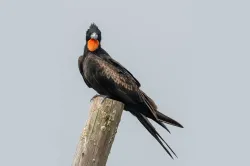
The Great-tailed Grackle is a medium-to-large perching bird, with males reaching lengths of 38-46 cm, significantly larger than their female counterparts. The male of the species is characterized by its deep, glossy black plumage, which displays a stunning iridescent sheen under direct sunlight, reflecting shades of purple, blue, and green. A defining feature of the male is its exceptionally long, V-shaped tail that can be folded or spread depending on its activity. In contrast, the females are smaller and possess a more understated appearance, featuring brownish-gray feathers on their upperparts and lighter underparts, which helps them remain camouflaged during nesting. Both sexes possess sharp, pointed bills and bright yellow eyes that give them an intense, alert expression. Their strong legs and feet are perfectly adapted for walking on the ground or perching on various surfaces, including power lines, tree branches, and man-made structures. This sexual dimorphism is among the most pronounced in the bird world, making them easy to identify.
The Great-tailed Grackle is an incredibly adaptable species, showing a marked preference for open areas near water sources. Historically, they were found in marshes, wetlands, and coastal thickets. However, as human development has expanded, these birds have effectively colonized suburban and urban landscapes. You can frequently find them in agricultural fields, manicured lawns, golf courses, and bustling shopping center parking lots. They are rarely found in dense forests, as they require open spaces to forage and display. Their reliance on water means they are often seen near ponds, irrigation ditches, or drainage canals. This versatility in habitat selection is a primary reason for their successful population growth and range expansion over the last few decades.
As opportunistic omnivores, the Great-tailed Grackle maintains a highly varied and flexible diet. They are known to forage primarily on the ground, where they search for insects, spiders, and small invertebrates. Beyond this, they are frequent consumers of seeds, grains, and various fruits. Their adaptability also extends to human food sources; they are common scavengers at outdoor dining areas, trash receptacles, and bird feeders. In some instances, they have been observed preying on small vertebrates, including lizards, frogs, and even the eggs or nestlings of other bird species. Their sharp, sturdy bills allow them to manipulate a wide range of food items, ensuring they rarely go hungry regardless of the season or local availability of specific resources.
The breeding season for the Great-tailed Grackle is a time of intense social activity and complex displays. Males are polygynous, often defending a territory that contains multiple nesting females. During courtship, males perform elaborate displays, puffing out their feathers and fanning their long tails while emitting a variety of raspy, metallic calls to attract mates. Females are responsible for the construction of the nest, which is typically a bulky, cup-shaped structure made of twigs, grasses, and mud, often reinforced with man-made materials like plastic or string. Nests are usually placed in trees or dense shrubs, often in colonies known as rookeries. A typical clutch consists of three to four pale blue or green eggs with dark markings. The female performs the majority of the incubation, while the male remains nearby, aggressively defending the nesting site from potential intruders or predators.
Behaviorally, the Great-tailed Grackle is a highly social and vocal bird. They are rarely seen alone, preferring the company of their own kind in large, noisy flocks. Their communication is diverse, consisting of a wide array of clicks, whistles, and harsh, mechanical-sounding notes. One of their most interesting behaviors is 'anting,' where they allow ants to crawl over their feathers, presumably to utilize the formic acid to rid themselves of parasites. They are also known for their intelligence and problem-solving abilities, often learning to exploit new food sources created by human activity. While they can be aggressive toward other birds, their social structure is highly organized, with complex hierarchies maintained through visual displays and vocal interactions.
The Great-tailed Grackle is currently classified as a species of Least Concern by the IUCN. Their population is robust and continues to trend upward as they successfully exploit new territories created by urban sprawl and agricultural development. Unlike many species struggling with habitat loss, the Great-tailed Grackle has benefited from human-altered environments. They currently face no major threats to their overall numbers, and their ability to thrive in proximity to humans ensures that they will remain a common sight in the years to come, provided their primary water and food sources remain stable.
For birdwatchers, the Great-tailed Grackle provides a fantastic subject for studying avian behavior. To observe them effectively, visit local parks, shopping centers, or wetland edges early in the morning. Because they are so bold, you do not need to hide to see them; simply standing near a bird feeder or a park bench will often bring them within close range. Pay close attention to the males' courtship rituals, as these are highly dramatic and visually engaging. If you are interested in photography, their iridescent feathers require specific lighting angles to capture the full spectrum of their purple and blue hues. Bring a notebook to document their varied vocalizations, as their 'language' is surprisingly complex and changes depending on the social context of the flock.
In conclusion, the Great-tailed Grackle (Quiscalus mexicanus) is a remarkable example of an avian species that has successfully navigated the challenges of a changing world. Through their extreme adaptability, social intelligence, and opportunistic diet, they have cemented their place as one of the most common and visible birds in the Americas. While some may view them as a nuisance due to their presence in urban areas, their ecological significance as both predator and scavenger is undeniable. Their stunning iridescent plumage and complex social behaviors offer birdwatchers a constant source of wonder and study. By understanding the life history of the Great-tailed Grackle, we gain a better appreciation for the resilience of nature in the face of human expansion. Whether you are admiring the male's majestic, flowing tail or listening to their unique, metallic songs, these birds are an essential component of the avian landscape. We should continue to observe and protect these intelligent creatures, as they serve as a vivid reminder of the complexity and beauty found within our own backyards.
We are working with our official data partners to update this information.
Tag:


Birds have their own beautiful world, we should not interfere in it. We should enjoy this beauty. Its beauty should be captured in the camera but be careful not to disturb them.
Tap a language to switch instantly.
Tap a language to switch instantly.