Northwestern Crow Distribution Map & Range
The distribution map for this species will be available soon.
We are working with our official data partners to update this information.

Sign in with your Google account to access all features


| Scientific Name | Corvus caurinus |
|---|---|
| Status | LC Least Concern |
| Size | 33-41 cm (13-16 inch) |
| Colors |
Black
None
|
| Type |
Perching Birds

|
| Family | Crows and jays |
The Northwestern Crow (Corvus caurinus) is a fascinating member of the Corvidae family, uniquely adapted to life along the rugged coastlines of the Pacific Northwest. Often overshadowed by its larger relative, the American Crow, the Northwestern Crow occupies a distinct ecological niche that defines its behavior and survival strategies. These intelligent, perching birds are quintessential coastal scavengers, thriving in environments where the land meets the sea. Their presence is a hallmark of the temperate rainforests and shorelines stretching from southern Alaska down through British Columbia to Washington State.
Understanding the Northwestern Crow requires looking beyond its simple, monochromatic appearance. These birds exhibit remarkable problem-solving abilities, a trait common among corvids, which allows them to exploit a wide variety of food sources in ever-changing tidal environments. As social creatures, they form complex family groups and maintain intricate communication networks. For bird enthusiasts and researchers alike, the Northwestern Crow offers a compelling study in evolutionary adaptation, demonstrating how a specialized species can flourish in a highly specific, resource-rich habitat. This guide explores every facet of their existence, from their physical characteristics to their complex breeding rituals and conservation needs.
The Northwestern Crow is a medium-sized perching bird, typically measuring between 33 and 41 centimeters in length. Its most striking physical feature is its uniform, glossy black plumage, which covers its entire body from head to tail. Unlike many other bird species that display vibrant secondary colors or intricate patterns, the Northwestern Crow is entirely black, including its bill, legs, and feet. This monochromatic aesthetic provides excellent camouflage against the dark, rocky shorelines and dense evergreen forests they frequent.
While they are similar in appearance to the American Crow, the Northwestern Crow is generally smaller and possesses a more slender bill. When observed closely, the subtle iridescence of their feathers can be seen under direct sunlight, reflecting deep violets or blues. Their wings are broad and rounded, facilitating agile flight maneuvers, which are essential for navigating coastal winds and dense forest canopies. The tail is slightly squared at the end, distinguishing it from the fan-shaped tails of other corvids. Their eyes are dark brown, almost black, contributing to their intense and intelligent expression. Juveniles tend to have duller, brownish-black feathers until they reach full maturity, at which point they attain the characteristic deep, lustrous black plumage of the adults.
The habitat of the Northwestern Crow is intrinsically linked to the marine environment. They are primarily found along the coastal regions of the Pacific Northwest, favoring shorelines, tidal flats, and the adjacent coniferous forests. They are rarely found far inland, as they rely heavily on marine-based food sources. During low tide, these birds can be seen foraging extensively along the exposed beaches, searching for shellfish and other marine invertebrates. When not feeding, they retreat to the protection of dense forest edges or tall trees, where they roost and nest. Their ability to bridge the gap between marine and terrestrial ecosystems makes them a vital component of the coastal food web, acting as both predators and scavengers in these diverse environments.
The Northwestern Crow is an opportunistic omnivore with a diet heavily influenced by its proximity to the ocean. Their primary food sources include a variety of marine invertebrates such as mussels, clams, crabs, and sea urchins. They are well-known for their habit of flying to a significant height and dropping shelled prey onto rocks to break them open, a behavior that showcases their high intelligence. Beyond marine life, they also consume carrion, bird eggs, nestlings, berries, and various human-provided food scraps. This dietary flexibility allows them to maintain stable populations even when specific prey sources are scarce, making them highly successful survivors in their coastal home.
Breeding for the Northwestern Crow typically occurs in the spring, with pairs establishing territories in dense forest patches near the shore. Unlike some other crow species, they often nest in small, loose colonies, though solitary nesting pairs are also common. The nest itself is a bulky structure built from twigs, sticks, and lined with softer materials like moss, feathers, or fur, usually placed high in a conifer tree for protection against predators.
The female usually lays a clutch of three to five pale blue-green eggs, speckled with brown. Both parents are deeply involved in the nesting process, sharing duties in building the nest and feeding the chicks. The incubation period lasts approximately 18 to 20 days. Once hatched, the altricial chicks remain in the nest for several weeks, fed by both parents. Interestingly, young birds from previous years sometimes remain with the parents to assist in feeding and protecting the new brood, a cooperative breeding behavior that enhances the survival rates of the offspring.
Northwestern Crows are highly social and intelligent birds, often seen in large, noisy groups when not breeding. They exhibit complex social hierarchies and engage in various forms of play and cooperative foraging. Communication is key to their success, with a wide repertoire of calls, including clicks, rattles, and the iconic 'caw'. Their flight is direct and powerful, though they are also capable of skillful maneuvering through dense foliage. They are bold and curious, often investigating human activity, which has led to them becoming common urban scavengers in coastal towns. Their ability to learn and adapt to human presence is a testament to their high cognitive capacity.
Currently, the Northwestern Crow is classified as a species of least concern by major conservation organizations. Their population remains stable across their primary range in the Pacific Northwest. However, they are sensitive to environmental changes, particularly those affecting the health of coastal ecosystems, such as oil spills or pollution that impacts their marine food sources. Habitat loss due to coastal development also poses a long-term threat. Continued monitoring of their population trends is essential to ensure that this unique corvid continues to thrive in its natural coastal environment for future generations.
For birdwatchers hoping to spot the Northwestern Crow, the best approach is to visit coastal beaches during low tide. This is when the birds are most active and visible while foraging for crustaceans and mollusks. Bring a pair of high-quality binoculars to distinguish them from other corvids; look for the slightly smaller frame and the distinct, slender bill. Pay attention to their calls, as they have a unique, slightly more nasal tone compared to the common crow. Being patient and quiet near forested edges adjacent to the beach will often reveal them returning to their roosts. Remember to observe from a respectful distance to avoid disturbing their natural foraging behaviors, especially during the spring nesting season when they are more protective of their territory.
In conclusion, the Northwestern Crow (Corvus caurinus) is a remarkable testament to the adaptability and intelligence of the corvid family. By mastering the challenging and resource-rich environment of the Pacific Northwest coastline, these birds have carved out a unique existence that blends terrestrial and marine survival strategies. From their sophisticated tool-using behaviors, such as dropping shells onto rocky surfaces, to their cooperative breeding structures, they offer endless fascination for ornithologists and casual birdwatchers alike. Their presence is not merely a common sight along the coast; it is a vital indicator of the health of our shorelines.
As we look toward the future, the conservation of the Northwestern Crow remains tied to the protection of the coastal habitats they call home. By maintaining clean oceans and preserving the coniferous forests that line our shores, we ensure that these intelligent, black-feathered residents continue to thrive. Whether you are observing them as they scavenge on a tide flat or listening to their complex social chatter in a cedar tree, the Northwestern Crow serves as a reminder of the intricate connections within our natural world. We encourage all bird enthusiasts to continue studying and appreciating this unique species, as every interaction provides a deeper understanding of the avian world and the resilience of nature in the face of an ever-changing environment.
We are working with our official data partners to update this information.



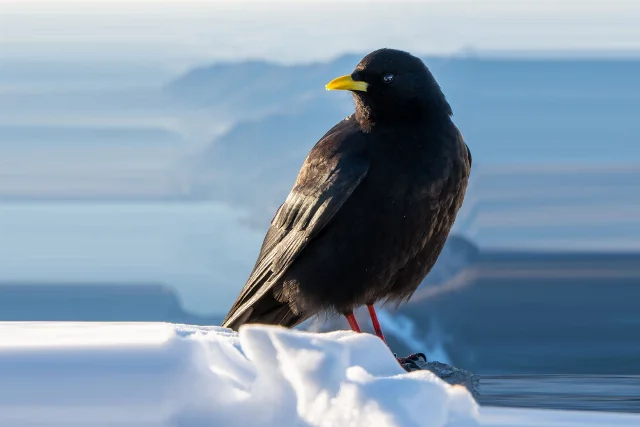
Birds have their own beautiful world, we should not interfere in it. We should enjoy this beauty. Its beauty should be captured in the camera but be careful not to disturb them.
Tap a language to switch instantly.
Tap a language to switch instantly.