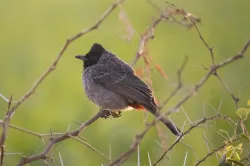
Ochre-breasted Tanager Distribution Map & Range
The distribution map for this species will be available soon.
We are working with our official data partners to update this information.

Sign in with your Google account to access all features

| Scientific Name | Habia stolzmanni |
|---|---|
| Status | LC Least Concern |
| Size | 14-15 cm (6-6 inch) |
| Colors |
Brown
Ochre
|
| Type |
Perching Birds

|
| Family | Cardinals |
The Ochre-breasted Tanager (Habia stolzmanni) is a fascinating member of the tanager family (Thraupidae), known for its elusive nature and distinct coloration. Found primarily in the dense, humid forests of the Andean foothills, this perching bird is a target species for many ornithologists and bird enthusiasts exploring South America. Unlike some of its more brightly colored relatives, the Ochre-breasted Tanager possesses a subtle, earthy palette that allows it to blend seamlessly into the forest understory. Despite its relatively small size, measuring just 14 to 15 centimeters, it commands attention with its complex social structure and vocalizations. This species serves as an important indicator of ecosystem health, thriving in habitats that maintain a high level of biodiversity. As we delve into the life of the Habia stolzmanni, we uncover the intricate adaptations that allow it to survive in one of the most competitive avian environments on the planet. Understanding this bird provides invaluable insights into the ecological connectivity of its native range, highlighting the importance of forest preservation for sustaining unique avian lineages.
The physical appearance of the Ochre-breasted Tanager is characterized by its modest yet striking plumage. Measuring approximately 14 to 15 centimeters in length, the bird exhibits a predominantly brown coloration across its upperparts, wings, and tail, which provides excellent camouflage against the dark, shadowed forest floor and lower canopy where it typically resides. The most distinguishing feature, from which the species derives its common name, is the vibrant ochre wash across its breast and throat. This warm, yellowish-brown hue contrasts beautifully with the deeper brown tones, making it a key identification mark for observers in the field. The bill is typically stout and slightly hooked, adapted for a varied diet of insects and fruit. Both males and females share similar plumage patterns, though subtle variations in intensity may occur based on age or regional populations. Their eyes are dark and alert, facilitating quick movement through dense vegetation. The overall body shape is compact and streamlined, typical of active perching birds that rely on agility to navigate thick foliage. The legs and feet are well-developed for gripping branches, reflecting their life as arboreal insectivores and foragers.
The Ochre-breasted Tanager is primarily restricted to the humid montane forests of the Andes, ranging from Colombia through Ecuador and into Peru. It prefers the humid understory and mid-story levels of primary forests, where the foliage is dense and the microclimate remains stable. This species is rarely found in open areas or heavily degraded landscapes, making it a specialist of intact forest ecosystems. It thrives in regions with high precipitation and thick epiphyte coverage, which provides both protection from predators and a bounty of food resources. Because of its reliance on specific forest structures, habitat fragmentation poses a significant threat to its long-term survival, as the bird is hesitant to cross open gaps between forest patches.
The diet of the Ochre-breasted Tanager is diverse and opportunistic, primarily consisting of small insects and various forest fruits. As an active forager, it spends much of its day searching through foliage for arthropods, including beetles, caterpillars, and spiders. This insectivorous behavior is critical during the breeding season when high-protein food is required for developing chicks. In addition to insects, they frequently consume small berries and fruits found in the canopy or understory, which provide essential energy. They are often observed in mixed-species foraging flocks, a social strategy that helps them locate food more efficiently while simultaneously providing protection against potential predators in the dense forest environment.
Breeding for the Ochre-breasted Tanager typically coincides with the peak of the rainy season, when food resources are most abundant. The nesting process begins with the construction of a cup-shaped nest, meticulously fashioned from twigs, rootlets, and moss, and often lined with finer plant fibers for insulation. These nests are usually placed in the fork of a small tree or within dense shrubbery, usually at a low to mid-level height to keep them concealed from predators. The female typically lays a clutch of two to three eggs, which are incubated for roughly two weeks. Both parents are highly involved in the rearing process, taking turns to provision the nestlings with a steady supply of insects. This cooperative effort is essential for the survival of the offspring in the high-predation environment of the tropical forest understory, ensuring the chicks fledge successfully after about twelve to fourteen days.
Behaviorally, the Ochre-breasted Tanager is a shy and somewhat elusive bird, often detected more by its call than by sight. They are known for their social nature, frequently joining mixed-species flocks where they interact with other tanagers and insectivorous birds. This behavior not only aids in foraging but also provides a collective defense mechanism against hawks and other avian predators. They are highly active during the early morning and late afternoon hours, exhibiting a restless, darting flight pattern as they move through the undergrowth. Their vocalizations are often complex, consisting of sharp chirps and whistles used to maintain contact with flock members while navigating the dense, tangled vegetation of their natural habitat.
The Ochre-breasted Tanager is currently classified as a species of Least Concern by the IUCN; however, this status masks potential local threats. The primary concern for this species is the ongoing loss and fragmentation of Andean forest habitats due to agricultural expansion and logging. As a habitat specialist, the Ochre-breasted Tanager cannot easily adapt to modified landscapes. Continued monitoring of its populations and the protection of large, contiguous forest tracts are essential to ensure that this beautiful tanager remains a stable component of the Neotropical avian fauna for future generations.
For birdwatchers hoping to spot the Ochre-breasted Tanager, patience and a keen ear are your best tools. Because they are shy and prefer the dense understory, scanning the mid-level canopy of humid Andean forests during the early morning is the most successful strategy. Listen for the specific calls of mixed-species flocks, as these tanagers are often hidden within the group. Using high-quality binoculars with a close-focus capability is recommended, as these birds may forage just a few meters away without being immediately visible against the dark bark. Always remain quiet and move slowly to avoid startling them, as they are quick to retreat into the thicker foliage at the first sign of disturbance. Recording their calls can also help confirm their presence in areas where they are notoriously difficult to see.
In summary, the Ochre-breasted Tanager (Habia stolzmanni) is a remarkable example of specialized avian evolution within the Andean ecosystem. Its subtle beauty, characterized by its signature ochre breast and earthy brown tones, makes it a prized sighting for any serious ornithologist or birdwatcher. By occupying a specific niche in the humid forest understory, this bird plays an integral part in maintaining the delicate balance of its environment. However, its future remains tethered to the health of these forests, which are increasingly under pressure from human activity. Protecting the integrity of the Andean foothills is not just about saving a single species, but about preserving the complex web of life that the Ochre-breasted Tanager represents. As we continue to study and appreciate this bird, we are reminded of the urgency of conservation efforts in South America. Whether you are observing them in their natural habitat or studying their unique behaviors, the Ochre-breasted Tanager remains a captivating subject that underscores the richness of global biodiversity. Continued research and habitat preservation are essential to ensure that this elusive, charming percher continues to thrive in the wild forests it calls home.
We are working with our official data partners to update this information.
Tag:


Birds have their own beautiful world, we should not interfere in it. We should enjoy this beauty. Its beauty should be captured in the camera but be careful not to disturb them.
Tap a language to switch instantly.
Tap a language to switch instantly.