Not available
Fire-tailed Sunbird
Aethopyga ignicauda
Last update: 09 Mar 2026
Read in:
English
Español
Português
हिन्दी
বাংলা
தமிழ்
മലയാളം
मराठी
ગુજરાતી
తెలుగు
French
Deutsch
Русский
日本語
简体中文
Italiano
Tiếng Việt
العربية
ಕನ್ನಡ
ਪੰਜਾਬੀ
Fire-tailed Sunbird Basic Information
| Scientific Name | Aethopyga ignicauda |
|---|---|
| Status | LC Least Concern |
| Size | 15-20 cm (6-8 inch) |
| Colors |
Red
Yellow
|
| Type |
Perching Birds

|
| Family | Sunbirds |
Introduction
The Fire-tailed Sunbird, scientifically known as Aethopyga ignicauda, is arguably one of the most spectacular avian residents of the Himalayan mountain range. Belonging to the Nectariniidae family, these perching birds are renowned for their vivid coloration and high-energy lifestyles. As a specialist nectarivore, this bird plays a crucial ecological role as a pollinator within its montane forest environment. Often spotted flitting between rhododendrons and other flowering shrubs, the Fire-tailed Sunbird is a favorite among ornithologists and nature photographers alike. Their presence is a testament to the rich biodiversity found in the high-altitude landscapes of countries like India, Nepal, Bhutan, and China. Understanding the life cycle, behaviors, and specific environmental needs of this sunbird provides deep insights into the fragile ecosystems of the Himalayas. Whether you are a professional researcher or a casual bird enthusiast, the Fire-tailed Sunbird offers a masterclass in adaptation and aesthetic brilliance, making it a true jewel of the avian world.
Physical Appearance
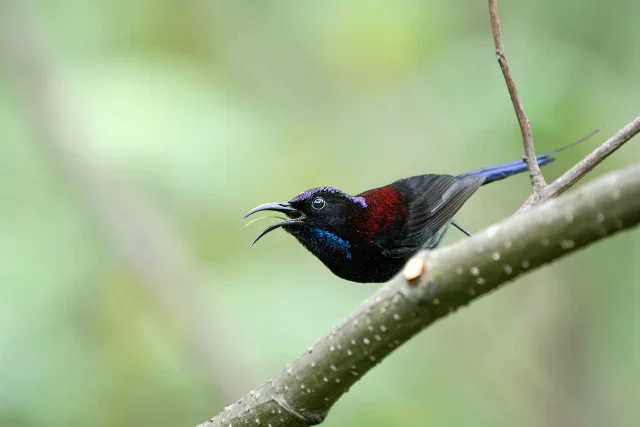
The Fire-tailed Sunbird is a masterwork of natural design, typically measuring between 15 and 20 cm in length. The male of the species is particularly striking, characterized by a deep, fiery red plumage that covers the majority of its body, transitioning into a brilliant yellow on the rump and underparts. Its most iconic feature is the elongated central tail feathers, which give the bird its common name and create a graceful silhouette during flight. The female, while more subdued in her coloration, possesses an elegant olive-green plumage that provides excellent camouflage against the foliage. Both sexes feature a slender, downward-curved bill, which is an evolutionary adaptation perfectly suited for extracting nectar from tubular flowers. Their iridescent throat patches often shimmer in the sunlight, changing hues based on the angle of view. This combination of vibrant primary and secondary colors makes them easily distinguishable from other sunbird species in the region, turning every sighting into a vivid visual experience.
Habitat
The Fire-tailed Sunbird primarily inhabits the temperate and sub-alpine forests of the Himalayan region. They are most commonly found at elevations ranging from 1,500 to 3,500 meters above sea level. Their preferred habitat includes dense evergreen forests, rhododendron thickets, and the edges of montane woodlands where flowering plants are abundant. Unlike many other species that remain at lower altitudes, the Fire-tailed Sunbird is highly adapted to cooler, high-altitude climates. During the harsh winter months, some populations may descend to lower elevations in search of food, but they generally remain tied to the mountainous terrain that provides both the necessary flora for sustenance and the dense cover required for nesting and protection from predators.
Diet
As a specialized nectar feeder, the diet of the Fire-tailed Sunbird consists primarily of nectar harvested from a variety of forest flowers. They are particularly fond of rhododendrons, which bloom extensively in their habitat. Their thin, decurved bills allow them to reach deep into the corollas of flowers that other birds cannot access. In addition to nectar, they supplement their diet with small insects and spiders, especially during the breeding season when protein is essential for the growth of their chicks. By hovering while feeding, they exhibit remarkable flight control, often visiting hundreds of flowers in a single day, which simultaneously facilitates the essential process of plant cross-pollination across their mountainous range.
Breeding and Nesting
The breeding season for the Fire-tailed Sunbird typically aligns with the spring and early summer months when floral resources are at their peak. The female is primarily responsible for constructing the nest, which is an intricate, pear-shaped structure suspended from a thin branch or hidden deep within thick foliage. These nests are woven from fine plant fibers, moss, and spider silk, providing both insulation and structural integrity. Usually, two to three eggs are laid in each clutch, and the female incubates them for roughly two weeks. During this period, the male remains vigilant, defending the territory from rivals and providing food for the female. Once the chicks hatch, both parents share the responsibility of foraging for insects to ensure the rapid development of the nestlings before they eventually fledge and begin to explore the canopy on their own.
Behavior
The Fire-tailed Sunbird is an incredibly active and energetic bird, rarely remaining still for long periods. They are known for their ability to hover in mid-air, similar to hummingbirds, while they probe flowers for nectar. They are generally solitary or found in pairs, though they can be seen in small groups when food sources are highly concentrated. Their flight is rapid and direct, often accompanied by a series of high-pitched, metallic chirps. They are highly territorial, especially the males, who will aggressively defend their preferred flowering patches from other nectar-feeding birds. Despite their small size, they are bold and display intricate courtship rituals involving elaborate aerial maneuvers and the flashing of their bright tail feathers.
Conservation Status - LC Least Concern
Currently, the Fire-tailed Sunbird is classified as a species of Least Concern by the IUCN. However, their populations are susceptible to habitat loss due to deforestation, climate change, and the degradation of high-altitude forests. As specialized pollinators, any significant decline in their population could have cascading effects on the floral biodiversity of the Himalayan ecosystem. Conservation efforts focus on protecting the integrity of montane forests and ensuring that the corridors between their breeding and wintering grounds remain intact, allowing these vibrant birds to continue thriving in their natural high-altitude environments.
Interesting Facts
- They are often compared to hummingbirds due to their ability to hover while feeding.
- The male's long, red, fiery tail can represent over half of its total body length.
- They serve as vital pollinators for various Himalayan rhododendron species.
- Unlike many birds, they are highly specialized to survive at high altitudes.
- Their metallic calls are often the first sign of their presence in the dense forest canopy.
- Females have evolved duller colors to stay protected while nesting.
- They use spider silk to bind their delicate nests to tree branches.
Tips for Birdwatchers
To spot the Fire-tailed Sunbird, patience and the right location are key. Focus your birding efforts on areas with blooming rhododendrons, particularly in the spring months. Use high-quality binoculars to observe their rapid, hovering flight patterns. Because they are constantly moving, it is best to locate a flowering bush and wait quietly nearby, as they will often return to the same patch. Early morning is the best time for activity. Dress in neutral-colored clothing to avoid alerting them to your presence and remain as still as possible. Photography requires a fast shutter speed to capture their quick movements, as they rarely stay in one position for more than a few seconds while feeding.
Pro-Tip: To spot this bird in dense forest canopy, a 8x42 binoculars or telescope is highly recommended.
- [Check out our top recommended gear here]
Pro-Tip: To capture the stunning beauty of this bird, a high-quality wildlife camera and lens are highly recommended.
- [Check out best wildlife cameras here]
Conclusion
The Fire-tailed Sunbird is a true marvel of the Himalayan wilderness, representing the delicate balance between high-altitude flora and specialized avian life. Their striking red and yellow plumage serves as a vibrant reminder of the beauty contained within these remote, mountainous regions. By understanding their unique behaviors, such as their nectar-dependent diet and specialized nesting habits, we gain a greater appreciation for the complexity of mountain ecosystems. Protecting the Fire-tailed Sunbird is not just about saving a single species; it is about preserving the biodiversity of the entire Himalayan range. As climate change and habitat alteration continue to pose challenges, the need for continued observation and scientific research remains paramount. Whether you are observing them in the wild or studying their ecological impact from afar, these birds serve as a captivating subject that inspires awe and respect for the natural world. Their persistence in the face of harsh, high-altitude conditions is a testament to the resilience of life, and their presence ensures the continued pollination and health of the beautiful forests they call home. Every encounter with a Fire-tailed Sunbird is a privilege, offering a fleeting glimpse into the vibrant, high-energy life of one of nature’s most magnificent creatures.
Tag:

200 Follower
is a writer who draws. He’s the Bestselling author of “Number of The Year”. Donec vitae tortor efficitur, convallis lelobortis elit.
Recent Posts




Subscribe For Daily Newsletter