Not available
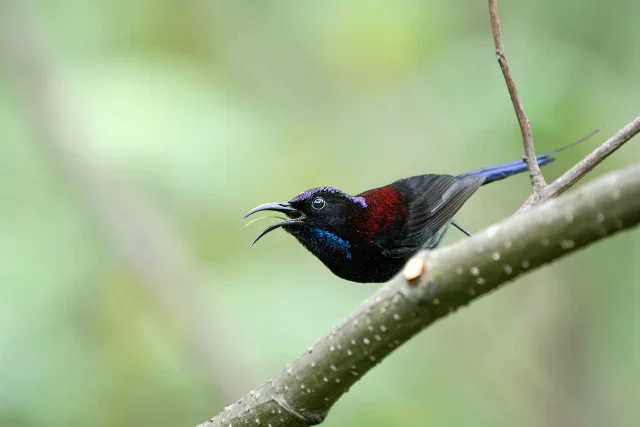
Green-tailed Sunbird
Aethopyga nipalensis
Last update: 09 Mar 2026
Read in:
English
Español
Português
हिन्दी
বাংলা
தமிழ்
മലയാളം
मराठी
ગુજરાતી
తెలుగు
French
Deutsch
Русский
日本語
简体中文
Italiano
Tiếng Việt
العربية
ಕನ್ನಡ
ਪੰਜਾਬੀ
Green-tailed Sunbird Basic Information
| Scientific Name | Aethopyga nipalensis |
|---|---|
| Status | LC Least Concern |
| Size | 10-15 cm (4-6 inch) |
| Colors |
Green
Yellow
|
| Type |
Perching Birds

|
| Family | Sunbirds |
Introduction
The Green-tailed Sunbird (Aethopyga nipalensis) is a stunning member of the Nectariniidae family, renowned for its vivid plumage and energetic nature. As a small, perching bird found primarily in the mountainous regions of South and Southeast Asia, it occupies a unique ecological niche. Often observed flitting between blossoms, this species plays a vital role in pollination, mirroring the behavior of hummingbirds in the Americas. With its slender, down-curved bill and striking coloration, the Green-tailed Sunbird is a favorite among ornithologists and bird enthusiasts alike. It is highly adapted to life in high-altitude forests, where it navigates dense foliage with remarkable agility. Understanding this bird requires a look into its complex life cycle, social structure, and the delicate environments it inhabits. Whether you are a seasoned birder or a nature enthusiast, the Green-tailed Sunbird offers a fascinating glimpse into the biodiversity of Himalayan ecosystems and beyond, serving as a biological indicator of forest health in its native range.
Physical Appearance
Measuring between 10 to 15 cm in length, the Green-tailed Sunbird is a masterclass in avian aesthetics. Its primary coloration is a deep, iridescent green, which shifts brilliantly when caught by the sunlight. This is elegantly complemented by secondary shades of yellow, particularly on the underparts and rump, creating a vibrant contrast that makes the bird easily identifiable. The male of the species often exhibits more intense, saturated colors compared to the female, which tends to be more olive-toned to provide better camouflage while nesting. A defining feature is its long, slender, and slightly decurved bill, which has evolved specifically to extract nectar from tubular flowers. The tail is notably long and often displays a greenish sheen, giving the bird its common name. The wings are relatively short and rounded, allowing for the precise, darting flight patterns necessary to hover briefly while feeding. Overall, the physical structure of the Aethopyga nipalensis is perfectly optimized for an active, nectar-dependent lifestyle in mountainous terrain.
Habitat
The Green-tailed Sunbird is primarily found in the temperate and subtropical forests of the Himalayas, stretching from the foothills of Nepal and India into parts of Southeast Asia. It prefers high-altitude regions, typically residing in dense broadleaved evergreen forests, oak-rhododendron woodlands, and occasionally clearings near forest edges. These birds are altitudinal migrants, moving to lower elevations during the harsh winter months to escape freezing temperatures and find consistent food sources. Their reliance on high-canopy vegetation means they are rarely seen on the ground, preferring the safety and abundance of the mid-to-upper canopy layers where flowering trees are most prevalent.
Diet
As a specialized nectarivore, the Green-tailed Sunbird relies heavily on the nectar of flowering plants and trees. Its long, curved bill is perfectly adapted for probing deep into blossoms that are inaccessible to many other bird species. In addition to nectar, these sunbirds consume a significant amount of small insects and spiders, especially during the breeding season when protein is essential for the development of nestlings. This dual diet makes them both pollinators and natural pest controllers within their forest habitats. By moving from flower to flower, they facilitate plant reproduction, ensuring the continued health and diversity of the Himalayan forest ecosystem.
Breeding and Nesting
Breeding for the Green-tailed Sunbird typically occurs during the spring and summer months when food resources are at their peak. The female takes the primary responsibility for constructing the nest, which is an architectural marvel. The nest is typically purse-shaped or oval, suspended from a thin branch or hidden deep within dense foliage to protect it from predators. Constructed using fine grasses, moss, spider webs, and plant down, the nest is both flexible and remarkably sturdy. The female usually lays a clutch of two to three eggs, which she incubates alone. During this period, the male remains nearby, actively defending the territory from rivals and providing food to the female, ensuring the survival of the next generation of these vibrant, perching birds.
Behavior
The Green-tailed Sunbird is an incredibly active and restless bird. It is almost constantly in motion, darting from one flower to the next with rapid wingbeats. While they are generally social and can be seen in small groups, they are also fiercely territorial, especially during the nesting season. Their vocalizations are high-pitched, thin, and metallic, often serving as a way to communicate with their mates or warn off intruders. They display remarkable curiosity and are known for their fearlessness, often approaching flowering plants even when humans are nearby, provided the observer remains quiet and still within their habitat.
Conservation Status - LC Least Concern
Currently, the Green-tailed Sunbird is classified as a species of Least Concern by the IUCN. While their populations are generally stable, they are not immune to environmental pressures. Habitat loss due to deforestation, climate change affecting the blooming cycles of their preferred flowers, and the fragmentation of Himalayan forests pose long-term threats to their survival. Conservation efforts focusing on preserving the integrity of high-altitude forest ecosystems are essential to ensure that this beautiful species continues to thrive in its native mountain ranges for generations to come.
Interesting Facts
- They are often mistaken for hummingbirds due to their hovering flight and nectar-feeding habits.
- The male's plumage features iridescent feathers that change color based on the viewing angle.
- They play a crucial role as pollinators for various Himalayan alpine flowers.
- Unlike hummingbirds, they belong to the Old World sunbird family and are not related to New World hummingbirds.
- They have a specialized tongue that helps them extract nectar efficiently from deep floral tubes.
- During winter, they perform altitudinal migrations to find warmer climates and food.
- Their nests are often camouflaged with lichen and moss to blend into the surrounding tree bark.
Tips for Birdwatchers
To spot the Green-tailed Sunbird, patience is your greatest asset. Focus your search on flowering trees, particularly rhododendrons, during the mid-morning hours when the birds are most active. Use high-quality binoculars to observe their rapid movements. Since they are small and quick, it is often easier to listen for their high-pitched, metallic call before visually locating them. Dress in neutral-colored clothing to blend into the forest environment and avoid sudden movements. If you find a blooming tree, stay still nearby; these birds are often curious and may approach closer than you expect, providing excellent opportunities for observation and photography.
Pro-Tip: To spot this bird in dense forest canopy, a 8x42 binoculars or telescope is highly recommended.
- [Check out our top recommended gear here]
Pro-Tip: To capture the stunning beauty of this bird, a high-quality wildlife camera and lens are highly recommended.
- [Check out best wildlife cameras here]
Conclusion
The Green-tailed Sunbird (Aethopyga nipalensis) is a true gem of the avian world, embodying the vibrant life of the high-altitude forests it calls home. From its dazzling green and yellow plumage to its specialized role as a pollinator, this bird is a testament to the intricate balance of nature. As we have explored, their survival is deeply linked to the health of their forest habitats, making them not just beautiful creatures to observe, but also important indicators of ecological stability. Whether you are captivated by their energetic flight, their complex nesting habits, or their vital role in the ecosystem, the Green-tailed Sunbird remains a species that inspires awe and respect. For birdwatchers, they represent both a challenge and a reward, encouraging us to slow down, listen to the canopy, and appreciate the small, fast-paced lives that contribute to the majesty of the wilderness. By supporting conservation efforts and maintaining a respectful distance during observation, we can ensure that these remarkable perching birds continue to bring color and life to the mountains for years to come. Their presence is a reminder of the delicate, interconnected web of life that we are privileged to witness and protect.
Tag:

200 Follower
is a writer who draws. He’s the Bestselling author of “Number of The Year”. Donec vitae tortor efficitur, convallis lelobortis elit.
Recent Posts




Subscribe For Daily Newsletter