Not available
Little Spiderhunter
Arachnothera longirostra
Last update: 09 Mar 2026
Read in:
English
Español
Português
हिन्दी
বাংলা
தமிழ்
മലയാളം
मराठी
ગુજરાતી
తెలుగు
French
Deutsch
Русский
日本語
简体中文
Italiano
Tiếng Việt
العربية
ಕನ್ನಡ
ਪੰਜਾਬੀ
Little Spiderhunter Basic Information
| Scientific Name | Arachnothera longirostra |
|---|---|
| Status | LC Least Concern |
| Size | 13-16 cm (5-6 inch) |
| Colors |
Olive
Yellow
|
| Type |
Perching Birds

|
| Family | Sunbirds |
Little Spiderhunter Names In Other Languages
| bengali | ছোট মাকড়শাশিকারি, মেটেঠোঁট মাকড়শাশিকারি |
|---|---|
| french | Arachnothère à long bec |
| hindi | छोटा मकड़ीखोर |
| kannada | ಸಣ್ಣ ಜೇಡರಹುಲ್ಲೆ, ಸಣ್ಣ ಜೇಡ ಬೇಟೆಗಾರ |
| malayalam | ചെന്തത്തൻ, തേൻകിളി |
| marathi | लहान कोळीखाऊ, कोळीखाऊ |
| nepali | लघु माकुरे भ्याकुर, सानो माकुरे भ्याकुर |
| portuguese | Caçador-de-aranhas-pequeno |
| spanish | Araquntera picuda, Araquntera de pico largo |
| tamil | சிலந்திப்பிடிப்பான் |
Introduction
The Little Spiderhunter (Arachnothera longirostra) is a fascinating member of the sunbird family, Nectariniidae. Renowned for its distinctive, elongated bill and agile movements, this small perching bird is a common yet captivating sight across the tropical forests of South and Southeast Asia. Unlike many of its colorful sunbird cousins, the Little Spiderhunter sports a more understated, earthy plumage that perfectly complements the lush, shaded environments it calls home. These birds play a vital ecological role as pollinators, particularly for various species of ginger and banana plants, which rely on the spiderhunter’s specialized beak to reach deep-seated nectar. Their presence is a hallmark of healthy, biodiverse forest ecosystems. Observing these energetic birds as they dart between blossoms offers a glimpse into the complex interactions between avian species and tropical flora. Whether you are an experienced ornithologist or a casual nature enthusiast, understanding the life of the Little Spiderhunter provides profound insights into the delicate balance of rainforest life and the remarkable adaptations evolved by small, specialized nectar-feeders.
Physical Appearance
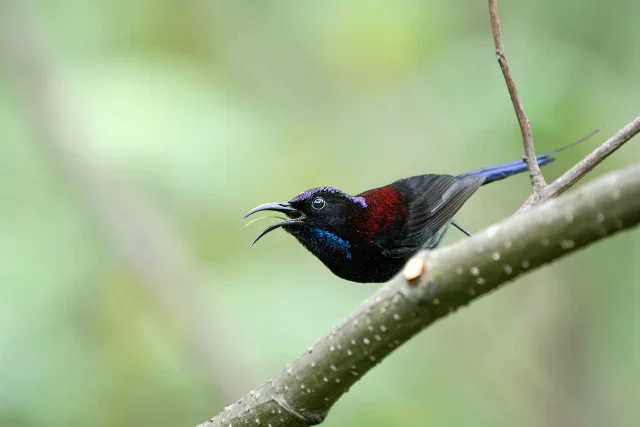
The Little Spiderhunter is a compact bird, typically measuring between 13 and 16 centimeters in length. Its most defining physical characteristic is its exceptionally long, decurved, and slightly serrated bill, which is perfectly adapted for probing deep into tubular flowers. The plumage is primarily an olive-green color on the upperparts, providing excellent camouflage against the dense foliage of the forest canopy. The underparts are a vibrant, contrasting yellow, which often appears paler toward the throat and breast. A subtle, dark malar stripe is usually present, adding character to its facial features. The eyes are dark, and the legs are typically a pale, grayish-brown. Despite its small size, the bird possesses a robust build, allowing it to navigate through thick vegetation with ease. Both males and females share similar coloration, making them sexually monomorphic, though males may occasionally exhibit slightly more intense yellow hues during the breeding season. Their wings are relatively short and rounded, facilitating quick, erratic flight patterns used to maneuver through the tangled undergrowth of their native tropical habitats.
Habitat
The Little Spiderhunter is predominantly found in the tropical regions of South and Southeast Asia, ranging from India and Bangladesh through to the Malay Peninsula, Sumatra, Borneo, and the Philippines. They are highly specialized inhabitants of primary and secondary evergreen forests. These birds show a strong preference for humid, lowland environments, often frequenting areas near forest edges, clearings, and plantations where nectar-bearing plants are abundant. They are rarely found in open country, as they rely heavily on the cover of trees and shrubs for protection and foraging. Their range is closely tied to the distribution of specific flowering plants, which they visit with remarkable regularity, making them a fixture of the forest understory and middle canopy layers.
Diet
As its name suggests, the diet of the Little Spiderhunter is primarily composed of nectar, though it is not strictly restricted to this. They are specialized nectarivores, using their long, curved bills to extract energy-rich nectar from a variety of forest flowers, especially those belonging to the ginger (Zingiberaceae) and banana (Musaceae) families. Beyond nectar, they are also opportunistic insectivores. They frequently hunt for small spiders—hence the name—as well as small beetles, caterpillars, and other invertebrates found hiding within curled leaves or flower clusters. This dual diet ensures they receive the necessary protein for muscle maintenance and reproduction, while the nectar provides the high-octane fuel required for their high-metabolism lifestyle throughout the day.
Breeding and Nesting
The nesting habits of the Little Spiderhunter are among the most remarkable in the avian world. Unlike many birds that build cup-shaped nests on branches, this species constructs a specialized hanging nest. The nest is typically a purse-like structure, skillfully sewn onto the underside of a large, broad leaf, such as a banana leaf. They use spider silk as a natural adhesive, threading it through punctures they create in the leaf to secure the nest firmly in place. This innovative design provides excellent protection from both predators and heavy tropical rains. The female is primarily responsible for the construction and incubation, laying a clutch of two to three eggs. Both parents participate in feeding the chicks, bringing a diet rich in insects to support their rapid growth. This intricate nesting strategy ensures the safety of their offspring in the challenging forest environment.
Behavior
The Little Spiderhunter is a highly active and energetic bird, characterized by its rapid, darting flight as it moves between foraging patches. They are generally solitary or found in pairs, rarely forming large flocks. Their call is a distinctive, high-pitched, metallic 'tsink' or 'tsee-tsee' sound, which is often the first indicator of their presence in the dense forest. They are quite vocal and assertive, often defending their favorite flowering trees from other nectar-feeding birds. Despite their small size, they display significant territoriality. Their movement through the canopy is deliberate and methodical, as they carefully inspect each flower and leaf for potential food, showing a high degree of intelligence and familiarity with their home range.
Conservation Status - LC Least Concern
The Little Spiderhunter is currently classified as 'Least Concern' by the IUCN, as it maintains a wide distribution and a relatively stable population across its range. However, this does not mean they are immune to environmental threats. The primary risk to their continued success is the ongoing loss and fragmentation of tropical forest habitats due to deforestation, logging, and agricultural expansion. Because they are so closely tied to specific flowering plants for their food, any disruption to the local flora can have a direct impact on their ability to survive and reproduce. Conservation efforts focusing on preserving primary forest corridors are essential to ensure these agile nectar-feeders continue to thrive in the wild.
Interesting Facts
- The Little Spiderhunter uses spider silk to 'sew' its nest to the underside of large leaves.
- Its long, curved bill is perfectly evolved to reach nectar that other birds cannot access.
- They are vital pollinators for several plant species, including wild gingers.
- Despite being called a 'spiderhunter,' they consume more nectar than spiders.
- They are known for being very vocal and have a distinct, metallic-sounding call.
- The species exhibits very little difference in appearance between males and females.
- They are known to be highly territorial when it comes to their primary feeding trees.
Tips for Birdwatchers
To spot the Little Spiderhunter, start by identifying areas with abundant flowering ginger or banana plants, as these are their favorite foraging spots. Because they are fast and move erratically, it is helpful to listen for their sharp, metallic 'tsink' call before trying to locate them visually. Use high-quality binoculars and focus on the middle to lower canopy, as they prefer the shade over the bright, open sky. Patience is key; wait near a blooming bush, and the bird will likely reappear as it makes its rounds. Early morning is the best time for observation, as their activity levels are highest. Avoid sudden movements, as these birds are naturally skittish and will quickly retreat into the dense foliage if they feel threatened.
Pro-Tip: To spot this bird in dense forest canopy, a 8x42 binoculars or telescope is highly recommended.
- [Check out our top recommended gear here]
Conclusion
The Little Spiderhunter is a testament to the wonders of evolutionary specialization. Its unique physical adaptations, such as the curved bill and the ingenious 'sewn' nest, highlight the incredible ways in which species adapt to survive in the competitive environment of the tropical rainforest. As both a pollinator and a predator of small invertebrates, it plays an indispensable role in maintaining the health and diversity of its ecosystem. By studying and protecting this small but significant bird, we gain a greater appreciation for the complexity of nature and the importance of habitat conservation. Whether it is the flash of yellow in the canopy or the familiar metallic call echoing through the trees, the Little Spiderhunter remains an essential part of the Asian forest experience. For birdwatchers and nature lovers alike, encountering this species is a rewarding reminder of the hidden beauty that resides in the heart of our world's jungles. We must continue to support forest preservation to ensure that future generations can witness the tireless energy and unique behaviors of the Little Spiderhunter in its natural, undisturbed habitat.
Tag:

200 Follower
is a writer who draws. He’s the Bestselling author of “Number of The Year”. Donec vitae tortor efficitur, convallis lelobortis elit.
Recent Posts





Subscribe For Daily Newsletter