
Not available
Streaked Spiderhunter
Arachnothera magna
Last update: 09 Mar 2026
Read in:
English
Español
Português
हिन्दी
বাংলা
தமிழ்
മലയാളം
मराठी
ગુજરાતી
తెలుగు
French
Deutsch
Русский
日本語
简体中文
Italiano
Tiếng Việt
العربية
ಕನ್ನಡ
ਪੰਜਾਬੀ
Streaked Spiderhunter Basic Information
| Scientific Name | Arachnothera magna |
|---|---|
| Status | LC Least Concern |
| Size | 16-17 cm (6-7 inch) |
| Colors |
Olive
Black
|
| Type |
Perching Birds

|
| Family | Sunbirds |
Introduction
The Streaked Spiderhunter (Arachnothera magna) is a fascinating member of the Nectariniidae family, widely recognized for its specialized feeding habits and distinctive plumage. As a medium-sized perching bird, it stands out among other spiderhunters due to its bold, dark streaks that contrast sharply against its olive-green body. Primarily found across the lush landscapes of South and Southeast Asia, this bird plays a critical role in its ecosystem as a pollinator for various tropical flowers. Unlike many smaller sunbirds, the Streaked Spiderhunter possesses a long, decurved bill perfectly evolved to probe deep into tubular blossoms. Its presence is often announced by a loud, metallic call that echoes through the dense forest canopy. For birdwatchers and ornithologists alike, observing this species offers a glimpse into the intricate relationships between avian life and forest flora. As we explore the life cycle, habitat, and behaviors of this remarkable bird, we gain a deeper appreciation for the biodiversity found within the Himalayan foothills and beyond.
Physical Appearance
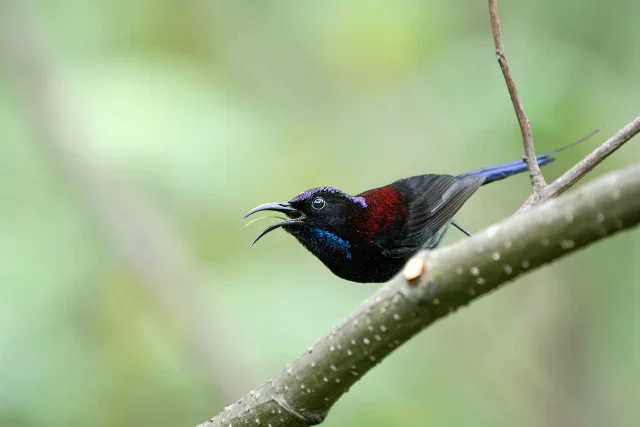
The Streaked Spiderhunter is a striking bird, measuring approximately 16 to 17 cm in length. Its most defining characteristic is its plumage, which features a vibrant olive-green base color accented by prominent, heavy black streaking that runs vertically down the breast and flanks. This coloration provides excellent camouflage against the dappled sunlight of the forest understory. The bird’s most prominent feature is its long, black, downward-curved bill, which is specifically adapted for reaching nectar deep within large flowers. The eyes are dark, often framed by a subtle ocular ring, and the legs are a sturdy, dark grey or black, allowing it to grip branches securely while feeding. Both sexes are relatively similar in appearance, though subtle variations may exist. Its wings are rounded, and the tail is relatively short, which aids in the bird's agility as it navigates through dense vegetation. This combination of size, color, and specialized beak shape makes the Streaked Spiderhunter easily identifiable to the trained eye in its native range.
Habitat
The Streaked Spiderhunter thrives in a variety of forested environments, showing a strong preference for broadleaf evergreen forests, hill forests, and dense mountain thickets. They are commonly found in the Himalayan foothills, parts of Southern China, and throughout Southeast Asia. Their habitat choice is largely dictated by the availability of flowering plants, as they rely heavily on nectar sources. Consequently, they are frequently sighted in forest edges, clearings, and secondary growth areas where diverse vegetation flourishes. They prefer elevations ranging from the lowlands up to approximately 2,000 meters above sea level. By occupying these vertical strata, they maintain access to a year-round supply of nectar-rich blooms, which is vital for their survival and reproductive success in these complex, biodiverse ecosystems.
Diet
The diet of the Streaked Spiderhunter is primarily nectarivorous, though it is also known to supplement its intake with small insects and spiders, which is where it gets its common name. They are particularly fond of large, tubular flowers such as those found on banana plants and various gingers. Their long, curved bill allows them to access nectar that other birds cannot reach, often piercing the base of the flower to bypass the petals. This foraging behavior makes them essential pollinators for many plant species. When nectar sources are scarce, they actively hunt for small arthropods, showing remarkable agility as they snatch prey from leaves and bark, demonstrating a versatile feeding strategy that helps them thrive in varying seasonal conditions.
Breeding and Nesting
Breeding for the Streaked Spiderhunter typically occurs during the spring and early summer months, coinciding with the peak flowering season. Their nesting habits are quite unique; they often construct elaborate, cup-shaped nests suspended from the underside of large leaves, such as banana or palm fronds. They use spider silk to bind fine plant fibers and moss to the leaf, creating a secure, camouflaged cradle that protects their clutch from predators and the elements. A typical clutch consists of two to three eggs, which are incubated primarily by the female. Both parents participate in feeding the chicks once they hatch, bringing a combination of nectar and small insects to ensure rapid growth. This clever nesting strategy highlights their adaptation to the tropical environment, utilizing existing foliage to secure their next generation.
Behavior
Streaked Spiderhunters are generally solitary or found in pairs, maintaining a relatively elusive presence within the canopy. They are highly active birds, constantly moving from flower to flower with swift, darting flights. Their vocalizations are distinct, often emitting a sharp, metallic 'tchink' or a series of rapid, piercing notes. Unlike some social birds, they are quite territorial when it comes to their preferred flowering trees, often chasing away intruders to protect their nectar supply. While they are agile flyers, they spend a significant amount of time perched on branches, carefully scanning their surroundings before diving into a cluster of blooms to feed, showcasing a balance of caution and high-energy activity.
Conservation Status - LC Least Concern
The Streaked Spiderhunter is currently classified as a species of Least Concern by the IUCN. This is largely due to their wide geographic distribution and their ability to adapt to secondary forests and human-modified landscapes. However, like many tropical species, they face localized threats from habitat loss, deforestation, and the use of pesticides in agricultural areas near forest edges. While their populations remain stable, ongoing monitoring is essential to ensure that the fragmentation of their native forests does not lead to a decline in their numbers, as they are highly dependent on specific nectar-producing flora for survival.
Interesting Facts
- The Streaked Spiderhunter uses its long bill to 'rob' nectar by piercing the base of flowers.
- They are expert nest architects, using spider webs to glue their nests to the underside of large leaves.
- They play a major role in the pollination of wild banana plants in Asian forests.
- Despite their name, they consume more nectar than they do spiders.
- Their loud, metallic call is often the first indication of their presence in the canopy.
- They are known to be quite aggressive when defending their favorite nectar-rich territories.
Tips for Birdwatchers
For birdwatchers seeking the Streaked Spiderhunter, the best approach is to locate flowering banana or ginger patches in forested hill areas. Early morning is the most productive time for observation, as the birds are highly active while foraging. Look for the characteristic vertical streaks on the chest and listen for their sharp, metallic calls, which often precede their arrival at a flower. Using high-quality binoculars is recommended, as these birds often remain high in the canopy or deep within dense foliage. Patience is key; remain still near a blooming tree, and the bird will likely reveal itself as it moves systematically from one blossom to the next.
Pro-Tip: To spot this bird in dense forest canopy, a 8x42 binoculars or telescope is highly recommended.
- [Check out our top recommended gear here]
Conclusion
The Streaked Spiderhunter (Arachnothera magna) is a quintessential example of evolutionary specialization, perfectly adapted to the nectar-rich forests of Asia. From its uniquely curved bill to its ingenious method of constructing nests beneath large, protective leaves, every aspect of this bird’s biology is tailored to its environment. As pollinators, they are indispensable to the health of their forest ecosystems, facilitating the reproduction of countless plant species. While they are currently secure in their conservation status, their reliance on specific habitats reminds us of the delicate balance required to maintain biodiversity in our world. For those lucky enough to spot one, the Streaked Spiderhunter offers a rewarding experience, showcasing the beauty and complexity of avian life. As we continue to study and protect these vibrant creatures, we ensure that future generations will also have the opportunity to witness the swift, olive-streaked flashes of color that define this remarkable species. Whether you are an experienced ornithologist or a casual nature enthusiast, learning about the Streaked Spiderhunter is a rewarding journey into the wonders of the natural world, highlighting the intricate connections that bind birds, plants, and their shared habitats together in a beautiful, ever-changing cycle of life.
Tag:

200 Follower
is a writer who draws. He’s the Bestselling author of “Number of The Year”. Donec vitae tortor efficitur, convallis lelobortis elit.
Recent Posts





Subscribe For Daily Newsletter