Warning: Undefined variable $by_location in /home/odescxjtd641/public_html/beefound.in/bird-details.php on line 874
intermediate egret
Ardea intermedia
Last update: 27 Jul 2026
Read in:
English
Español
Português
हिन्दी
বাংলা
தமிழ்
മലയാളം
मराठी
ગુજરાતી
తెలుగు
French
Deutsch
Русский
日本語
简体中文
Italiano
Tiếng Việt
العربية
ಕನ್ನಡ
ਪੰਜਾਬੀ
Intermediate Egret Basic Information
| Scientific Name | Ardea intermedia |
|---|---|
| Status | LC Least Concern |
| Size | 65-72 cm (26-28 inch) |
| Colors |
White
Grey
|
| Type |
Waders

|
| Family | Herons |
Intermediate Egret Names In Other Languages
| assamese | পানী বগলী |
|---|---|
| french | Héron intermédiaire |
| malayalam | ചെറàµà´®àµà´£àµà´Ÿà´¿ |
| marathi | मधà¥à¤¯à¤® बगळा |
| tamil | வெண௠கொகà¯à®•à¯ |
Introduction
The Intermediate Egret (Mesophoyx intermedia) is a medium-sized heron known for its elegant white plumage. As its name suggests, it sits perfectly between the Great Egret and the Little Egret in size, making it a fascinating subject for birdwatchers across Africa, Asia, and Australia.
Physical Appearance
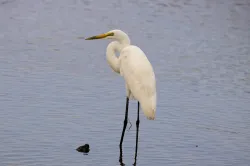
This bird features all-white plumage and stands between 65-72 cm tall. It is characterized by a thickish yellow bill and generally dark legs. During the breeding season, its appearance transforms: the bill may turn reddish or black, and it develops beautiful, loose filamentous plumes on its breast and back. A key identification feature is its gape line, which ends directly below the eye, unlike the Great Egret whose gape extends further back.
Habitat
Intermediate Egrets are primarily found in wetland environments. Their preferred habitats include:
- Marshes and flooded grasslands
- Well-vegetated pools
- Lakeshores and reservoirs
- Mangrove swamps and tidal creeks
Diet
The diet of the Intermediate Egret is varied and opportunistic. It primarily feeds on:
- Fish
- Frogs
- Crustaceans
- Insects
Breeding and Nesting
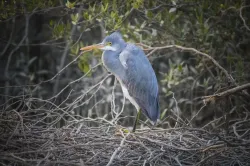
These birds often nest in large colonies alongside other heron species. They build their nests as platforms of sticks located in trees or shrubs near water. Depending on the region, the female typically lays between two to five eggs per clutch.
Behavior
Unlike the more active Little Egret, the Intermediate Egret hunts by slow stalking in shallow water. It tends to stalk upright with its neck extended forward. While they may forage individually, they are known to roost communally and can often be found in small flocks that separate during feeding hours.
Conservation Status - LC Least Concern
The Intermediate Egret is currently classified as Least Concern by the IUCN, although it remains dependent on the preservation of healthy wetland ecosystems and is protected in many regions.
Interesting Facts
- Its scientific name, Mesophoyx, reflects its middle-sized status among egret species.
- The Great Egret has a noticeable 'kink' in its neck that the Intermediate Egret lacks.
- During breeding, their upper legs can turn a dull yellow or pinkish hue depending on the region.
- They are less patient than Great Egrets, preferring a steady, methodical stalk over a stationary stance.
Tips for Birdwatchers
To identify an Intermediate Egret, look closely at the gape line (the corner of the mouth). If it stops directly under the eye, it is an Intermediate; if it extends in a dagger shape behind the eye, it is a Great Egret. Additionally, check the feet—Little Egrets have yellow-soled feet, whereas Intermediates have dark feet.
Conclusion
The Intermediate Egret is a graceful and essential inhabitant of the world's wetlands. By understanding its specific physical markers and behavioral patterns, bird enthusiasts can better appreciate and identify this 'middle child' of the egret family during their next field outing.
Tag:

200 Follower
is a writer who draws. He’s the Bestselling author of “Number of The Year”. Donec vitae tortor efficitur, convallis lelobortis elit.
Recent Posts






Subscribe For Daily Newsletter