
Not available
Bar-tailed Lark
Ammomanes cinctura
Last update: 13 Jul 2026
Read in:
English
Español
Português
हिन्दी
বাংলা
தமிழ்
മലയാളം
मराठी
ગુજરાતી
తెలుగు
French
Deutsch
Русский
日本語
简体中文
Italiano
Tiếng Việt
العربية
ಕನ್ನಡ
ਪੰਜਾਬੀ
Bar-tailed Lark Basic Information
| Scientific Name | Ammomanes cinctura |
|---|---|
| Status | LC Least Concern |
| Size | 13-15 cm (5-6 inch) |
| Colors |
Brown
Buff
|
| Type |
Perching Birds

|
| Family | Larks |
Introduction
The Bar-tailed Lark (Ammomanes cinctura) is a fascinating member of the Alaudidae family, perfectly adapted to the harsh, arid environments it calls home. Small and inconspicuous, this perching bird is a master of camouflage, blending seamlessly into the sandy landscapes of North Africa, the Middle East, and parts of Central Asia. As a ground-dwelling species, it has evolved specific physiological and behavioral traits to survive in regions where water is scarce and temperatures can reach extreme heights. Ornithologists often study this bird to understand the evolutionary pressures of desert survival. Unlike many other species that rely on dense vegetation, the Bar-tailed Lark thrives in the vast, open expanses of stone and sand, making it a unique subject for birdwatchers interested in specialized avian adaptations. Its presence serves as an indicator of a healthy desert ecosystem, though its elusive nature makes it a challenging find for even the most experienced enthusiasts. Understanding the Bar-tailed Lark requires a deep dive into its unique biology, social structures, and the delicate balance it maintains within its rugged, sun-drenched habitat.
Physical Appearance
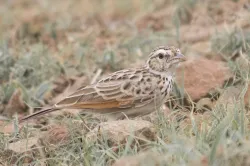
Measuring between 13 and 15 centimeters in length, the Bar-tailed Lark is a compact and sturdy bird characterized by its muted, earth-toned plumage. Its primary coloration is a sandy brown, which provides essential camouflage against the rocky and sandy substrates of its desert home. This is complemented by a secondary buff coloration, particularly on its underparts, which helps break up its outline against the sun-bleached landscape. One of its most distinctive features is the tail, which gives the species its name; it possesses a dark subterminal band that is particularly visible during flight. The bird has a relatively large head, a stout, pale bill designed for foraging in loose soil, and strong legs suited for walking and running across the desert floor. Its wings are broad and rounded, facilitating the short, bounding flights it uses to navigate its territory. Sexual dimorphism is minimal, with both males and females exhibiting similar patterns, allowing them to remain equally cryptic in their environment. This combination of size, color, and structural adaptation makes the Bar-tailed Lark a master of stealth in an open environment.
Habitat
The Bar-tailed Lark is primarily a bird of the desert, showing a strong preference for arid and semi-arid landscapes. It is commonly found in gravelly plains, rocky deserts, and sparse scrublands where vegetation is minimal. Unlike many other lark species that might inhabit grasslands or agricultural fields, the Bar-tailed Lark is highly specialized for life in the most barren regions. It avoids densely forested or high-altitude areas, preferring the heat-radiating surfaces of the Sahara, the Arabian Peninsula, and the dry plains of Iran and Afghanistan. This bird requires open ground to forage, as it relies on its ability to spot food items against the desert floor while keeping a keen eye out for potential predators lurking in the distance.
Diet
As an omnivorous species, the Bar-tailed Lark possesses a versatile diet that allows it to survive in nutrient-poor environments. Its foraging strategy involves walking slowly across the ground, using its stout bill to probe the surface for seeds, grains, and small plant matter. During the warmer months, the bird supplements its intake with a variety of invertebrates, including beetles, ants, and small larvae, which provide essential protein and hydration. Because standing water is rarely available in its core range, the Bar-tailed Lark has adapted to obtain most of its necessary moisture directly from its food sources. This dietary flexibility is crucial for its survival during periods of drought when plant life is scarce.
Breeding and Nesting
Breeding for the Bar-tailed Lark is highly opportunistic, often triggered by seasonal rainfall that brings a temporary flush of vegetation and insect life to the desert. The nesting site is typically a shallow scrape on the ground, often placed near the base of a small rock or a stunted desert shrub to provide minimal shelter from the intense sun and wind. The female is primarily responsible for constructing the nest, using available materials like dry grass, twigs, and feathers. A typical clutch consists of two to four eggs, which are incubated primarily by the female. Both parents contribute to the feeding of the altricial chicks, bringing insects back to the nest to support their rapid growth. This high level of parental investment is necessary to ensure the survival of the offspring in an environment where environmental conditions can shift rapidly and unpredictably, requiring the young to fledge and become independent as quickly as possible.
Behavior
The Bar-tailed Lark is known for its terrestrial nature, preferring to run or walk rather than fly, even when disturbed. When it does take to the air, its flight is short and undulating, often ending abruptly as it drops back to the ground to blend in with the landscape. It is a generally quiet species, though it may produce a soft, melodic song during the breeding season to establish territory. During the hottest parts of the day, the bird exhibits thermoregulatory behaviors, such as seeking shade under rocks or orienting its body to minimize exposure to direct sunlight. Its social structure is generally solitary or found in loose pairs, though small groups may congregate around rare, localized food sources.
Conservation Status - LC Least Concern
The Bar-tailed Lark is currently classified as a species of Least Concern by the IUCN. Its vast range across the deserts of Africa and Asia, combined with a relatively stable population, suggests that it is not currently facing an immediate threat of extinction. However, the species is sensitive to habitat degradation caused by overgrazing and climate change, which can alter the delicate desert ecosystems it occupies. While it remains widespread, ongoing monitoring is essential to ensure that localized populations do not decline due to human encroachment or the expansion of desertification in surrounding regions.
Interesting Facts
- The Bar-tailed Lark is a master of camouflage, often becoming invisible when it stays still against desert rocks.
- It can survive for long periods without drinking water by obtaining moisture from its food.
- The bird's scientific name, Ammomanes cinctura, roughly translates to 'sand-loving' and 'encircled' or 'belted.'
- Its tail's dark band is a key diagnostic feature used by ornithologists for field identification.
- Unlike many other birds, it prefers running across the sand to flying away from threats.
- The species is highly opportunistic, timing its breeding cycle perfectly with unpredictable desert rain events.
Tips for Birdwatchers
For birdwatchers hoping to spot the Bar-tailed Lark, patience and a keen eye are the most valuable tools. Because these birds are perfectly camouflaged, they are often only detected when they move. Focus your search on rocky, gravelly plains during the cooler morning or late afternoon hours, as the birds are more active when temperatures are moderate. Using high-quality binoculars or a spotting scope is essential, as these birds will likely be at a distance. If you spot one, remain still; they are often curious and may continue foraging if they do not perceive you as a threat. Always respect the fragility of the desert environment and keep a respectful distance from any potential nesting sites you might encounter in the field.
Pro-Tip: To spot this bird in dense forest canopy, a 8x42 binoculars or telescope is highly recommended.
- [Check out our top recommended gear here]
Conclusion
In summary, the Bar-tailed Lark (Ammomanes cinctura) is a remarkable example of evolutionary adaptation, thriving in environments that would be inhospitable to most other avian species. From its cryptic, sand-colored plumage to its specialized dietary habits and opportunistic breeding strategies, every aspect of this bird’s life is finely tuned to the rhythms of the desert. While it may not be the most colorful or vocal bird, its presence is a testament to the resilience of life in the world's most arid regions. For birdwatchers and scientists alike, the Bar-tailed Lark offers a unique window into the complexities of desert ecology. As we continue to study and document this species, we gain a deeper appreciation for the biodiversity that exists within landscapes often mistakenly viewed as empty or lifeless. Protecting the habitats where the Bar-tailed Lark resides is not only vital for the species itself but also for the preservation of the unique desert ecosystems that characterize large portions of our planet. Whether you are an experienced ornithologist or a casual nature enthusiast, encountering this elusive desert dweller is a rewarding experience that highlights the beauty of natural adaptation.
Tag:

200 Follower
is a writer who draws. He’s the Bestselling author of “Number of The Year”. Donec vitae tortor efficitur, convallis lelobortis elit.
Recent Posts






Subscribe For Daily Newsletter