
Not available
Horned Lark
Eremophila alpestris
Last update: 09 Mar 2026
Read in:
English
Español
Português
हिन्दी
বাংলা
தமிழ்
മലയാളം
मराठी
ગુજરાતી
తెలుగు
French
Deutsch
Русский
日本語
简体中文
Italiano
Tiếng Việt
العربية
ಕನ್ನಡ
ਪੰਜਾਬੀ
Horned Lark Basic Information
| Scientific Name | Eremophila alpestris |
|---|---|
| Status | LC Least Concern |
| Size | 16-20 cm (6-8 inch) |
| Colors |
Brown
Yellow
|
| Type |
Perching Birds

|
| Family | Larks |
Introduction
The Horned Lark (Eremophila alpestris) is a fascinating member of the Alaudidae family and stands out as the only native lark species in North America. These hardy, ground-dwelling birds are renowned for their resilience, surviving in some of the most desolate and exposed environments on the continent. Often seen walking or running along the ground rather than hopping, the Horned Lark is a true specialist of open landscapes. Their name is derived from the tiny, feather-like tufts on their heads that resemble small horns, which are most prominent in breeding males. Throughout the year, these birds exhibit remarkable adaptability, shifting their ranges and behaviors to cope with seasonal changes. Whether navigating the windswept tundra of the Arctic or the arid plains of the Southwest, the Horned Lark remains a captivating subject for ornithologists and birdwatchers alike. Understanding their biology provides deep insights into how avian species thrive in harsh, open-country ecosystems where shelter is minimal and the elements are unforgiving.
Physical Appearance
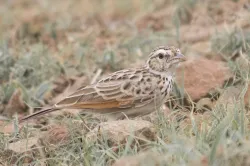
Measuring between 16 and 20 cm in length, the Horned Lark is a medium-sized passerine with a distinct, sophisticated plumage pattern. Its primary coloration is a subtle, earthy brown, which provides excellent camouflage against the bare ground and sparse vegetation of its habitat. This brown base is contrasted by striking facial markings, including a bold black mask and a yellow or white throat and eyebrow, depending on the subspecies. The most iconic feature, from which the bird takes its name, is the pair of small, black feather tufts on the crown that can be raised to form 'horns.' The underparts are generally pale, often fading to a whitish color on the belly. Their legs are relatively long and sturdy, adapted for a life spent walking across uneven terrain. Juveniles appear more mottled and lack the sharp, clean lines of the adults, but they share the same compact, streamlined body shape. This intricate coloration serves as a perfect adaptation for blending into the gravelly, open environments they call home, making them difficult to spot when they remain still.
Habitat
The Horned Lark is a bird of wide-open spaces. They are rarely found near trees or dense forests, preferring instead environments where they have a clear line of sight. Their primary habitats include arctic tundra, high-altitude alpine meadows, coastal dunes, arid deserts, and large agricultural fields. They are particularly fond of areas with short, sparse vegetation or completely barren ground, such as gravel roadsides, overgrazed pastures, and burnt-over lands. During the winter, these birds often form large, loose flocks that congregate in open fields or airports, where they search for food on the ground. Their ability to tolerate extreme wind and cold makes them one of the few species capable of nesting in the high-latitude tundra, where they thrive in conditions that would be inhospitable to many other perching birds.
Diet
As ground-foragers, the Horned Lark has a diet that is strictly determined by the seasons. During the spring and summer months, their diet consists primarily of insects and small invertebrates, including beetles, grasshoppers, caterpillars, and spiders. This high-protein intake is essential for the growth of their chicks. As the seasons change and winter approaches, the Horned Lark shifts its dietary focus significantly toward plant material. They become granivorous, feeding on a wide variety of seeds, including those from grasses, weeds, and agricultural crops like wheat or corn. They use their strong, conical bills to peck at the ground, often scratching the surface to uncover hidden seeds. This dietary flexibility is a key survival strategy, allowing them to remain in their range even when insect populations vanish during the coldest months of the year.
Breeding and Nesting
Breeding for the Horned Lark is a meticulous process that begins early in the season. The male performs elaborate flight displays, singing a high-pitched, thin song while hovering high above the ground before descending rapidly. Once a pair is established, the female takes the lead in nest construction. She builds a simple, cup-shaped nest, usually placed directly on the ground in a slight depression. The nest is often tucked against a rock, a clump of grass, or in an open area with minimal cover, and is lined with soft plant fibers, feathers, or wool. The female typically lays 3 to 4 eggs, which she incubates for about 11 to 14 days. Both parents participate in feeding the altricial chicks, which fledge and leave the nest within 9 to 12 days. Because they nest on the ground, the eggs and nestlings are highly vulnerable to predators, prompting the parents to be extremely cautious and secretive near the nest site.
Behavior
The behavior of the Horned Lark is defined by its constant movement on the ground. Unlike many other perching birds, they are rarely seen perching in trees or shrubs, preferring to spend almost their entire lives on the soil surface. They possess a unique walking gait, moving with purpose and speed rather than the hopping movement common to many songbirds. They are social creatures, especially during the non-breeding season, when they congregate in large, nomadic flocks that move across the landscape in search of food. When startled, the entire flock often takes flight simultaneously, circling briefly before landing again nearby. Their flight is undulating and direct, often accompanied by soft, tinkling calls that help keep the flock coordinated in the vast, open spaces they inhabit.
Conservation Status - LC Least Concern
The Horned Lark is currently classified as a species of Least Concern by the IUCN. While they remain widespread and relatively common across their vast North American and Eurasian range, they do face localized threats. Habitat loss due to intensive agricultural development, urbanization, and changing land-management practices can negatively impact local populations. However, their ability to utilize human-altered landscapes, such as airports and fallow fields, has helped them maintain stable numbers. Conservation efforts focus primarily on preserving large, open grasslands and ensuring that agricultural practices remain bird-friendly, allowing these resilient ground-dwellers to continue thriving in their specialized niches.
Interesting Facts
- The Horned Lark is the only member of the lark family native to North America.
- Their 'horns' are not true horns but small, erectile black feathers on the crown.
- They are known for their 'skylarking' flight displays during the breeding season.
- Horned Larks can survive in temperatures well below freezing by fluffing their feathers to trap body heat.
- These birds often walk or run rather than hop, a trait shared by few other small passerines.
- They are highly adaptable and have been known to nest on flat roofs in some urban areas.
- The species is highly migratory in the northern parts of its range, moving south in large flocks during winter.
Tips for Birdwatchers
To successfully spot a Horned Lark, focus your search on large, open areas with short vegetation. Early spring is the best time to observe their spectacular courtship flight displays, where males hover high in the sky. When scanning a field, look for movement on the ground rather than in the trees; their brown plumage provides excellent camouflage, so they are often spotted only when they move. Using a pair of high-quality binoculars or a spotting scope is essential, as these birds are often skittish and may flush if approached too closely. Visiting gravel roads, airport perimeters, or harvested agricultural fields during the winter months can yield great results, as these are common congregating spots for the species. Patience is key—find a vantage point, remain still, and watch for their distinctive walking pattern.
Pro-Tip: To spot this bird in dense forest canopy, a 8x42 binoculars or telescope is highly recommended.
- [Check out our top recommended gear here]
Conclusion
The Horned Lark (Eremophila alpestris) serves as a remarkable testament to avian adaptation. By successfully colonizing some of the most challenging, open-country environments on earth, this species has carved out a unique ecological niche that few other birds can occupy. From their intricate, earth-toned plumage that provides near-perfect camouflage to their resilient foraging behaviors and complex aerial courtship displays, every aspect of the Horned Lark is finely tuned to the demands of the tundra and the plains. As birdwatchers and nature enthusiasts, observing these birds offers a profound appreciation for the diversity of survival strategies in the avian world. While they may not have the colorful plumage of a warbler or the melodic song of a thrush, the Horned Lark possesses a quiet, rugged beauty that is undeniably captivating. Protecting the vast, open spaces they call home is essential to ensuring that future generations can continue to witness these hardy, ground-dwelling survivors as they navigate the windswept landscapes of our planet. Whether you are a seasoned ornithologist or a casual backyard observer, the Horned Lark remains a rewarding and essential species to study and admire in the wild.
Tag:

200 Follower
is a writer who draws. He’s the Bestselling author of “Number of The Year”. Donec vitae tortor efficitur, convallis lelobortis elit.
Recent Posts





Subscribe For Daily Newsletter