
Not available
Humes Lark
Calandrella acutirostris
Last update: 09 Mar 2026
Read in:
English
Español
Português
हिन्दी
বাংলা
தமிழ்
മലയാളം
मराठी
ગુજરાતી
తెలుగు
French
Deutsch
Русский
日本語
简体中文
Italiano
Tiếng Việt
العربية
ಕನ್ನಡ
ਪੰਜਾਬੀ
Humes Lark Basic Information
| Scientific Name | Calandrella acutirostris |
|---|---|
| Status | LC Least Concern |
| Size | 13-14 cm (5-6 inch) |
| Colors |
Grey
White
|
| Type |
Perching Birds

|
| Family | Larks |
Introduction
The Hume's Lark, scientifically classified as Calandrella acutirostris, is a fascinating member of the Alaudidae family, often categorized among the perching birds. This small, unassuming passerine is primarily found across the arid landscapes of Central and South Asia. Named after the distinguished ornithologist Allan Octavian Hume, this species is renowned for its remarkable ability to thrive in harsh, high-altitude environments where few other avian species dare to venture. Despite its relatively modest appearance, the Hume's Lark is a subject of significant interest for ornithologists due to its complex migratory patterns and specific ecological niche.
Occupying the vast, open plains and semi-desert regions, these birds have evolved specialized survival strategies to cope with extreme temperature fluctuations and limited resources. Their presence is often a testament to the ecological health of the steppes. As a species that primarily interacts with the ground, the Hume's Lark displays unique behaviors that distinguish it from its arboreal cousins. Understanding the life cycle, dietary preferences, and structural adaptations of this bird provides valuable insights into the biodiversity of Asian grassland ecosystems. Whether you are an avid birder or a student of avian biology, the Hume's Lark offers a compelling case study in evolutionary adaptation and habitat resilience.
Physical Appearance
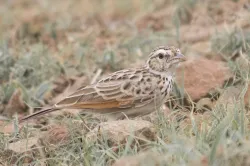
Measuring approximately 13 to 14 cm in length, the Hume's Lark is a quintessential example of cryptic coloration designed for survival in open, arid terrains. Its plumage is dominated by a subtle grey base, which is intricately streaked with darker tones to mimic the dusty, rocky soil of its natural environment. This primary grey coloration provides exceptional camouflage against predators, making the bird difficult to spot when it remains stationary on the ground. The underparts are predominantly white, providing a sharp, clean contrast that is often visible during flight or when the bird assumes a display posture.
Structurally, the Hume's Lark features a compact, rounded body typical of the lark family. Its bill is relatively short, fine, and sharply pointed, an adaptation perfectly suited for foraging among gravel and sparse vegetation. The wings are long and pointed, which facilitates the sustained, agile flight required for long-distance migration. The legs are sturdy and well-adapted for a terrestrial lifestyle, allowing the bird to walk or run across uneven ground with ease. The tail is relatively short with white outer feathers that become prominent in flight, a key field mark for identification. Overall, the Hume's Lark's physical appearance is a masterclass in functional design, blending perfectly into the muted tones of its habitat.
Habitat
The Hume's Lark is primarily a bird of the open, windswept landscapes. Its preferred habitat consists of high-altitude steppes, barren plateaus, and dry, stony deserts. They are frequently found in regions across Central Asia, including parts of Tibet, Afghanistan, and Pakistan. Unlike many perching birds that require trees or dense forests, the Hume's Lark thrives in areas with minimal vegetation, such as rocky slopes and gravel plains. This preference for open ground allows them to scan the horizon for potential threats while foraging for food. During the winter months, they may migrate to slightly lower elevations or more temperate southern regions, often congregating in agricultural fields or arid basins.
Diet
The diet of the Hume's Lark is primarily granivorous and insectivorous, reflecting the seasonal availability of food in its harsh environment. During the warmer spring and summer months, their intake consists largely of small insects, larvae, and spiders, which provide the essential protein required for breeding and raising chicks. As the seasons shift and temperatures drop, the birds transition to a diet consisting of seeds, grains, and small plant matter found on the steppe floor. They are expert foragers, using their fine, pointed beaks to probe the soil or pick seeds directly from the ground. This dietary flexibility is crucial for their survival in environments where food resources can be scarce and unpredictable.
Breeding and Nesting
The breeding season of the Hume's Lark typically occurs during the spring and early summer, coinciding with the peak of food availability. These birds are ground-nesters, choosing well-concealed spots beneath small shrubs, rocks, or tufts of grass to protect their clutch from harsh winds and predators. The nest is a simple, cup-shaped structure meticulously fashioned from dry grass, roots, and fine plant fibers, often lined with softer material like feathers or animal hair to provide insulation for the eggs.
A typical clutch consists of three to four eggs, which exhibit a pale, speckled pattern that blends seamlessly with the surrounding soil. Both parents play an active role in the nesting process, sharing duties in incubation and chick-rearing. The female usually performs the bulk of the incubation, while the male remains vigilant, often performing song flights to defend the territory. Once hatched, the chicks are fed a steady diet of insects by both parents until they are ready to fledge, usually within two weeks. This rapid development is an essential strategy for survival in an environment where the window for successful breeding is limited by seasonal weather patterns.
Behavior
The behavior of the Hume's Lark is characterized by its terrestrial nature and remarkable agility. Unlike many other passerines that spend much of their time in branches, this species is almost exclusively ground-dwelling. They are known for their distinct 'song flights,' where the male ascends into the air, hovering and singing before descending back to the ground. This behavior serves as both a territorial display and a courtship ritual. When on the ground, they move with a swift, shuffling gait, frequently pausing to scan their surroundings. They are generally shy and cautious, often remaining motionless to avoid detection when threatened. Their social structure is usually solitary or found in small groups, particularly during the non-breeding season when they may join larger flocks of other lark species.
Conservation Status - LC Least Concern
The Hume's Lark is currently classified as a species of Least Concern by major conservation organizations. Despite the harshness of its environment, the species maintains a relatively stable population across its vast, remote range. The primary threats to their long-term survival include habitat degradation caused by overgrazing and the potential impacts of climate change on high-altitude ecosystems. However, because their range is so extensive and includes many inaccessible regions, they are currently shielded from intense anthropogenic pressures. Continued monitoring of population trends and protection of their steppe habitats remain essential to ensuring this resilient bird continues to thrive in its challenging environment.
Interesting Facts
The Hume's Lark is named after Allan Octavian Hume, a famous British civil servant and ornithologist.,They are among the few bird species capable of thriving in the extreme, high-altitude environments of the Tibetan Plateau.,Their plumage is a perfect example of disruptive coloration, helping them blend into rocky, arid soil.,Unlike many perching birds, they spend nearly their entire lives on the ground, rarely perching in trees.,During courtship, males perform impressive aerial displays, hovering high above their territory.,They possess highly specialized bills designed for foraging in gravel and sparse vegetation.
Tips for Birdwatchers
For birdwatchers hoping to spot the Hume's Lark, patience and a keen eye are essential. Because of their excellent camouflage, they are often only detected once they take flight. Focus your search on open, rocky steppes or high-altitude plateaus during the spring migration. Using a high-quality spotting scope is highly recommended, as these birds can be quite skittish and will often remain stationary on the ground to avoid notice. Listen for their melodic, short songs, which are often the best indicator of their presence in a seemingly empty landscape. Early morning and late afternoon are the best times to observe their activity, as they are most active during these cooler periods. Always maintain a respectful distance to avoid disturbing their nesting sites.
Pro-Tip: To spot this bird in dense forest canopy, a 8x42 binoculars or telescope is highly recommended.
- [Check out our top recommended gear here]
Conclusion
In summary, the Hume's Lark (Calandrella acutirostris) stands as a remarkable testament to the power of evolutionary adaptation. This small perching bird has mastered the art of survival in some of the most unforgiving environments on Earth, from the high-altitude plateaus of Tibet to the arid, stony deserts of Central Asia. Its subtle grey and white plumage, specialized foraging behaviors, and resilient breeding strategies all contribute to its success as a species. For the birdwatcher, spotting a Hume's Lark is a rewarding experience that requires patience, skill, and an appreciation for the vast, open landscapes they call home.
As we continue to study the avian world, the Hume's Lark serves as a vital reminder of the biodiversity found in often-overlooked habitats. Their presence in the steppe ecosystem plays a subtle yet significant role in the balance of their environment. By protecting these delicate regions and continuing to document the lives of such unique species, we ensure that the natural world remains diverse and vibrant for future generations. Whether you are observing them for their beautiful song flights or simply admiring their ability to endure, the Hume's Lark is undoubtedly a species worthy of our ongoing fascination and conservation efforts. Their story is one of endurance, simplicity, and the quiet beauty of the natural world.
Tag:

200 Follower
is a writer who draws. He’s the Bestselling author of “Number of The Year”. Donec vitae tortor efficitur, convallis lelobortis elit.
Recent Posts






Subscribe For Daily Newsletter