Not available
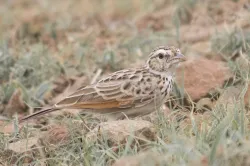
Horsfields Bushlark
Mirafra javanica
Last update: 09 Mar 2026
Read in:
English
Español
Português
हिन्दी
বাংলা
தமிழ்
മലയാളം
मराठी
ગુજરાતી
తెలుగు
French
Deutsch
Русский
日本語
简体中文
Italiano
Tiếng Việt
العربية
ಕನ್ನಡ
ਪੰਜਾਬੀ
Horsfields Bushlark Basic Information
| Scientific Name | Mirafra javanica |
|---|---|
| Status | LC Least Concern |
| Size | 12-15 cm (5-6 inch) |
| Colors |
Brown
Buff
|
| Type |
Perching Birds

|
| Family | Larks |
Introduction
The Horsfield's Bushlark (Mirafra javanica) is a fascinating and elusive member of the Alaudidae family, widely recognized for its cryptic appearance and melodic songs. Often overlooked due to its tendency to blend seamlessly into its surroundings, this small perching bird is a master of camouflage. Named after Thomas Horsfield, a 19th-century naturalist, the species is found across a broad range including parts of Australia, Southeast Asia, and the Indian subcontinent. As a ground-dwelling passerine, the Horsfield's Bushlark thrives in open grassy environments, where it spends much of its time foraging for food or performing its characteristic aerial displays. Understanding this bird requires patience and a keen eye, as its habit of crouching low in the vegetation makes it difficult to spot for even the most experienced birdwatchers. Whether you are a casual observer or a dedicated ornithologist, studying the Horsfield's Bushlark offers a unique window into the life of a bird perfectly adapted to the challenges of living in open, sun-drenched landscapes.
Physical Appearance
Measuring between 12 and 15 centimeters in length, the Horsfield's Bushlark is a compact bird that exhibits remarkable camouflage. Its plumage is primarily a mottled brown, which serves as an effective disguise against the dusty soil and dried grasses of its natural habitat. The upperparts are streaked with darker brown and black, while the underparts display a lighter, warm buff coloration that helps the bird blend into the shadows of the grass. One of its most distinctive physical features is its relatively large, conical bill, which is well-suited for a varied diet of seeds and small insects. The bird also sports a short, rounded crest that it can raise slightly when agitated or during courtship displays. Its wings are broad and rounded, and when in flight, they reveal distinctive reddish-brown patches that act as a quick identification mark for observers. The legs are sturdy, adapted for walking and running across the ground rather than hopping, a trait that distinguishes it from many other smaller passerine species found in the same regions.
Habitat
The Horsfield's Bushlark is primarily associated with open, grassy environments. It favors areas with short-to-medium grass, such as grasslands, agricultural fields, pastures, and the edges of swamps or woodlands. Unlike many other forest-dwelling birds, the Bushlark avoids dense vegetation, preferring wide-open spaces that allow it to scan for predators while remaining concealed by its cryptic coloration. Its range is quite expansive, stretching from the arid outback of Australia to the tropical grasslands of Southeast Asia. Because it is highly dependent on ground cover, the species is sensitive to major changes in land management, such as overgrazing or intensive urban development, which can rapidly remove the nesting and foraging materials it requires to survive.
Diet
As an omnivorous ground-feeder, the Horsfield's Bushlark consumes a diverse range of food items found on the forest floor or within the grass canopy. Its diet consists largely of small seeds, grains, and various types of grass stalks. During the breeding season, the bird supplements its intake with a significant amount of animal protein, primarily in the form of insects and small invertebrates. It is frequently seen walking slowly through the grass, pausing to peck at the soil or snatch up beetles, ants, and spiders. This opportunistic feeding strategy allows the species to remain resilient even in environments where food sources might fluctuate depending on the season or rainfall patterns.
Breeding and Nesting
Breeding for the Horsfield's Bushlark is a highly seasonal affair, often triggered by rainfall in arid regions. The nest is a simple, cup-shaped structure built on the ground, usually tucked away under a small clump of grass or a protective tuft of vegetation to shield it from the sun and predators. The female is primarily responsible for constructing the nest using dry grass, roots, and fine plant fibers. Typically, the clutch consists of two to four eggs, which are white or cream with fine speckles. Both parents share the responsibility of feeding the hatchlings, which are altricial and remain in the nest for several weeks before they are ready to fledge. The male often performs elaborate song flights during the nesting period to defend his territory and attract a mate, hovering high above the ground before descending in a slow, fluttering glide.
Behavior
The behavior of the Horsfield's Bushlark is characterized by its secretive nature when on the ground and its exuberant displays when in the air. When approached, the bird often prefers to freeze or run through the grass rather than take flight, relying on its excellent camouflage to remain undetected. However, the male is quite vocal during the breeding season. It performs a spectacular 'song flight,' where it ascends vertically into the sky, singing a complex, warbling melody, before parachuting back down to the ground. This behavior is crucial for territory establishment and mate attraction. They are generally solitary or found in pairs, rarely forming large flocks, and are most active during the cooler parts of the day.
Conservation Status - LC Least Concern
Currently, the Horsfield's Bushlark is listed as a species of Least Concern by the IUCN. While its population is considered stable across its broad geographic range, the species faces ongoing threats from habitat loss due to agricultural expansion and the degradation of native grasslands. In some regions, the introduction of invasive weeds and changes in fire regimes have also impacted local populations. Conservation efforts focus on protecting large tracts of native grassland and encouraging sustainable farming practices that leave sufficient cover for ground-nesting birds to thrive without disruption from machinery or livestock.
Interesting Facts
- The Horsfield's Bushlark is a master of mimicry and can often imitate the calls of other birds in its environment.
- It is one of the few birds that can perform a 'parachuting' flight display during courtship.
- The bird's scientific name, Mirafra javanica, references the island of Java where it was first described.
- They spend almost their entire lives on the ground, rarely perching in trees unless necessary.
- Their nests are often so well-hidden that they are frequently stepped on by accident by humans.
- They are known to be able to survive in very hot, arid conditions where few other small birds can persist.
Tips for Birdwatchers
To successfully spot a Horsfield's Bushlark, birdwatchers should focus on open, grassy paddocks or plains during the early morning or late afternoon. Patience is your greatest tool; rather than walking quickly through a field, stand quietly at the edge of a grassland and wait for the birds to emerge from the vegetation. Listen for their distinctive, trilling song, which is often the first clue to their presence. Using high-quality binoculars is essential, as these birds are small and blend in perfectly with the dirt. If you see a bird performing a vertical flight display, keep your eyes on the landing spot, as they often return to the exact same area of grass, allowing for a closer observation once they descend.
Pro-Tip: To spot this bird in dense forest canopy, a 8x42 binoculars or telescope is highly recommended.
- [Check out our top recommended gear here]
Conclusion
The Horsfield's Bushlark (Mirafra javanica) serves as a poignant reminder of the incredible diversity found within our grassland ecosystems. Despite its small size and unassuming brown coloration, this species plays a vital role in its environment, contributing to seed dispersal and insect population control. Its complex aerial displays and melodic songs offer a rewarding experience for any birdwatcher willing to take the time to observe it in its natural element. As we continue to modify the landscapes around us, it is more important than ever to protect the open, grassy habitats that these birds depend on for survival. By fostering a deeper understanding and appreciation for species like the Horsfield's Bushlark, we can ensure that these resilient little birds continue to thrive in the wild for generations to come. Whether you are observing them in the Australian outback or the fields of Southeast Asia, the Bushlark remains a testament to the wonders of avian adaptation. We encourage all nature enthusiasts to support local conservation initiatives that prioritize the preservation of native grasslands, ensuring that the song of the Bushlark remains a constant feature of our open landscapes.
Tag:

200 Follower
is a writer who draws. He’s the Bestselling author of “Number of The Year”. Donec vitae tortor efficitur, convallis lelobortis elit.
Recent Posts




Subscribe For Daily Newsletter