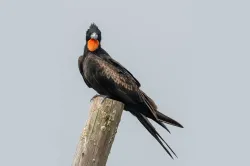
Campo Flicker Basic Information
| Scientific Name |
Colaptes campestris
|
| Status |
LC
Least Concern
|
| Size |
30-35 cm (12-14 inch)
|
| Colors |
|
| Type |
|
| Family |
Woodpeckers |
Introduction
The Campo Flicker, scientifically known as Colaptes campestris, is one of the most distinctive and fascinating members of the woodpecker family found in South America. Unlike many of its relatives that spend their entire lives high in the canopy of dense forests, this species has adapted to life in open environments, earning its common name from the Portuguese word 'campo,' meaning field or grassland. These birds are remarkable examples of evolutionary adaptation, having shifted from the traditional arboreal lifestyle typical of woodpeckers to a more terrestrial existence. As a medium-sized bird, the Campo Flicker plays a vital role in its ecosystem by controlling insect populations and, through its nesting habits, providing homes for other species. Its striking appearance, characterized by a contrasting blend of brown and yellow, makes it a highly sought-after subject for birdwatchers and ornithologists alike. Understanding the life cycle and habits of this bird offers deep insights into how avian species adapt to the challenges of the South American savanna and scrublands.
Physical Appearance
The Campo Flicker is a robust bird, measuring between 30 and 35 centimeters in length. Its physical appearance is striking and easy to recognize, even from a distance. The primary coloration of the bird is a warm, earthy brown, which provides excellent camouflage against the soil and dry vegetation of its savanna habitat. This brown plumage is often mottled or barred, helping the bird blend into its surroundings. A standout feature is its vibrant yellow secondary coloring, which is most visible on the wings and underparts, creating a beautiful contrast during flight. The bird also possesses a distinct black throat and a yellow crown, which often varies slightly between subspecies. The bill is strong, sharp, and slightly curved, perfectly adapted for excavating the ground or pecking into soft wood. Its tail feathers are stiff, which is a common trait among woodpeckers, providing necessary support when it briefly clings to tree trunks or fence posts. The overall structure of the Campo Flicker is built for both agility on the ground and brief, powerful bouts of flight, making it a perfectly balanced avian specimen in its natural environment.
Habitat
The Campo Flicker is primarily found in the open landscapes of South America, including Brazil, Bolivia, Paraguay, Uruguay, and Argentina. Unlike typical woodpeckers that prefer dense woodlands, this species thrives in savannas, grasslands, cerrado, and even agricultural areas with scattered trees. They are highly adaptable and have been observed in parks and suburban gardens, provided there is enough open ground for foraging. Their preference for open habitats is tied to their terrestrial diet, which requires access to the soil. Because they are not strictly dependent on large, mature forests, they are relatively resilient to moderate habitat fragmentation, though they still rely on small stands of trees or termite mounds for nesting and shelter.
Diet
The diet of the Campo Flicker is largely terrestrial, setting it apart from many other woodpecker species. They are predominantly insectivorous, with ants and termites forming the bulk of their intake. To forage, they often walk along the ground, using their strong bills to probe the soil, overturn debris, or break into active termite mounds. This behavior is highly efficient in the savanna ecosystems they inhabit. In addition to insects, they are known to supplement their diet with fruits, berries, and seeds, especially when insect availability fluctuates seasonally. Their ability to switch between protein-rich insect prey and plant-based foods makes them highly successful foragers in diverse, changing environments.
Breeding and Nesting
Breeding for the Campo Flicker is an intriguing process that showcases their social nature. Unlike many woodpeckers that carve holes deep into hard timber, these birds frequently utilize existing structures. They are well-known for nesting in active or abandoned termite mounds, which provide a stable, temperature-controlled environment for their offspring. They may also occupy natural cavities in trees or even holes in fence posts. Both the male and female participate in the excavation and maintenance of the nest site. A typical clutch consists of three to five white eggs. Both parents take turns incubating the eggs and feeding the chicks once they hatch. This cooperative effort ensures a higher survival rate for the young in the often-harsh conditions of the open savanna, demonstrating their strong pair bonds and parental dedication.
Behavior
The Campo Flicker is a gregarious bird that is often seen in pairs or small family groups. They are diurnal and spend a significant portion of their day actively foraging on the ground. When threatened, they are quick to fly to a nearby tree or fence post, where they cling vertically for a few moments to survey the area before either returning to the ground or seeking cover. Their flight pattern is undulating, typical of the woodpecker family. They are vocal birds, often communicating with a series of loud, rhythmic calls that can be heard across the open plains, especially during the breeding season when they establish and defend their territories.
Conservation Status
-
LC
Least Concern
The Campo Flicker is currently listed as 'Least Concern' by the IUCN. This status is largely due to their wide geographic distribution and their ability to adapt to human-modified landscapes, such as cattle pastures and agricultural lands. While they are not currently facing immediate threats of extinction, they are still impacted by large-scale habitat loss and the degradation of the cerrado biome. Continued monitoring of their populations is essential, as their reliance on termite mounds and specific open-country habitats makes them sensitive to changes in land management practices that might reduce these critical resources.
Interesting Facts
- The Campo Flicker is one of the few woodpecker species that spends the majority of its time foraging on the ground rather than on trees.
- They are famous for nesting inside termite mounds, which keeps their eggs protected and insulated.
- Their scientific name, Colaptes campestris, translates to 'pecker of the fields.'
- These birds are known to be quite social and are often spotted in groups.
- They possess a stiff tail that acts as a tripod when they are clinging to vertical surfaces.
- Despite being woodpeckers, they are rarely seen drumming on hard wood like their forest-dwelling cousins.
Tips for Birdwatchers
If you are planning to spot the Campo Flicker, focus your efforts on open areas like savannas, grasslands, or even rural roadsides where trees are sparse. Early morning is the best time for observation, as the birds are most active while foraging for ants and termites. Look for them on the ground rather than in the canopy. If you see a medium-sized bird with a yellowish wing patch flying in an undulating pattern, follow it to its landing spot. They are not particularly shy, so with a bit of patience and a good pair of binoculars, you should be able to get a clear view of their distinct markings.
Conclusion
In conclusion, the Campo Flicker (Colaptes campestris) stands as a testament to the versatility of nature. By carving out a niche in the open savannas of South America, this woodpecker has evolved unique behaviors and dietary habits that distinguish it from its forest-bound relatives. From their clever use of termite mounds as nesting sites to their specialized ground-foraging techniques, these birds are perfectly adapted to the environments they call home. As observers of the natural world, we can learn a great deal from the Campo Flicker about resilience and adaptation in the face of changing landscapes. Whether you are a professional ornithologist or a casual birdwatcher, encountering this species in the wild is a rewarding experience that highlights the incredible diversity of avian life. As we move forward, it is important to continue protecting the habitats that these birds rely on, ensuring that future generations can enjoy the sight of these yellow-winged wonders navigating the vast, open fields of South America. Protecting the Campo Flicker is effectively protecting the health and integrity of the grasslands and savannas they inhabit, making them an important indicator species for the ecological well-being of their range.
Campo Flicker Distribution Map & Range
The distribution map for this species will be available soon.
We are working with our official data partners to update this information.