

Not available

Caspian Plover
Charadrius asiaticus
Last update: 13 Jul 2026
Read in:
English
Español
Português
हिन्दी
বাংলা
தமிழ்
മലയാളം
मराठी
ગુજરાતી
తెలుగు
French
Deutsch
Русский
日本語
简体中文
Italiano
Tiếng Việt
العربية
ಕನ್ನಡ
ਪੰਜਾਬੀ
Caspian Plover Basic Information
| Scientific Name | Charadrius asiaticus |
|---|---|
| Status | LC Least Concern |
| Size | 19-21 cm (7-8 inch) |
| Colors |
Brown
White
|
| Type |
Waders

|
| Family | Plovers |
Introduction
The Caspian Plover (Charadrius asiaticus) is a fascinating migratory wader belonging to the family Charadriidae. Known for its extensive travels across continents, this bird breeds in the arid steppes of Central Asia and migrates south to spend the winter in eastern and southern Africa. As a member of the plover family, it shares many characteristics with other shorebirds, yet it is distinct in its preference for dry, inland environments rather than coastal wetlands. Ornithologists and bird enthusiasts alike find the Caspian Plover particularly intriguing due to its resilience and complex migratory patterns. Despite its name, it is not restricted to the Caspian Sea region, but rather uses it as part of its broad range across the Ponto-Caspian steppe. Understanding this species is vital for conservationists, as its populations are sensitive to habitat degradation in both its breeding grounds and its wintering sites, making it a key species for monitoring the health of grassland and arid ecosystems.
Physical Appearance
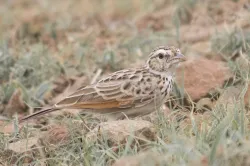
The Caspian Plover is a small, elegant wader, typically measuring between 19 and 21 cm in length. Its plumage is characterized by a sophisticated palette of earth tones, designed for camouflage in its arid habitat. The primary color is a soft, warm brown that covers the upperparts, including the back and wings, providing excellent concealment against dry soil and vegetation. The secondary color is a crisp white, which contrasts beautifully on the underparts, including the belly, throat, and a distinct supercilium above the eye. During the breeding season, males develop a notable chestnut-brown band across the chest, bordered by a thin black line, which serves as a visual signal during courtship. The bill is relatively short, dark, and robust, adapted for feeding on the ground. Its legs are long and yellowish-gray, facilitating efficient movement across open terrain. Juveniles and non-breeding adults appear more muted, lacking the bold chest band, making identification more challenging for the casual observer.
Habitat
Unlike many other waders that gravitate toward wet coastal regions, the Caspian Plover is primarily an inhabitant of dry, open landscapes. Its preferred breeding habitat includes arid, semi-desert regions, salt flats, and short-grass steppes throughout Central Asia. These environments provide the necessary visibility for detecting predators and the specific substrate required for their nesting habits. During the winter months in Africa, they maintain this preference for open spaces, often congregating in dry, overgrazed grasslands, savanna areas, and occasionally the edges of alkaline lakes. They avoid dense vegetation and tall grasses, as they rely on their camouflage and keen eyesight to navigate these harsh, exposed environments. Maintaining these open, arid habitats is crucial for the survival of the species.
Diet
The diet of the Caspian Plover consists primarily of small invertebrates, which they forage for by walking across the ground with a distinctive 'run-and-stop' motion. Their menu includes a variety of insects, such as beetles, ants, grasshoppers, and various larvae found on the surface of the soil. Occasionally, they will also consume small spiders or other terrestrial arthropods. They rarely probe deep into the mud like other waders; instead, they rely on visual detection to spot prey items on the surface. Once prey is identified, they quickly snap it up with their short, efficient bills. This opportunistic feeding behavior allows them to thrive in diverse, albeit dry, environments across their vast migratory range, provided there is a sufficient population of insects.
Breeding and Nesting
Breeding for the Caspian Plover typically occurs from April through July in the arid steppes of Central Asia. They are ground-nesters, choosing sites that are sparsely vegetated to ensure they can spot approaching threats from a distance. The nest is essentially a shallow depression or scrape in the ground, sometimes lined with small bits of dry grass or pebbles to keep the eggs slightly elevated from the soil. A typical clutch consists of three eggs, which are expertly camouflaged to match the surrounding desert terrain. Both parents share the responsibility of incubation, which lasts approximately three to four weeks. Once the precocial chicks hatch, they are able to leave the nest almost immediately, following their parents to forage, though they remain under close protection until they are fully fledged and capable of flight.
Behavior
The Caspian Plover exhibits a behavior typical of many plovers: a restless, alert demeanor. When foraging, they move with a swift, jerky pace, frequently pausing to scan their surroundings for both food and potential predators. They are generally solitary or found in small, loose groups, though they may gather in larger numbers at suitable feeding sites during migration. They are highly migratory birds, undertaking impressive journeys between their breeding grounds in Asia and their wintering grounds in Africa. When threatened, they are more likely to run or fly a short distance to relocate rather than hide, relying on their speed and agility to escape danger. Their flight is strong and purposeful, allowing them to traverse vast geographical distances.
Conservation Status - LC Least Concern
The Caspian Plover is currently listed as a species of 'Least Concern' by the IUCN, but this does not mean it is without threats. Its population faces risks primarily from habitat loss, particularly in the steppes of Central Asia where agriculture, overgrazing, and desertification are changing the landscape. Furthermore, their reliance on specific, open habitats during their long migration makes them vulnerable to environmental changes at various stopover points. Continued monitoring of population trends is essential to ensure that their habitat requirements are met across their entire migratory route, protecting this resilient bird from future decline.
Interesting Facts
- They are one of the few waders that prefer dry, semi-desert environments over wetlands.
- They possess a unique 'run-and-stop' foraging technique to catch surface insects.
- The male develops a distinctive chestnut chest band during the breeding season.
- They migrate thousands of kilometers from Central Asia to sub-Saharan Africa.
- They are highly social during migration but defend nesting territories during the breeding season.
- Their eggs are perfectly camouflaged to blend into the arid soil where they nest.
- They are known to follow grazing herds in Africa to feed on insects stirred up by the animals.
Tips for Birdwatchers
To successfully spot a Caspian Plover, you must adjust your expectations regarding wader habitats. Forget the mudflats and coastal beaches; instead, focus your efforts on dry, open plains, overgrazed grasslands, and sparsely vegetated arid regions. Use high-quality binoculars or a spotting scope, as these birds are small and their plumage is masterfully designed to blend into the background. Early morning or late afternoon are the best times to observe them when they are most active feeding. Watch for their characteristic stop-start movement across the ground. If you are in Africa during the winter months, look for them near inland alkaline pools or on dry, flat savanna areas where the vegetation is short enough to offer them a clear view of their surroundings.
Pro-Tip: To spot this bird in dense forest canopy, a 8x42 binoculars or telescope is highly recommended.
- [Check out our top recommended gear here]
Conclusion
The Caspian Plover (Charadrius asiaticus) stands as a remarkable testament to avian adaptation. By carving out a niche in some of the most arid and challenging environments, this species demonstrates a unique evolutionary strategy that sets it apart from its wetland-dwelling relatives. From the vast, open steppes of Central Asia to the sun-drenched grasslands of Africa, the Caspian Plover navigates a complex world with grace and tenacity. For birdwatchers, encountering this plover is a rewarding challenge that requires patience, keen observation, and a shift in perspective regarding traditional shorebird habitats. As we continue to study and appreciate the Caspian Plover, it serves as a vital reminder of the interconnectedness of our global ecosystems. Protecting the vast, open spaces they rely on is not just about saving a single species; it is about preserving the ecological integrity of the diverse landscapes they call home. Whether you are an experienced ornithologist or a casual nature enthusiast, the Caspian Plover offers a compelling story of migration, survival, and natural beauty that enriches our understanding of the avian world.
Tag:

200 Follower
is a writer who draws. He’s the Bestselling author of “Number of The Year”. Donec vitae tortor efficitur, convallis lelobortis elit.
Recent Posts





Subscribe For Daily Newsletter

