Warning: Undefined variable $by_location in /home/odescxjtd641/public_html/beefound.in/bird-details.php on line 874
Common Redstart
Phoenicurus phoenicurus
Last update: 14 Jul 2026
Read in:
English
Español
Português
हिन्दी
বাংলা
தமிழ்
മലയാളം
मराठी
ગુજરાતી
తెలుగు
French
Deutsch
Русский
日本語
简体中文
Italiano
Tiếng Việt
العربية
ಕನ್ನಡ
ਪੰਜਾਬੀ
Common Redstart Basic Information
| Scientific Name | Phoenicurus phoenicurus |
|---|---|
| Status | LC Least Concern |
| Size | 13-15 cm (5-6 inch) |
| Colors |
Orange
Grey
|
| Type |
Perching Birds

|
| Family | Old World Flycatchers and Chats |
Introduction
The Common Redstart (Phoenicurus phoenicurus) is a small, charismatic passerine bird that belongs to the Muscicapidae family. Known for its striking appearance and energetic nature, this perching bird is a summer visitor to many parts of Europe and western Asia, before migrating to sub-Saharan Africa for the winter months. Often described as one of the most beautiful birds in the European countryside, the Redstart is highly prized by birdwatchers for its vibrant coloration and nervous, flicking tail movements. As an insectivore, it plays a vital role in local ecosystems by controlling insect populations. Despite its widespread distribution, the species faces various environmental challenges, including habitat fragmentation and climate change. Understanding the life cycle, habitat requirements, and behavioral patterns of the Common Redstart is essential for conservation efforts and for those looking to appreciate the delicate balance of avian life in our forests and gardens.
Physical Appearance
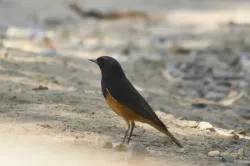
The Common Redstart is a small bird, typically measuring between 13 and 15 centimeters in length. The species exhibits pronounced sexual dimorphism, meaning males and females look significantly different. The male is particularly eye-catching, boasting a slate-grey crown and back, a black face and throat, and a brilliant, fiery orange-red breast that fades to a lighter shade on the belly. Its most distinctive feature is the rusty-red tail, which it constantly flicks—a behavior that gives the bird its name, as 'start' is an old English word for tail. Females, by contrast, possess a more muted, brownish-grey plumage, which provides excellent camouflage while nesting. Both sexes share the characteristic orange tail, which is a key diagnostic feature when observing the bird in flight or perched on a branch. Their slender beaks and delicate legs are perfectly adapted for a life spent perching in trees and snatching insects mid-air or from the ground.
Habitat
The Common Redstart shows a strong preference for open, mature woodland areas, particularly those with a mix of deciduous trees like oak and birch. They are often found in parklands, orchards, and traditional gardens where old trees provide essential nesting cavities. Unlike some other woodland birds, Redstarts avoid dense, dark forests, preferring areas with plenty of light and accessible foraging grounds. They rely heavily on the presence of natural holes in trees or crevices in stone walls for breeding. Because they are migratory, their habitat requirements shift between their breeding grounds in the north and their wintering grounds in the African savanna, where they occupy scrubby, semi-arid landscapes.
Diet
As an insectivorous species, the Common Redstart has a diet primarily composed of small invertebrates. During the breeding season, they are highly active hunters, often performing short, agile flights to catch flying insects such as gnats, flies, and moths. They also forage on the ground, scanning the soil for spiders, beetles, ants, and larvae. This behavior is often described as 'fly-catching' or 'ground-gleaning.' In late summer and autumn, as insects become less abundant, the diet of the Common Redstart may shift slightly to include various berries and small fruits, which provide the necessary energy reserves required for their long-distance migration to warmer climates.
Breeding and Nesting
Breeding typically begins in late spring, with the male arriving at the nesting site first to establish a territory. The Common Redstart is a cavity-nester, meaning it seeks out holes in old trees, rock crevices, or even man-made nest boxes. The female takes the lead in constructing the nest, building a cup-shaped structure out of moss, dry grass, and hair. Once the nest is complete, she lays a clutch of five to seven pale blue eggs. Incubation lasts approximately two weeks, and both parents participate in feeding the chicks once they hatch. The young typically fledge within two weeks, though they remain dependent on the parents for food for a short period thereafter.
Behavior
The Common Redstart is a highly energetic and restless bird. Its most famous behavior is the rapid shivering or flicking of its tail, a movement that signals alertness or agitation. They are generally solitary birds, except during the breeding season. Males are territorial and will aggressively defend their chosen nesting area from rivals by singing from prominent perches. Their song is a short, melodic, and slightly melancholy warble. Despite their nervous disposition, they can be quite bold when protecting their nests, often displaying alarm calls to warn off potential predators or intruders that venture too close to their nesting cavity.
Conservation Status - LC Least Concern
The Common Redstart is currently classified as 'Least Concern' on the IUCN Red List. However, populations in some regions have seen declines due to the loss of old-growth forests and traditional orchards, which provide essential nesting sites. Climate change also poses a risk, as it can disrupt the timing of insect emergence, which is critical for feeding their young. Conservationists emphasize the importance of maintaining mature trees and installing nest boxes to support local populations, ensuring these vibrant birds continue to thrive in their natural ranges.
Interesting Facts
- The name 'Redstart' comes from the Old English word 'steort,' meaning tail, referring to its bright orange-red tail.
- They are long-distance migrants, traveling thousands of miles from Europe to sub-Saharan Africa.
- Males are known for their beautiful, complex songs often delivered at dawn.
- They are 'hole-nesters' and will readily use man-made nest boxes if provided.
- Their diet is almost exclusively insect-based during the breeding season.
- They are often seen flicking their tails repeatedly while perched.
- Females have duller colors to stay hidden from predators while sitting on the nest.
Tips for Birdwatchers
To spot a Common Redstart, birdwatchers should focus on open woodland edges or mature orchards during the early morning hours when the birds are most active. Because they are shy, using binoculars and staying quiet is essential. Look for the distinct flash of their orange-red tail as they fly between trees. If you have a garden, installing a nest box with a small hole may attract a breeding pair. Patience is key, as they move quickly and often disappear into the canopy. Checking local birding reports for arrival dates in spring can also significantly increase your chances of witnessing their seasonal migration.
Pro-Tip: To spot this bird in dense forest canopy, a 8x42 binoculars or telescope is highly recommended.
- [Check out our top recommended gear here]
Conclusion
The Common Redstart is a testament to the beauty and complexity of the natural world. With its striking orange plumage and lively personality, it remains a favorite among bird enthusiasts and researchers alike. From its intricate nesting habits in ancient trees to its epic migratory journeys across continents, the Redstart occupies a unique niche in our environment. However, the future of this species depends on our collective ability to preserve the habitats they rely on. By protecting mature woodlands and encouraging biodiversity in our local areas, we can ensure that future generations will have the opportunity to hear the Redstart's song and catch a glimpse of its fiery tail. Whether you are a seasoned ornithologist or a casual backyard observer, the Common Redstart offers a window into the wonders of avian life. We encourage everyone to take an interest in bird conservation, as protecting even the smallest species contributes to the health of our global ecosystem. Let us cherish and protect these remarkable birds for years to come.

200 Follower
is a writer who draws. He’s the Bestselling author of “Number of The Year”. Donec vitae tortor efficitur, convallis lelobortis elit.
Recent Posts





Subscribe For Daily Newsletter