
Not available
Hooded Wheatear
Oenanthe monacha
Last update: 14 Jul 2026
Read in:
English
Español
Português
हिन्दी
বাংলা
தமிழ்
മലയാളം
मराठी
ગુજરાતી
తెలుగు
French
Deutsch
Русский
日本語
简体中文
Italiano
Tiếng Việt
العربية
ಕನ್ನಡ
ਪੰਜਾਬੀ
Hooded Wheatear Basic Information
| Scientific Name | Oenanthe monacha |
|---|---|
| Status | LC Least Concern |
| Size | 17-19 cm (7-7 inch) |
| Colors |
Black
White
|
| Type |
Perching Birds

|
| Family | Old World Flycatchers and Chats |
Introduction
The Hooded Wheatear (Oenanthe monacha) is a fascinating and highly specialized avian species that thrives in the harshest desert environments. As a member of the Muscicapidae family, this perching bird is renowned for its remarkable adaptability to arid landscapes, particularly across the Middle East and parts of North Africa. Ornithologists often study this species for its distinct physiological traits that allow it to survive in regions with extreme temperature fluctuations and scarce resources. Unlike many other wheatears that are migratory or inhabit grasslands, the Hooded Wheatear is largely sedentary, maintaining its territory in rocky, barren wadis and desert canyons. Its name, derived from the unique plumage pattern that resembles a hood, distinguishes it from its relatives. For bird enthusiasts and researchers alike, observing this bird in its natural, rugged home offers a profound look into the evolutionary resilience of desert-dwelling passerines. Understanding the ecological role and life cycle of the Hooded Wheatear is essential for conservationists aiming to protect the fragile desert ecosystems these birds call home.
Physical Appearance
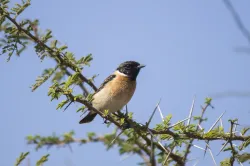
The Hooded Wheatear is a medium-sized perching bird, typically measuring between 17 and 19 centimeters in length. Its physical appearance is striking and unmistakable, characterized by a bold, contrasting plumage. The male is particularly notable for its unique coloration: the head, neck, and throat are adorned in a clean, creamy white, which contrasts sharply with the deep, solid black of its wings and underparts. This creates a 'hooded' effect, hence its common name. The tail pattern is equally distinctive, featuring a white rump and a central black T-shape, which is a common diagnostic feature among the wheatear genus. The female is generally duller, often exhibiting sandy-brown or grayish tones to provide better camouflage against the desert rocks, though she still retains the characteristic tail pattern of the species. Both sexes possess a slender, dark bill perfectly suited for picking insects off the ground or from rock crevices. Their legs are strong and dark, adapted for hopping across uneven, rocky terrain. Overall, the elegant yet rugged appearance of the Hooded Wheatear is a testament to its evolution within arid, sun-drenched landscapes.
Habitat
The Hooded Wheatear is a true specialist of arid, barren landscapes. It is primarily found in desert regions characterized by rocky wadis, steep-sided canyons, and gravelly plains with minimal vegetation. Unlike some birds that require lush environments, this species thrives in extreme conditions where rocks and boulders provide both shelter and high vantage points for spotting prey. Its range spans across the Middle East, including countries such as Egypt, Israel, Jordan, and Saudi Arabia, extending into parts of Pakistan and India. The presence of rocky outcrops is essential for its survival, as these structures provide necessary nesting sites and protection from predators in an otherwise exposed environment. Because it is highly territorial, the Hooded Wheatear maintains specific rocky zones, often near ephemeral water sources, which are crucial for its survival during the hottest months of the year.
Diet
As an insectivorous perching bird, the Hooded Wheatear relies heavily on a diet consisting primarily of small invertebrates found within its harsh habitat. Its feeding behavior involves scanning the ground from a prominent rock or ledge, then swooping down to capture prey with precision. Its diet includes a variety of beetles, ants, spiders, and grasshoppers that are hardy enough to survive in desert climates. During periods when insect populations fluctuate due to rainfall patterns, the Hooded Wheatear demonstrates incredible foraging efficiency. It is known to probe into deep rock crevices and under stones, using its sharp, slender bill to extract hidden prey. Occasionally, it may also consume small seeds or berries if animal protein is scarce, but it remains fundamentally an insect-eating bird. This dietary habit plays a vital role in local ecosystem control, as it helps regulate insect populations within its specific desert territory.
Breeding and Nesting
Breeding for the Hooded Wheatear is a meticulous process dictated by the availability of suitable nesting sites in the desert. These birds are solitary nesters, preferring to build their homes in deep crevices, holes in rock faces, or sometimes within abandoned burrows. The construction of the nest involves a combination of twigs, dry grass, and sometimes soft fibers or feathers for lining, ensuring the nest is insulated against the shifting temperatures of the desert. The female typically lays a clutch of three to five eggs, which are often pale blue or greenish with light speckling. Incubation is primarily performed by the female, while the male remains vigilant, guarding the territory and providing food. The nesting period is timed to coincide with the most favorable climatic conditions, often following seasonal rains when insect life is most abundant. Both parents are dedicated to rearing the chicks, working tirelessly to provide enough food to ensure the survival of their offspring in the unforgiving arid environment.
Behavior
The Hooded Wheatear is a highly territorial and active bird. Observers often notice its characteristic upright posture while perched on rocks, frequently flicking its wings or bobbing its tail. This behavior is not just for display; it serves as a method of communication and territorial signaling to other members of its species. When threatened, it is known for its agility, capable of quick, darting flights between boulders to evade predators. Despite the harshness of its environment, the Hooded Wheatear is surprisingly bold and may tolerate the presence of humans if they remain stationary. During the breeding season, males perform impressive aerial displays, singing melodic, warbling songs to attract mates and define their boundaries. They are largely sedentary birds, rarely venturing far from their established home ranges, which allows them to become intimately familiar with the food sources and protective cover within their specific territory.
Conservation Status - LC Least Concern
Currently, the Hooded Wheatear is classified as a species of Least Concern by the IUCN, primarily due to its vast range and stable population trends in remote desert areas. However, this does not mean it is immune to environmental pressures. Habitat degradation, climate change, and human encroachment into desert wadis represent potential long-term threats to the species. As their specialized habitat becomes increasingly fragmented, maintaining the integrity of protected desert wilderness areas is essential. Continued monitoring of population density and nesting success is recommended to ensure that this unique bird continues to thrive in its natural, arid home.
Interesting Facts
- The Hooded Wheatear is known for its remarkable ability to mimic the sounds of other desert birds.
- Its scientific name, Oenanthe monacha, translates to 'solitary wine-flower,' reflecting its isolated nature.
- The bird's white plumage acts as a form of signaling in the bright, high-contrast light of the desert.
- It is one of the few bird species that can survive in temperatures exceeding 45 degrees Celsius.
- The male performs a 'flight song' display that is both visual and auditory to impress females.
- They do not migrate, making them a permanent fixture of their rocky desert territories throughout the year.
Tips for Birdwatchers
For birdwatchers hoping to catch a glimpse of the Hooded Wheatear, patience is your greatest asset. Because they inhabit remote, rocky wadis, you should focus your search in arid regions of the Middle East or North Africa during the cooler morning or late afternoon hours. Bring high-quality binoculars or a spotting scope, as these birds are often perched on high, distant rocks. Look for the distinct black and white pattern against the monochromatic desert backdrop. It is advisable to wear neutral-colored clothing and remain as still as possible, as these birds are highly alert to movement. If you find a suitable rocky outcrop, wait quietly; the Hooded Wheatear’s curious nature may lead it to investigate your presence. Always respect the environment and avoid approaching nesting sites, as disturbing these birds during breeding can have negative consequences for their survival.
Pro-Tip: To spot this bird in dense forest canopy, a 8x42 binoculars or telescope is highly recommended.
- [Check out our top recommended gear here]
Conclusion
In conclusion, the Hooded Wheatear (Oenanthe monacha) stands as a testament to nature's ability to adapt to the most extreme conditions on Earth. From its striking black-and-white plumage to its specialized feeding and nesting behaviors, every aspect of this bird is perfectly tuned to the life of a desert inhabitant. As we have explored, its role within the arid ecosystems of the Middle East is both significant and fascinating. By understanding the unique requirements of this perching bird—its need for rocky crevices, its reliance on desert insects, and its territorial nature—we gain a deeper appreciation for the complex biodiversity found in what might otherwise appear to be a barren landscape. For the dedicated birdwatcher, encountering a Hooded Wheatear is a rewarding experience that highlights the beauty and resilience of desert wildlife. Ensuring the preservation of their natural habitats is crucial for the continued success of this species. As we look to the future, continued research and conservation efforts will be vital in protecting the Hooded Wheatear and ensuring that these iconic birds continue to grace the rocky canyons of our world for generations to come. Whether you are an ornithologist, a conservationist, or simply an admirer of nature, the Hooded Wheatear remains an essential species to study and protect.

200 Follower
is a writer who draws. He’s the Bestselling author of “Number of The Year”. Donec vitae tortor efficitur, convallis lelobortis elit.
Recent Posts






Subscribe For Daily Newsletter