Not available
Forster's Tern
Sterna forsteri
Last update: 13 May 2026
Read in:
English
Español
Português
हिन्दी
বাংলা
தமிழ்
മലയാളം
मराठी
ગુજરાતી
తెలుగు
French
Deutsch
Русский
日本語
简体中文
Italiano
Tiếng Việt
العربية
ಕನ್ನಡ
ਪੰਜਾਬੀ
Forster's Tern Basic Information
| Scientific Name | Sterna forsteri |
|---|---|
| Status | LC Least Concern |
| Size | 33-36 cm (13-14 inch) |
| Colors |
White
Gray
|
| Type |
Seabirds

|
| Family | Gulls, Terns, Skimmers |
Introduction
The Forster's Tern (Sterna forsteri) is a captivating and elegant seabird that belongs to the Laridae family. Named in honor of the German naturalist Johann Reinhold Forster, this species is primarily found throughout North America, where it graces both freshwater marshes and coastal environments. Unlike many other tern species that are strictly marine, the Forster's Tern exhibits a unique preference for inland wetlands during the breeding season, making it a fascinating subject for ornithologists and casual birdwatchers alike. These birds are known for their graceful flight patterns, agile hunting maneuvers, and distinctive vocalizations that echo across the marshes. Understanding the life cycle and ecological requirements of the Forster's Tern provides essential insights into the health of wetland ecosystems, which are currently facing various environmental pressures. As a medium-sized seabird, it plays a vital role in the food web, acting as both a predator of small aquatic organisms and a component of the broader avian community. Whether you are a seasoned birder or a nature enthusiast, learning about this remarkable species offers a deeper appreciation for the biodiversity found in our North American waterways.
Physical Appearance
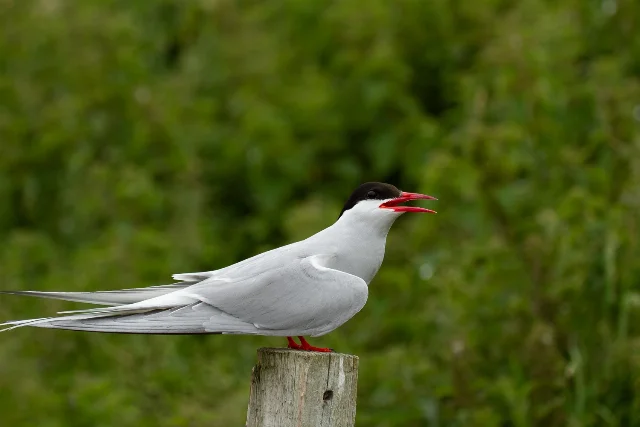
Measuring between 33 and 36 centimeters in length, the Forster's Tern is a medium-sized bird that exhibits a sleek, aerodynamic build perfectly suited for its active lifestyle. The primary plumage color of the adult is a striking white, which contrasts beautifully with the soft gray mantle and wings. During the breeding season, these birds are easily identifiable by a bold, black cap that extends from the forehead down to the nape, creating a sharp contrast against their snowy white underparts. Their bills are notably orange-red with a distinctive black tip, and their legs are a vibrant orange-red hue. In the winter, the plumage undergoes a transition, as the black cap fades into a mask-like patch around the eyes, though the overall white and gray coloration remains consistent. The wings are long and pointed, supporting a deeply forked tail that aids in their incredible aerial agility. Juvenile birds often display a more mottled appearance, gradually molting into the classic adult coloration over several months. Their lightweight structure and efficient wing-loading allow them to hover, dive, and perform complex maneuvers while searching for prey above the water's surface.
Habitat
Forster's Terns are highly adaptable birds that utilize a variety of aquatic habitats throughout their lifecycle. During the breeding season, they are most commonly found in freshwater marshes, prairie sloughs, and shallow lakes where dense vegetation such as cattails or bulrushes provides cover for nesting. Unlike many other terns, they show a strong affinity for inland wetlands, though they are also frequently sighted in salt marshes and coastal bays. As migratory birds, their habitat range shifts seasonally; in the winter, they are often found along the Atlantic and Pacific coasts, as well as the Gulf of Mexico, where they forage in estuaries, tidal flats, and sheltered lagoons. Their reliance on both freshwater and saltwater environments highlights their ecological flexibility, although they remain strictly tied to areas with abundant water and sufficient food resources.
Diet
The Forster's Tern is a specialized piscivore, meaning its diet consists primarily of small fish. They are highly skilled hunters, often employing a "plunge-diving" technique where they hover briefly above the water before folding their wings and dropping headfirst to snatch prey just below the surface. In addition to small minnows and other fish species, their diet includes a variety of aquatic invertebrates, such as insects and crustaceans, especially during the breeding season when protein-rich food is essential for chick development. They are opportunistic feeders, often following schools of fish or taking advantage of insects stirred up by wind or other wildlife. Their ability to switch between fish and insects allows them to thrive in diverse wetland ecosystems, provided the water remains clear enough for them to spot their prey from the air.
Breeding and Nesting
Breeding for the Forster's Tern is a colonial affair, with birds often nesting in loose groups among reeds and other aquatic vegetation. They are known for building floating nests made of dead plant material, such as cattails, which are anchored to living stalks to prevent them from drifting away. The female typically lays a clutch of three to four eggs, which are incubated by both parents for approximately three weeks. Once the chicks hatch, they are semi-precocial, meaning they are able to leave the nest relatively quickly but still rely on their parents for food and protection. Both parents remain deeply invested in the rearing process, bringing fish to the nest to feed their offspring until they fledge. The use of floating nests is a clever adaptation that protects eggs from terrestrial predators, though it leaves them vulnerable to changes in water levels and severe weather events.
Behavior
Forster's Terns are highly social birds, often seen interacting within their colonies through elaborate courtship displays and vocalizations. Their flight behavior is particularly impressive; they are masters of the air, capable of quick direction changes and sustained hovering. When threatened or when defending their nesting territory, they become quite aggressive, diving at intruders—including humans—with sharp, piercing alarm calls. They are also known for their "fish flight" displays, where a male carries a fish in its bill to attract a potential mate. Outside of the nesting season, they tend to be more nomadic, moving between coastal foraging grounds in small groups. Their intelligence and social structure are key to their survival, allowing them to coordinate activities and communicate effectively within their busy, noisy colonies.
Conservation Status - LC Least Concern
Currently, the Forster's Tern is considered a species of least concern by major conservation organizations, thanks to its relatively wide distribution and stable population numbers. However, they are not immune to environmental threats. The primary concern for this species is the loss and degradation of wetland habitats, which are crucial for their nesting and foraging success. Pollution, water level fluctuations, and the introduction of invasive species can significantly impact their local populations. Ongoing monitoring and protection of critical wetland areas are essential to ensure the long-term health and stability of the Forster's Tern population across North America.
Interesting Facts
- Forster's Terns often nest on floating platforms made of vegetation to stay safe from land predators.
- They are capable of hovering over water for several seconds before diving for a meal.
- The species is named after Johann Reinhold Forster, a renowned 18th-century naturalist.
- Unlike many other terns, they prefer freshwater marshes for breeding rather than strictly marine environments.
- During the winter, they lose their distinct black cap, replacing it with a small, dark eye patch.
- They are known to be quite aggressive when protecting their nests, often mobbing potential intruders.
Tips for Birdwatchers
If you are planning to go birdwatching to spot a Forster's Tern, the best time to visit is during the spring or summer breeding season, when they are most active in freshwater marshes. Bring a pair of high-quality binoculars or a spotting scope, as these birds are often found at a distance from the shoreline. Look for their distinctive orange-red bills and the black caps against the greenery of the marsh. Patience is key; watch for their characteristic hover-and-dive behavior, which is a dead giveaway for a hunting tern. Because they are colonial nesters, if you find one, there are likely many more nearby. Always maintain a respectful distance from nesting colonies to avoid disturbing them, and use a camera with a good telephoto lens to capture their graceful flight patterns without causing stress to the birds.
Pro-Tip: To spot this bird in dense forest canopy, a 8x42 binoculars or telescope is highly recommended.
- [Check out our top recommended gear here]
Pro-Tip: To capture the stunning beauty of this bird, a high-quality wildlife camera and lens are highly recommended.
- [Check out best wildlife cameras here]
Conclusion
In conclusion, the Forster's Tern is a remarkable example of avian adaptation and ecological significance. From its striking white and gray plumage to its sophisticated hunting tactics and unique choice of floating nests, this bird offers a wealth of interest for anyone passionate about nature. Its presence in our wetlands serves as a living indicator of the health of these vital ecosystems, reminding us of the interconnectedness of all life within our waterways. As we continue to face challenges related to climate change and habitat loss, species like the Forster's Tern serve as a call to action for the preservation of our natural world. By supporting conservation efforts and engaging in responsible birdwatching, we can help ensure that these elegant birds continue to grace our marshes for generations to come. Whether you are mesmerized by their agile flight or simply appreciate the beauty they bring to the landscape, the Forster's Tern is undoubtedly a species worthy of our admiration, study, and protection. We encourage all nature enthusiasts to explore their local wetlands, keep a watchful eye for these beautiful creatures, and contribute to the collective knowledge of this fascinating seabird.

200 Follower
is a writer who draws. He’s the Bestselling author of “Number of The Year”. Donec vitae tortor efficitur, convallis lelobortis elit.
Recent Posts




Subscribe For Daily Newsletter