Duck-like Birds
avatar
Photo by Admin
Not available

White-winged Coot

Fulica leucoptera

Last update: 18 Mar 2026

White-winged Coot Basic Information

Scientific NameFulica leucoptera
Status LC Least Concern
Size45-60 cm (18-24 inch)
Colors
Black
White
Type
Duck-like Birds
type
FamilyRails, Gallinules, Coots

Introduction

The White-winged Coot (Fulica leucoptera) is a fascinating species of waterbird that belongs to the Rallidae family. Often mistaken for ducks due to their swimming behavior and aquatic lifestyle, these birds are actually distinct members of the rail family. Primarily found across the southern regions of South America, the White-winged Coot is highly adapted to life in freshwater environments. They are known for their striking appearance, characterized by a predominantly black plumage contrasted by vivid white wing patches that become visible during flight. As a widespread species, they play a crucial role in the ecosystems they inhabit, often serving as indicators of wetland health. Birdwatchers and ornithologists alike find these birds particularly interesting due to their unique social structures and vocalizations. Throughout this guide, we will explore the intricate life cycle, behaviors, and ecological significance of this remarkable bird, providing a comprehensive resource for enthusiasts looking to understand more about the Fulica leucoptera in its natural environment.

Physical Appearance

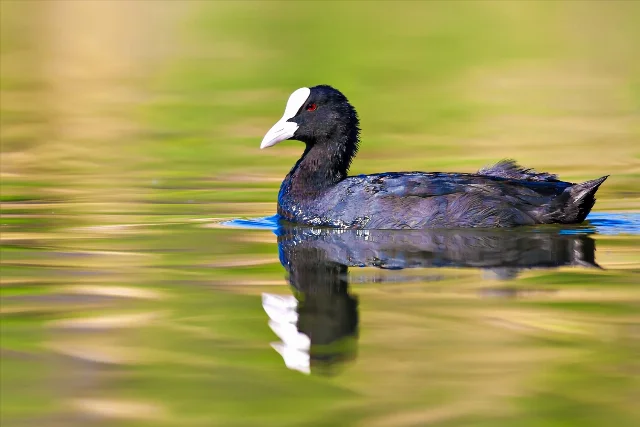
The White-winged Coot is a medium-sized waterbird, typically measuring between 45 and 60 centimeters in length. Its most defining characteristic is its sleek, jet-black plumage, which provides excellent camouflage in the dark, murky waters of marshes and lagoons. The bird features a distinctive frontal shield, which is a fleshy plate extending from the beak up the forehead; in this species, the shield is often yellow or orange, offering a stark contrast against the dark feathers. The most notable feature, however, is the white wing edge or secondary feathers, which are prominently displayed during flight or when the bird stretches its wings. Their legs are robust and yellowish-green, featuring lobed toes rather than webbed feet, an evolutionary adaptation that allows them to swim efficiently while also navigating through dense, aquatic vegetation. Their eyes are typically reddish, adding to their sharp, alert appearance. Both males and females are relatively similar in appearance, though slight variations in size may occur, making them a captivating subject for anatomical study.

Habitat

White-winged Coots are primarily found in South America, with a range that spans from Brazil and Argentina to Chile and parts of the Andean highlands. They are highly specialized for life in freshwater ecosystems, favoring shallow, stagnant, or slow-moving water bodies. You will frequently encounter them in marshes, swamps, lagoons, and lakes that are rich in aquatic vegetation. They rely heavily on these environments for protection, foraging, and nesting. The presence of dense reeds and grasses is essential for their security, as these plants provide cover from predators and serve as the primary material for their floating nests. They are generally resilient birds and can even thrive in man-made water reservoirs or agricultural ponds, provided there is sufficient food and cover available for them to maintain their daily activities.

Diet

The diet of the White-winged Coot is primarily herbivorous, consisting largely of aquatic plants, algae, and submerged vegetation. Using their specialized beaks, they forage by diving or dabbling in shallow waters to pluck greenery from the lake bed or surface. Occasionally, they will also consume small aquatic invertebrates, insects, and mollusks, which provide essential proteins during the breeding season. Their feeding behavior is methodical; they often swim slowly, scanning the water for edible material. Because they inhabit nutrient-rich wetlands, food is usually abundant. Their ability to consume a wide variety of plant matter allows them to maintain stable populations even in fluctuating environmental conditions, making them highly successful foragers within their niche.

Breeding and Nesting

Breeding for the White-winged Coot is a complex and highly territorial affair. During the nesting season, these birds become increasingly aggressive, defending their chosen patch of reeds or open water from rivals. They construct elaborate floating nests made of woven aquatic vegetation, which are anchored securely to reeds to prevent them from drifting away. A typical clutch consists of several eggs, which are incubated by both parents. Once the chicks hatch, they are precocial, meaning they are relatively mobile and can swim shortly after birth. The parents remain highly attentive, feeding the chicks and protecting them from predators until they are fully fledged. The timing of their breeding cycles is often synchronized with the rainy season or periods of high water levels, which ensure that there is enough food and cover to support the development of their offspring.

Behavior

The White-winged Coot is a social bird that is often seen in large groups, especially outside of the breeding season. They are known for their distinct swimming gait, where they bob their heads rhythmically. While they are capable fliers, they prefer to swim or run across the water's surface when disturbed. They are also quite vocal, producing a variety of calls that range from sharp, metallic clicks to deeper, resonant grunts used for communication within the flock. During territorial disputes, they may engage in dramatic displays, including splashing, chasing, and posturing. Despite their often-aggressive defense of nesting sites, they are generally peaceful toward other waterfowl species that share the same habitat, provided their personal space is respected.

Conservation Status - LC Least Concern

Currently, the White-winged Coot is classified as a species of Least Concern by the IUCN. Their population is considered stable, and they are widely distributed across their natural range in South America. While they face local threats from wetland drainage and habitat degradation, their ability to adapt to human-modified environments, such as irrigation ditches and farm ponds, has helped them maintain healthy numbers. Continued monitoring of wetland health is important, as these birds serve as vital indicators of the ecological integrity of the freshwater systems they rely upon for their survival.

Interesting Facts

  1. The White-winged Coot uses lobed toes instead of webbed feet to swim.
  2. They build floating nests that rise and fall with the water levels.
  3. The bird's frontal shield changes color during the breeding season.
  4. They are known to be quite territorial when nesting in dense reed beds.
  5. Despite their duck-like appearance, they are actually members of the rail family.
  6. They are excellent divers and can stay submerged for several seconds to forage.

Tips for Birdwatchers

For birdwatchers hoping to spot the White-winged Coot, the best approach is to visit wetlands during the early morning or late afternoon when they are most active. Bring a high-quality pair of binoculars or a spotting scope, as these birds can be shy and may retreat into dense vegetation if approached too quickly. Focus your search on the edges of reed beds where the water is calm. Pay attention to the water's surface for the distinct head-bobbing motion. If you are photographing them, remain stationary and wait for them to emerge from the reeds. Patience is key; by observing their social interactions and feeding habits, you will gain a deeper appreciation for their complex behavior and unique ecological role in the South American landscape.

Pro-Tip: To spot this bird in dense forest canopy, a 8x42 binoculars or telescope is highly recommended.
- [Check out our top recommended gear here]

Conclusion

The White-winged Coot (Fulica leucoptera) is more than just a common waterbird; it is a vital component of the South American wetland ecosystem. From its unique physical adaptations, such as its lobed toes and striking white wing patches, to its complex social behaviors and nesting strategies, this bird offers a wealth of knowledge for those interested in ornithology. While they may resemble ducks at first glance, their behavior and taxonomy reveal a much more nuanced life history. As we continue to face environmental challenges, protecting the wetlands that these birds call home is essential. By understanding the needs of the White-winged Coot, we contribute to the broader conservation of the diverse aquatic habitats they inhabit. Whether you are a seasoned birdwatcher or a nature enthusiast, observing the White-winged Coot in the wild is a rewarding experience that highlights the beauty and resilience of nature. We hope this guide has provided you with the insights necessary to appreciate and identify this remarkable species on your next outdoor adventure.

White-winged Coot Distribution Map & Range

The distribution map for this species will be available soon.

We are working with our official data partners to update this information.

Share:

Previous
Next

Explore More Species in the Rails, Gallinules, Coots Family

African Crake
20-23 cm
African Crake
Crex egregia
23-28 cm
African Rail
Rallus caerulescens
22-25 cm
Allen's Gallinule
Porphyrio alleni
34-43 cm
American Coot
Fulica americana
Andaman Crake
25-28 cm
Andaman Crake
Rallina canningi
40-48 cm
Andean Coot
Fulica ardesiaca
Ascension Crake
17-20 cm
Ascension Crake
Mundia elpenor
Ash-throated Crake
13-15 cm
Ash-throated Crake
Porzana albicollis
Auckland Island Rail
17-19 cm
Auckland Island Rail
Lewinia muelleri
25-30 cm
Austral Rail
Rallus antarcticus
Australian Crake
17-20 cm
Australian Crake
Porzana fluminea
25-30 cm
Azure Gallinule
Porphyrio flavirostris
17-19 cm
Baillons Crake
Zapornia pusilla
Band-bellied Crake
17-20 cm
Band-bellied Crake
Zapornia paykullii
Bar-winged Rail
20-25 cm
Bar-winged Rail
Hypotaenidia poeciloptera
Bare-eyed Rail
25-30 cm
Bare-eyed Rail
Gymnocrex plumbeiventris
Barred Rail
25-30 cm
Barred Rail
Hypotaenidia torquata
19-23 cm
Black Crake
Zapornia flavirostra
12-15 cm
Black Rail
Laterallus jamaicensis
black tailed crake
20-23 cm
black tailed crake
Zapornia bicolor
Black-banded Crake
17-19 cm
Black-banded Crake
Porzana fasciata
Black-tailed Native-hen
25-30 cm
Black-tailed Native-hen
Tribonyx ventralis
20-23 cm
Blackish Rail
Pardirallus nigricans
Blue-faced Rail
25-28 cm
Blue-faced Rail
Gymnocrex rosenbergii
20-25 cm
Bogota Rail
Rallus semiplumbeus
Bougainville Rail
20-23 cm
Bougainville Rail
Hypotaenidia tertia
brown crake
20-23 cm
brown crake
Zapornia akool
35-45 cm
Brown Wood-rail
Aramides wolfi
Brown-banded Rail
25-30 cm
Brown-banded Rail
Lewinia mirifica
Buff-banded Rail
30-34 cm
Buff-banded Rail
Hypotaenidia philippensis
14-16 cm
Buff-spotted Flufftail
Sarothrura elegans
Calayan Rail
29-30 cm
Calayan Rail
Aptenorallus calayanensis
Chatham Islands Rail
17-19 cm
Chatham Islands Rail
Cabalus modestus
Chestnut Forest Rail
23-26 cm
Chestnut Forest Rail
Rallicula rubra
Chestnut Rail
30-35 cm
Chestnut Rail
Eulabeornis castaneoventris
Chestnut-headed Crake
20-23 cm
Chestnut-headed Crake
Rufirallus castaneiceps
Chestnut-headed Flufftail
13-15 cm
Chestnut-headed Flufftail
Sarothrura lugens
32-41 cm
Clapper Rail
Rallus crepitans
Colombian Crake
15-18 cm
Colombian Crake
Neocrex colombiana
30-38 cm
Common Gallinule
Gallinula galeata
common moorhen
32-35 cm
common moorhen
Gallinula chloropus
22-25 cm
Corncrake
Crex crex
Dieffenbach's Rail
30-35 cm
Dieffenbach's Rail
Hypotaenidia dieffenbachii
Dot-winged Crake
13-15 cm
Dot-winged Crake
Laterallus spilopterus
Dusky Moorhen
35-40 cm
Dusky Moorhen
Gallinula tenebrosa
20-26 cm
Eastern Water Rail
Rallus indicus
eurasian coot
36-42 cm
eurasian coot
Fulica atra
Forbes's Forest Rail
20-23 cm
Forbes's Forest Rail
Rallicula forbesi
14-16 cm
Galapagos Rail
Laterallus spilonota
48-64 cm
Giant Coot
Fulica gigantea
46-50 cm
Giant Wood-rail
Aramides ypecaha
Gough Island Moorhen
28-33 cm
Gough Island Moorhen
Gallinula comeri
14-16 cm
Grey-breasted Crake
Laterallus exilis
38-46 cm
Grey-cowled Wood-rail
Aramides cajaneus
20-25 cm
Grey-throated Rail
Canirallus oculeus
Guadalcanal Rail
22-25 cm
Guadalcanal Rail
Hypotaenidia woodfordi
Guam Rail
28-30 cm
Guam Rail
Hypotaenidia owstoni
33-40 cm
Hawaiian Coot
Fulica alai
Hawaiian Rail
14-15 cm
Hawaiian Rail
Zapornia sandwichensis
Hawkins's Rail
25-30 cm
Hawkins's Rail
Diaphorapteryx hawkinsi
Henderson Island Crake
18-20 cm
Henderson Island Crake
Zapornia atra
Hodgen's Waterhen
40-45 cm
Hodgen's Waterhen
Tribonyx hodgenorum
45-55 cm
Horned Coot
Fulica cornuta
Inaccessible Island Rail
13-15 cm
Inaccessible Island Rail
Laterallus rogersi
Invisible Rail
22-25 cm
Invisible Rail
Habroptila wallacii
Isabelline Bush-hen
25-30 cm
Isabelline Bush-hen
Amaurornis isabellina
15-18 cm
Junin Rail
Laterallus tuerosi
38-48 cm
King Rail
Rallus elegans
Kosrae Crake
15-18 cm
Kosrae Crake
Zapornia monasa
Laysan Rail
13-15 cm
Laysan Rail
Zapornia palmeri
22-25 cm
Lesser Moorhen
Paragallinula angulata
Lewin's Rail
20-23 cm
Lewin's Rail
Lewinia pectoralis
17-20 cm
Little Crake
Zapornia parva
20-25 cm
Little Wood-rail
Aramides mangle
Lord Howe Woodhen
35-40 cm
Lord Howe Woodhen
Hypotaenidia sylvestris
13-15 cm
Madagascar Flufftail
Sarothrura insularis
23-25 cm
Madagascar Forest Rail
Mentocrex kioloides
23-25 cm
Madagascar Rail
Rallus madagascariensis
Makira Moorhen
25-30 cm
Makira Moorhen
Pareudiastes silvestris
25-35 cm
Mangrove Rail
Rallus longirostris
Marquesan Swamphen
40-50 cm
Marquesan Swamphen
Porphyrio paepae
Mascarene Coot
35-45 cm
Mascarene Coot
Fulica newtonii
Mayr's Forest Rail
20-23 cm
Mayr's Forest Rail
Rallicula mayri
Mexican Rail
25-30 cm
Mexican Rail
Rallus tenuirostris
Miller's Rail
15-17 cm
Miller's Rail
Zapornia nigra
New Britain Rail
20-24 cm
New Britain Rail
Hypotaenidia insignis
New Caledonia Gallinule
45-50 cm
New Caledonia Gallinule
Porphyrio kukwiedei
New Caledonian Rail
25-28 cm
New Caledonian Rail
Gallirallus lafresnayanus
New Guinea Flightless Rail
25-30 cm
New Guinea Flightless Rail
Megacrex inepta
30-35 cm
Nkulengu Rail
Himantornis haematopus
North Island Takahe
50-65 cm
North Island Takahe
Porphyrio mantelli
Ocellated Crake
14-16 cm
Ocellated Crake
Micropygia schomburgkii
Okinawa Rail
30-35 cm
Okinawa Rail
Hypotaenidia okinawae
Paint-billed Crake
20-25 cm
Paint-billed Crake
Neocrex erythrops
Pale-vented Bush-hen
22-28 cm
Pale-vented Bush-hen
Amaurornis moluccana
Philippine Bush-hen
25-30 cm
Philippine Bush-hen
Amaurornis olivacea
20-23 cm
Plain-flanked Rail
Rallus wetmorei
23-25 cm
Plumbeous Rail
Pardirallus sanguinolentus
26-37 cm
Purple Gallinule
Porphyrio martinicus
purple swamphen
45-50 cm
purple swamphen
Porphyrio porphyrio
Red Rail
30-35 cm
Red Rail
Aphanapteryx bonasia
14-16 cm
Red-and-white Crake
Laterallus leucopyrrhus
15-17 cm
Red-chested Flufftail
Sarothrura rufa
35-40 cm
Red-fronted Coot
Fulica rufifrons
35-42 cm
Red-gartered Coot
Fulica armillata
35-45 cm
Red-knobbed Coot
Fulica cristata
Red-legged Crake
25-30 cm
Red-legged Crake
Rallina fasciata
Red-necked Crake
20-25 cm
Red-necked Crake
Rallina tricolor
35-40 cm
Red-winged Wood-rail
Aramides calopterus
Reunion Gallinule
50-60 cm
Reunion Gallinule
Porphyrio caerulescens
Reunion Rail
25-30 cm
Reunion Rail
Dryolimnas augusti
32-40 cm
Ridgway's Rail
Rallus obsoletus
Rodrigues Rail
25-30 cm
Rodrigues Rail
Erythromachus leguati
27-30 cm
Rouget's Rail
Rougetius rougetii
Roviana Rail
20-25 cm
Roviana Rail
Hypotaenidia rovianae
20-23 cm
ruddy breasted crake
Zapornia fusca
16-18 cm
Ruddy Crake
Laterallus ruber
Rufous-faced Crake
13-15 cm
Rufous-faced Crake
Laterallus xenopterus
33-40 cm
Rufous-necked Wood-rail
Aramides axillaris
14-16 cm
Rufous-sided Crake
Laterallus melanophaius
15-17 cm
Russet-crowned Crake
Rufirallus viridis
35-42 cm
Russet-naped Wood-rail
Aramides albiventris
15-17 cm
Rusty-flanked Crake
Laterallus levraudi
Saint Helena Crake
15-18 cm
Saint Helena Crake
Zapornia astrictocarpus
Saint Helena Rail
15-18 cm
Saint Helena Rail
Laterallus podarces
25-28 cm
Sakalava Rail
Zapornia olivieri
Samoan Moorhen
25-28 cm
Samoan Moorhen
Pareudiastes pacificus
Santa Isabel Rail
22-25 cm
Santa Isabel Rail
Hypotaenidia immaculata
25-30 cm
Slaty-breasted Rail
Lewinia striata
30-35 cm
Slaty-breasted Wood-rail
Aramides saracura
21-25 cm
Slaty-legged Crake
Rallina eurizonoides
12-14 cm
Slender-billed Flufftail
Sarothrura watersi
Snoring Rail
25-30 cm
Snoring Rail
Aramidopsis plateni
20-25 cm
Sora
Porzana carolina
South Island Takahe
50-60 cm
South Island Takahe
Porphyrio hochstetteri
Speckled Rail
13-15 cm
Speckled Rail
Coturnicops notatus
32-35 cm
Spot-flanked Gallinule
Porphyriops melanops
Spotless Crake
18-20 cm
Spotless Crake
Zapornia tabuensis
19-24 cm
Spotted Crake
Porzana porzana
20-25 cm
Spotted Rail
Pardirallus maculatus
Streaky-breasted Flufftail
12-14 cm
Streaky-breasted Flufftail
Sarothrura boehmi
Striped Crake
18-20 cm
Striped Crake
Amaurornis marginalis
12-15 cm
Striped Flufftail
Sarothrura affinis
Swinhoe's Rail
17-20 cm
Swinhoe's Rail
Coturnicops exquisitus
Tahiti Rail
15-18 cm
Tahiti Rail
Hypotaenidia pacifica
Talaud Bush-hen
28-33 cm
Talaud Bush-hen
Amaurornis magnirostris
Talaud Rail
25-30 cm
Talaud Rail
Gymnocrex talaudensis
Tasmanian Native-hen
43-48 cm
Tasmanian Native-hen
Tribonyx mortierii
Tristan Moorhen
30-35 cm
Tristan Moorhen
Gallinula nesiotis
20-22 cm
Tsingy Forest Rail
Mentocrex beankaensis
20-25 cm
Uniform Crake
Amaurolimnas concolor
20-27 cm
Virginia Rail
Rallus limicola
Wake Island Rail
20-23 cm
Wake Island Rail
Hypotaenidia wakensis
35-43 cm
Watercock
Gallicrex cinerea
Weka
50-60 cm
Weka
Gallirallus australis
Western Water Rail
23-28 cm
Western Water Rail
Rallus aquaticus
white breasted waterhen
32-32 cm
white breasted waterhen
Amaurornis phoenicurus
White Swamphen
40-50 cm
White Swamphen
Porphyrio albus
White-browed Crake
18-20 cm
White-browed Crake
Amaurornis cinerea
12-14 cm
White-spotted Flufftail
Sarothrura pulchra
White-striped Forest Rail
20-23 cm
White-striped Forest Rail
Rallicula leucospila
17-20 cm
White-throated Crake
Laterallus albigularis
25-30 cm
White-throated Rail
Dryolimnas cuvieri
14-16 cm
White-winged Flufftail
Sarothrura ayresi
15-19 cm
Yellow Rail
Coturnicops noveboracensis
13-15 cm
Yellow-breasted Crake
Laterallus flaviventer
Zapata Rail
28-32 cm
Zapata Rail
Cyanolimnas cerverai