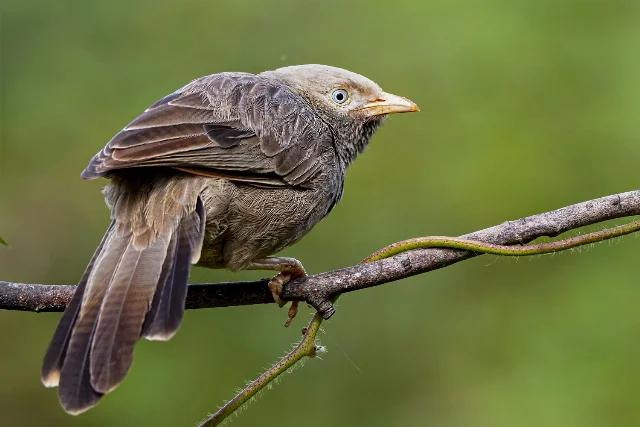

Not available
Red-tailed Minla
Minla ignotincta
Last update: 11 Mar 2026
Read in:
English
Español
Português
हिन्दी
বাংলা
தமிழ்
മലയാളം
मराठी
ગુજરાતી
తెలుగు
French
Deutsch
Русский
日本語
简体中文
Italiano
Tiếng Việt
العربية
ಕನ್ನಡ
ਪੰਜਾਬੀ
Red-tailed Minla Basic Information
| Scientific Name | Minla ignotincta |
|---|---|
| Status | LC Least Concern |
| Size | 13-15 cm (5-6 inch) |
| Colors |
Brown
Red
|
| Type |
Perching Birds

|
| Family | Laughingthrushes and allies |
Introduction
The Red-tailed Minla (Minla ignotincta) is a captivating species of perching bird that belongs to the Leiothrichidae family. Often admired for its striking appearance and active demeanor, this bird is a staple of the montane forests across the Himalayas and parts of Southeast Asia. As a small passerine, the Red-tailed Minla plays an essential role in its ecosystem, acting as both a predator of small insects and a subtle contributor to forest health. Its name perfectly encapsulates its most distinguishing feature: the vivid red coloration found on its tail and wing feathers, which contrasts beautifully with its otherwise earthy, brown plumage. Birdwatchers and ornithologists alike prize sightings of this species, as they are often found in mixed-species foraging flocks, darting through the dense canopy. Understanding the Red-tailed Minla requires a deep appreciation for the complex biodiversity of high-altitude forests, where these birds thrive despite the often challenging environmental conditions. This guide provides an in-depth look at their biology, behavior, and the essential information needed to identify and appreciate this remarkable avian species in its natural environment.
Physical Appearance
Standing at a modest size of 13 to 15 cm, the Red-tailed Minla is a compact and agile bird, perfectly adapted for life in the dense foliage of mountain forests. Its primary coloration is a rich, warm brown, which serves as an excellent form of camouflage against the bark and shadowed leaves of its habitat. The most striking visual element, however, is the bold, fiery red coloration found on the primary wing feathers and the tail. This splash of color acts as a diagnostic mark, making it relatively easy for birders to identify the species once spotted. The bird features a distinctive head pattern with a dark eye-stripe that runs across its face, providing a sharp contrast to its otherwise muted tones. The beak is slender and perfectly shaped for gleaning insects from crevices and leaves. Juveniles often mirror the adults but with slightly duller plumage, gaining their full intensity of color as they mature. The sleek, streamlined body shape allows the Red-tailed Minla to navigate thick undergrowth and tangled branches with ease, maintaining its balance even when clinging to thin, swaying twigs.
Habitat
The Red-tailed Minla is primarily found in the moist, temperate, and subtropical broadleaf forests of the Himalayas, stretching from the foothills of Nepal and India through Bhutan, Myanmar, and into parts of Southeast Asia. These birds are specifically adapted to montane environments, typically residing at elevations ranging from 1,000 to 3,000 meters above sea level. They prefer areas with dense understory vegetation, mossy tree trunks, and a thick canopy, which provides them with both shelter and an abundant supply of food. They are rarely found in open areas, as they rely heavily on the protection of dense forest cover to evade predators and maintain their social structures within mixed-species foraging flocks.
Diet
As an insectivorous species, the diet of the Red-tailed Minla consists primarily of a wide variety of small insects and their larvae, which they skillfully extract from the underside of leaves and deep within bark crevices. During the breeding season, when the demand for high-protein food is at its peak to support growing chicks, they may consume a larger volume of caterpillars, spiders, and small beetles. Occasionally, they supplement their insect-based diet with small berries, flower nectar, and various seeds, particularly during the winter months when insect populations decline. Their foraging behavior is highly active; they are constantly on the move, flitting from branch to branch in a display of agility that ensures they cover as much surface area as possible in their search for prey.
Breeding and Nesting
The breeding season for the Red-tailed Minla typically occurs during the spring and early summer months, aligning with the peak availability of insect prey. They are known to construct cup-shaped nests, which are meticulously crafted from fine grasses, moss, lichen, and spider silk to ensure structural integrity and camouflage. These nests are usually tucked away in the forks of trees or hidden deep within thick, leafy shrubs, often several meters above the ground. Both the male and female participate in the nest-building process and the subsequent care of the chicks. A standard clutch consists of two to four eggs, which are incubated primarily by the female for approximately two weeks. Once hatched, the parents work in tandem to provide a steady supply of insects to the nestlings, ensuring their rapid growth and eventual fledging from the nest.
Behavior
Red-tailed Minlas are highly social birds, almost always seen in small groups or as part of larger, mixed-species foraging flocks. This behavior is a survival strategy, as the presence of many eyes helps to detect predators more effectively in the dense forest environment. They are remarkably active and energetic, constantly moving, calling, and interacting with their companions. Their vocalizations are soft but persistent, serving to maintain contact within the flock as they navigate the canopy. While generally peaceful, they can be territorial during the breeding season, defending the immediate vicinity of their nest from intruders. Their agility in flight and ability to hang upside down while foraging are signature behaviors that define their interaction with the forest ecosystem.
Conservation Status - LC Least Concern
Currently, the Red-tailed Minla is classified as a species of Least Concern by the IUCN. While their population is generally considered stable, they are not immune to the pressures of habitat loss, particularly due to deforestation and the degradation of montane forest ecosystems in parts of their range. Climate change also poses a potential long-term threat by altering the specific temperature and humidity ranges these high-altitude birds require. Continued monitoring and the preservation of protected forest corridors are essential to ensure that this beautiful species continues to thrive in its natural Himalayan habitat for generations to come.
Interesting Facts
- The Red-tailed Minla is a key member of high-altitude mixed-species bird flocks.
- They use spider silk as a primary binding agent to secure their nests to branches.
- Despite their small size, they are incredibly vocal and maintain constant contact with their group.
- The red markings on their wings are only fully revealed during flight.
- They are known to be highly acrobatic, often hanging upside down to reach hidden insects.
- Their scientific name, Minla ignotincta, translates to 'fire-stained,' referring to their vivid red plumage.
- They play a significant role in forest pest control by consuming large quantities of insects.
Tips for Birdwatchers
For birdwatchers seeking the Red-tailed Minla, patience and a keen ear are your best tools. Focus your search on mid-to-high elevation broadleaf forests during the early morning hours, which is when these birds are most active. Because they are part of mixed-species flocks, listen for the high-pitched, chattering calls of other birds, as the Minlas are likely nearby. Use high-quality binoculars to scan the middle canopy and dense undergrowth, where they spend most of their time. It is helpful to remain stationary in a quiet, forested area and allow the flock to move through your location. Avoid wearing bright colors and maintain a respectful distance to ensure you do not disrupt their natural foraging patterns or stress the birds during critical breeding periods.
Pro-Tip: To spot this bird in dense forest canopy, a 8x42 binoculars or telescope is highly recommended.
- [Check out our top recommended gear here]
Conclusion
The Red-tailed Minla (Minla ignotincta) is more than just a colorful inhabitant of the Himalayas; it is a vital component of the montane ecosystem. Through its constant foraging and social interactions, it keeps insect populations in check and contributes to the dynamic life of the forest canopy. For the dedicated birdwatcher, encountering a group of Red-tailed Minlas is a rewarding experience that highlights the beauty and complexity of high-altitude avian life. Whether you are captivated by their striking brown and red plumage or impressed by their acrobatic hunting techniques, there is no denying that this species holds a special place in the hearts of naturalists. As we continue to study and protect the forests they call home, we ensure the survival of this charismatic bird. We hope this guide has provided you with the necessary knowledge to appreciate and identify the Red-tailed Minla. Remember that conservation begins with observation and education; by sharing your findings and supporting habitat preservation, you play an active role in protecting these delicate species. Whether you are an expert ornithologist or a budding birding enthusiast, the Red-tailed Minla remains a magnificent subject that encourages us to look closer at the wonders of the natural world.
Tag:

200 Follower
is a writer who draws. He’s the Bestselling author of “Number of The Year”. Donec vitae tortor efficitur, convallis lelobortis elit.
Recent Posts





Subscribe For Daily Newsletter