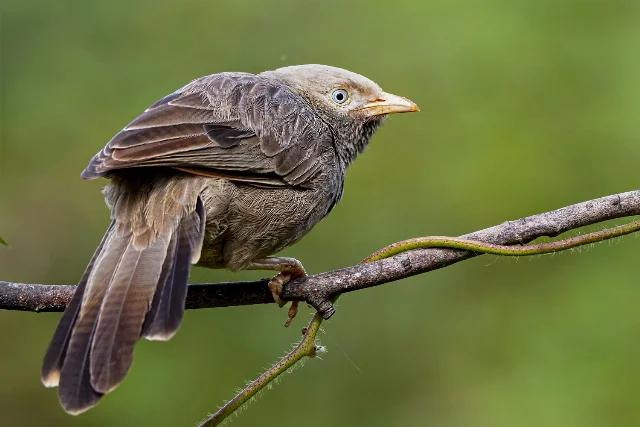


Spiny Babbler
Acanthoptila nipalensis
Last update: 14 Jul 2026
Read in:
English
Español
Português
हिन्दी
বাংলা
தமிழ்
മലയാളം
मराठी
ગુજરાતી
తెలుగు
French
Deutsch
Русский
日本語
简体中文
Italiano
Tiếng Việt
العربية
ಕನ್ನಡ
ਪੰਜਾਬੀ
Spiny Babbler Basic Information
| Scientific Name | Acanthoptila nipalensis |
|---|---|
| Status | LC Least Concern |
| Size | 25-27 cm (10-11 inch) |
| Colors |
Brown
Grey
|
| Type |
Perching Birds

|
| Family | Laughingthrushes and allies |
Introduction
The Spiny Babbler (Acanthoptila nipalensis) holds a distinguished place in the world of ornithology, primarily due to its status as the only bird species endemic to Nepal. This fascinating member of the Leiothrichidae family is often considered a 'holy grail' for international birdwatchers traveling to the Himalayas. Historically, this bird was shrouded in mystery, and its elusive nature made it difficult for early naturalists to document. It inhabits the middle hills and lower mountain regions of Nepal, thriving in specific ecological niches that are currently under pressure from habitat degradation. As a perching bird, it exhibits complex social structures and vocalizations that are characteristic of babblers. Understanding the life history of the Spiny Babbler is essential not only for biodiversity conservation but also for celebrating the unique avian heritage of the Himalayan landscape. This guide provides a comprehensive overview of this enigmatic species, exploring its physical traits, environmental requirements, and the challenges it faces in the modern world.
Physical Appearance
Measuring approximately 25 to 27 centimeters in length, the Spiny Babbler is a medium-sized, long-tailed bird that possesses a very distinct silhouette. Its plumage is predominantly brown, providing excellent camouflage within the dense scrub and thickets where it spends most of its time. The upper parts are typically a rich, streaked brown, while the underside features a lighter, earthy tone. The bird's wings and tail are adorned with subtle grey highlights, which become more apparent under specific lighting conditions. One of its most notable features is its strong, slightly decurved bill, which is perfectly adapted for foraging in dense foliage. The eyes are often a striking dark color, framed by a subtle eye-ring. Its legs are robust, characteristic of a bird that spends significant time navigating through tangled vegetation. The overall build of the bird suggests a sedentary lifestyle, yet it is capable of agile movements when disturbed or when chasing insects. The combination of its streaked feathers and long, graduated tail makes it relatively easy to distinguish from other similar-looking babbler species found in the region.
Habitat
The Spiny Babbler is primarily restricted to the mid-hill regions of Nepal, typically found at elevations ranging from 500 to 2,000 meters above sea level. It shows a strong preference for scrublands, bushy hillsides, and the edges of agricultural land interspersed with dense thickets. Unlike many other forest-dwelling birds, the Spiny Babbler is rarely found in deep, undisturbed primary forests. Instead, it thrives in secondary growth areas where thorny bushes and tall grasses provide both protection from predators and a bounty of food. These mosaic habitats, often characterized by human-modified landscapes, are crucial for the species' survival. They are frequently spotted in the Kathmandu Valley and surrounding districts, often near riverbanks or in overgrown terraced fields that offer ample cover.
Diet
As an insectivorous and omnivorous bird, the Spiny Babbler plays a vital role in its ecosystem by controlling insect populations. Its diet consists largely of various beetles, caterpillars, spiders, and other small invertebrates found within the leaf litter and on the branches of shrubs. During the foraging process, the bird is highly active, hopping through dense vegetation and using its bill to probe into bark crevices and curled leaves. In addition to insects, the Spiny Babbler also consumes a variety of small berries, seeds, and flower nectar, especially during seasons when insect abundance may fluctuate. This varied diet allows the bird to adapt to different environmental conditions throughout the year, ensuring it can sustain its energy levels even in challenging weather.
Breeding and Nesting
The breeding season of the Spiny Babbler typically occurs between April and August, coinciding with the monsoon season when food resources are at their peak. During this period, the birds become increasingly territorial and vocal, often engaging in complex courtship displays. They construct deep, cup-shaped nests, which are meticulously built using fine twigs, grass, roots, and spider webs for structural integrity. These nests are usually placed low to the ground, hidden within the heart of dense, thorny bushes or thick hedges to protect them from potential predators. The female typically lays a clutch of three to four eggs, which are incubated primarily by her, though the male plays an active role in guarding the territory and feeding the female during incubation. Once the chicks hatch, both parents contribute to the rigorous task of providing food, ensuring the survival of the next generation.
Behavior
The Spiny Babbler is known for its shy and secretive behavior, often remaining hidden in the dense undergrowth for long periods. Despite its reclusive nature, it is a highly social bird, frequently seen in small family groups or pairs. They exhibit a characteristic 'babbling' song, which is a series of rich, varied, and melodious notes that can echo through the scrubby hillsides. When moving through the vegetation, they are quite agile, using their long tails for balance. They are not known for long-distance flights and prefer to stay within their established home ranges, rarely venturing into open areas where they might be exposed to raptors or other threats.
Conservation Status - LC Least Concern
Currently, the Spiny Babbler is classified as a species of Least Concern by the IUCN, but its status is somewhat precarious due to its limited geographic range. The primary threats to this bird include habitat loss caused by urbanization, expansion of agricultural land, and the degradation of scrubland ecosystems. Because it is endemic to Nepal, any significant environmental change within its specific habitat could have dire consequences for the population. Conservation efforts are focused on protecting the scrubland corridors and raising awareness among local communities about the importance of preserving these unique avian habitats.
Interesting Facts
- The Spiny Babbler is the only bird species endemic to Nepal, making it a national treasure.
- It was scientifically described for the first time by Brian Houghton Hodgson in the 19th century.
- The bird was once thought to be extinct for a period during the mid-20th century before being rediscovered.
- Its name is derived from the 'spiny' or streaked appearance of its feathers.
- They are often heard before they are seen, thanks to their loud and distinct vocalizations.
- These birds are highly territorial during the breeding season and will aggressively defend their nesting sites.
- They play a crucial role in pest control by consuming large quantities of agricultural insects.
Tips for Birdwatchers
For birdwatchers hoping to spot the elusive Spiny Babbler, patience is the most important tool. The best time to look for them is during the early morning hours when they are most active and vocal. Focus your search on the mid-hill regions of Nepal, particularly in areas with dense, thorny scrubland or overgrown terraced fields. Wearing muted-colored clothing will help you blend into the environment and reduce the chances of startling them. Using high-quality binoculars and a field guide is essential. Listen carefully for their distinct, melodic babbling calls, which often give away their location in the thickets. Avoid making sudden movements, and stay quiet near the edge of the scrub, as they are very sensitive to human presence and will quickly retreat deeper into the brush if they feel threatened.
Pro-Tip: To spot this bird in dense forest canopy, a 8x42 binoculars or telescope is highly recommended.
- [Check out our top recommended gear here]
Conclusion
The Spiny Babbler (Acanthoptila nipalensis) is more than just an avian species; it is a symbol of Nepal's rich and unique biodiversity. As the only endemic bird of the country, it serves as a reminder of the importance of preserving the Himalayan mid-hill ecosystems. While it may not possess the vibrant colors of tropical birds, its subtle beauty and complex behaviors make it a fascinating subject for any ornithologist or bird enthusiast. Protecting this species requires a concerted effort to maintain the scrubland habitats that it depends on for survival. As urbanization and agricultural changes continue to reshape the landscape of Nepal, the future of the Spiny Babbler depends on our ability to balance development with conservation. By valuing such unique species, we contribute to the broader goal of global biodiversity preservation. Whether you are a professional researcher or a casual birdwatcher, encountering the Spiny Babbler in its natural habitat is an unforgettable experience that highlights the incredible diversity of life found within the Himalayan foothills. We must continue to support local conservation initiatives and promote sustainable land-use practices to ensure that this iconic bird continues to thrive for generations to come.
Tag:

200 Follower
is a writer who draws. He’s the Bestselling author of “Number of The Year”. Donec vitae tortor efficitur, convallis lelobortis elit.
Recent Posts





Subscribe For Daily Newsletter