
Not available
Bar-tailed Godwit
Limosa lapponica
Last update: 05 Mar 2026
Read in:
English
Español
Português
हिन्दी
বাংলা
தமிழ்
മലയാളം
मराठी
ગુજરાતી
తెలుగు
French
Deutsch
Русский
日本語
简体中文
Italiano
Tiếng Việt
العربية
ಕನ್ನಡ
ਪੰਜਾਬੀ
Bar-tailed Godwit Basic Information
| Scientific Name | Limosa lapponica |
|---|---|
| Status | NT Near Threatened |
| Size | 37-41 cm (15-16 inch) |
| Colors |
Brown
Grey
|
| Type |
Waders

|
| Family | Sandpipers, Snipes, Phalaropes |
Introduction
The Bar-tailed Godwit (Limosa lapponica) is a remarkable species of large wader in the sandpiper family, Scolopacidae. Renowned globally for its extraordinary migratory prowess, this bird undertakes one of the longest non-stop flights of any animal in the natural world. Breeding in the high Arctic tundra of Eurasia and Alaska, these birds travel thousands of miles to reach their non-breeding grounds in Australia, New Zealand, and coastal regions of Africa and Asia. Their biological capability to sustain flight for over a week without landing is a subject of intense scientific study. As a member of the wader group, the Bar-tailed Godwit is perfectly adapted to coastal life, utilizing its specialized bill to probe deep into mudflats for sustenance. This species serves as a vital indicator of the health of global wetland ecosystems, as their survival depends on a chain of high-quality stopover sites across the East Asian-Australasian Flyway. Understanding the life cycle of this bird offers profound insights into avian endurance and the necessity of international conservation efforts for migratory species.
Physical Appearance
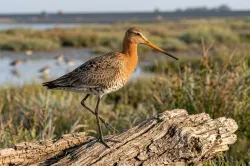
Standing between 37 to 41 cm in length, the Bar-tailed Godwit is a medium-to-large shorebird characterized by a robust build. Its primary coloration consists of a mottled brown plumage, which provides excellent camouflage against the mudflats and tundra environments it frequents. During the breeding season, males develop a striking, intense reddish-brown or chestnut coloration on their neck, breast, and underparts, while females remain paler. The grey tones are typically found on the upper wings and back, blending into a finely barred tail—a feature from which the bird derives its common name. The most distinctive feature is its long, slightly upturned bill, which is pinkish at the base and dark at the tip, designed specifically for probing deep into soft sediment. Their legs are relatively long and greyish, allowing them to wade through shallow water with ease. During flight, they exhibit a white rump and tail with thin dark bars, making them distinguishable from other godwit species. Their wings are long and pointed, facilitating the efficient, rapid flight required for their record-breaking transoceanic journeys.
Habitat
The Bar-tailed Godwit exhibits a strictly seasonal habitat requirement. During the breeding season, they inhabit the open, high-latitude Arctic tundra, specifically in areas with low vegetation, moss, and lichen, often near water bodies or river deltas. These regions provide the necessary seclusion and insect abundance for raising chicks. As winter approaches, the population migrates to coastal environments across the globe. Their non-breeding habitat consists primarily of large, intertidal mudflats, estuaries, sandy beaches, and coastal lagoons. These areas are crucial for their survival, as they rely on the rhythmic tidal exposure of nutrient-rich benthic organisms. Protecting these vital stopover sites is essential, as the birds often congregate in massive flocks to refuel before continuing their grueling migration across open oceans.
Diet
As specialized waders, the Bar-tailed Godwit primarily consumes a diet consisting of small invertebrates found in intertidal zones. Their long, sensitive bills act as precision instruments, allowing them to probe deep into the mud and sand to locate prey that is hidden from sight. Their diet includes a variety of marine worms, such as polychaetes, as well as bivalves, small crustaceans like amphipods, and occasionally small mollusks. During the breeding season in the Arctic, their diet shifts significantly to include more terrestrial insects, larvae, and spiders, which provide the high protein content necessary for rapid chick development. By foraging in the intertidal zone, they play a key role in the coastal food web, effectively cycling nutrients between the sediment and the water column.
Breeding and Nesting
Breeding for the Bar-tailed Godwit occurs in the remote, harsh environments of the Arctic tundra. The nesting process begins with elaborate courtship displays, where males perform aerial maneuvers and vocalizations to attract females. Once a pair is formed, they establish a nesting territory on the ground, often in a shallow scrape lined with dry lichen, moss, or grass, concealed within the sparse tundra vegetation. The female typically lays a clutch of three to four olive-brown, spotted eggs. Both parents participate in the incubation process, which lasts roughly three weeks. Upon hatching, the chicks are precocial, meaning they are capable of foraging for their own food almost immediately under the watchful eyes of their parents. This rapid development is a crucial adaptation to the short, intense Arctic summer, ensuring the young are prepared for the impending southward migration.
Behavior
The Bar-tailed Godwit is a highly social species, often seen in large, tightly packed flocks, especially during the non-breeding season. They are known for their vigilant behavior, often taking flight in unison if threatened. Their flight is strong, direct, and fast, which is necessary for navigating long distances over water. One of their most fascinating behaviors is their migratory strategy; they are capable of physiological changes, such as shrinking their internal organs and increasing their fat reserves, to survive long-distance flights. They communicate through a variety of calls, including a sharp 'ki-wit' sound, which helps maintain group cohesion while foraging or during their impressive migratory voyages across the hemispheres.
Conservation Status - NT Near Threatened
The Bar-tailed Godwit is currently classified as 'Near Threatened' by the IUCN. The primary threats to their population include the rapid loss and degradation of intertidal habitats along their migratory flyways, particularly in the Yellow Sea region. Land reclamation, pollution, and climate change affecting Arctic breeding grounds pose significant risks to their future survival. Ongoing conservation efforts focus on protecting critical stopover sites and creating international agreements to ensure the safety of these birds throughout their extensive migratory routes. Continued monitoring and research are essential to mitigate the decline of this iconic migratory shorebird.
Interesting Facts
- They hold the world record for the longest non-stop flight, covering over 13,000 km in roughly 11 days.
- During migration, they can lose up to half of their body weight.
- They can shrink their digestive organs before migration to save energy and space.
- Their scientific name, Limosa, is derived from the Latin word for 'muddy.'
- They are capable of flying at altitudes of several thousand meters to take advantage of favorable winds.
- Bar-tailed Godwits can live for over 20 years in the wild.
- They possess a highly sensitive bill tip that can detect prey by touch alone.
Tips for Birdwatchers
For birdwatchers hoping to spot the Bar-tailed Godwit, the best time to visit is during the migration periods or the non-breeding season at coastal estuaries. Use a high-quality spotting scope, as these birds are often found in large groups at a distance on mudflats. Pay close attention to the tide; they are most active and visible when the tide is outgoing, as they follow the receding water to feed. Wear muted clothing to avoid startling the flock, and maintain a respectful distance to observe their natural foraging behaviors. If you are in the Southern Hemisphere, look for them on sandy beaches or salt marshes during the summer months. Always check local birding databases or eBird to see recent sightings in your area, as their presence can be seasonal and highly specific to certain tidal conditions.
Pro-Tip: To spot this bird in dense forest canopy, a 8x42 binoculars or telescope is highly recommended.
- [Check out our top recommended gear here]
Conclusion
The Bar-tailed Godwit is truly one of nature's most impressive athletes. From the vast, frozen landscapes of the Arctic to the sun-drenched mudflats of the Southern Hemisphere, these birds connect diverse ecosystems through their incredible migratory journeys. Their ability to survive such extreme conditions is a testament to the evolutionary marvels of the avian world. However, their status as a 'Near Threatened' species serves as a stark reminder of our responsibility to preserve the planet's wetlands. By protecting the coastal environments they rely on, we not only safeguard the future of the Bar-tailed Godwit but also maintain the health of the entire global ecosystem. Whether you are a seasoned ornithologist or a casual bird enthusiast, witnessing these birds in their natural habitat is a humbling experience that underscores the interconnectedness of life on Earth. We must continue to support conservation initiatives, advocate for the protection of migratory flyways, and foster a deeper appreciation for these remarkable travelers. The journey of the Bar-tailed Godwit is far from over, and with collective global action, we can ensure that these magnificent shorebirds continue to grace our skies and coastlines for generations to come.
Tag:

200 Follower
is a writer who draws. He’s the Bestselling author of “Number of The Year”. Donec vitae tortor efficitur, convallis lelobortis elit.
Recent Posts



Subscribe For Daily Newsletter