
Not available
Spotted Sandpiper
Actitis macularius
Last update: 18 Mar 2026
Read in:
English
Español
Português
हिन्दी
বাংলা
தமிழ்
മലയാളം
मराठी
ગુજરાતી
తెలుగు
French
Deutsch
Русский
日本語
简体中文
Italiano
Tiếng Việt
العربية
ಕನ್ನಡ
ਪੰਜਾਬੀ
Spotted Sandpiper Basic Information
| Scientific Name | Actitis macularius |
|---|---|
| Status | LC Least Concern |
| Size | 18-20 cm (7-8 inch) |
| Colors |
Brown
White
|
| Type |
Waders

|
| Family | Sandpipers, Snipes, Phalaropes |
Introduction
The Spotted Sandpiper (Actitis macularius) is one of the most recognizable and widespread shorebirds in North America. These charming, small waders are beloved by birdwatchers for their distinct, energetic personality and unique physical traits. Classified as part of the Scolopacidae family, they are known for their constant, teetering motion, which makes them easy to identify even from a distance. Unlike many other sandpipers that congregate in large flocks on open beaches, the Spotted Sandpiper is often found alone or in pairs near water sources, ranging from rocky coastlines to quiet inland ponds and rushing streams. Their adaptability to various freshwater and saltwater environments has allowed them to thrive across a vast breeding range that spans across most of North America. Understanding their biology and behavior offers a fascinating glimpse into the lives of migratory shorebirds that bridge the gap between diverse ecosystems.
Physical Appearance
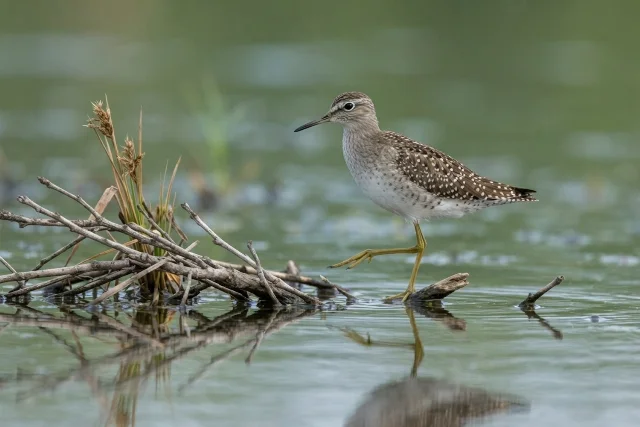
Measuring approximately 18 to 20 cm in length, the Spotted Sandpiper is a compact, slender bird. During the breeding season, adults are easily distinguished by the bold, dark spots that cover their white underparts, a feature that gives them their common name. Their upperparts are a rich, olive-brown color, which provides excellent camouflage against rocky shorelines. They feature a distinct white stripe above the eye and a pale orange or yellow bill with a dark tip. In their non-breeding plumage, the spots disappear, and the bird takes on a more uniform, grayish-brown appearance on the back with clean, white underparts. Their legs are relatively short and typically a pale yellowish-pink color. Juveniles resemble non-breeding adults but often show fine, scaly barring on their wing feathers. This seasonal transformation is a key aspect of their life cycle, allowing them to blend seamlessly into their environment throughout the year.
Habitat
The Spotted Sandpiper is incredibly versatile when it comes to habitat selection. While they are classified as waders, they are not strictly tied to coastal beaches. You will frequently find them along the margins of rivers, streams, lakes, and ponds. They have a preference for areas with rocky or gravelly shorelines where they can forage for insects. Unlike many other sandpipers, they are often found in inland habitats, including mountain streams and marshy edges. During migration, they may appear in a wider variety of wetland environments, but they always maintain a close proximity to water, which serves as both their primary hunting ground and a source of safety from predators.
Diet
The diet of the Spotted Sandpiper consists primarily of various invertebrates. As active foragers, they use their bills to probe the mud, sand, or gravel for small prey. Their menu includes a wide variety of insects such as flies, beetles, dragonflies, and midges, as well as crustaceans like amphipods. They are also known to consume earthworms, spiders, and occasionally small fish. Their hunting style is dynamic; they may run along the shore, picking prey off the surface, or stand still to watch for movement before darting forward to capture a meal. This opportunistic feeding behavior allows them to survive in diverse environments where food availability can fluctuate seasonally.
Breeding and Nesting
The breeding behavior of the Spotted Sandpiper is truly unique in the avian world because it exhibits a form of polyandry. In this system, females are often larger and more aggressive, defending territories and mating with multiple males. Once the eggs are laid, the male typically takes on the primary responsibility of incubating the clutch and raising the chicks. Their nests are simple depressions on the ground, usually concealed under vegetation or near rocks, lined with soft materials like grass or leaves. A typical clutch consists of four eggs. This reversed role-playing ensures that the species can maximize reproductive output, particularly in environments where food is abundant during the short northern summer, allowing the female to focus on producing subsequent clutches with different mates.
Behavior
The most iconic behavior of the Spotted Sandpiper is its incessant teetering. Even when standing still, the bird constantly bobs its tail and rear body up and down. This rhythmic motion is a hallmark of the species and serves as a diagnostic feature for birders. They are generally solitary creatures, often seen walking along the shoreline with a jerky, nervous gait. When flushed, they take flight with stiff, shallow wingbeats, often keeping their wings held slightly below the horizontal plane as they glide low over the water. They are highly territorial during the breeding season and will readily chase off intruders, including other birds that stray too close to their nesting site.
Conservation Status - LC Least Concern
The Spotted Sandpiper is currently listed as a species of Least Concern by the IUCN. Their widespread distribution and adaptable nature have helped them maintain stable populations across North America. However, like all migratory shorebirds, they face potential threats from habitat loss, particularly the degradation of wetlands and riparian zones due to human development and pollution. Climate change also poses a long-term risk, as it can disrupt the timing of insect emergence, which is critical for the survival of their chicks. Continued monitoring and conservation of wetland habitats remain essential to ensure their long-term viability in the wild.
Interesting Facts
- They are famous for their constant 'teetering' or bobbing motion.
- Spotted Sandpipers exhibit sex-role reversal, where females are more aggressive.
- Males are the primary caregivers, responsible for incubating eggs and raising chicks.
- They can be found inland along rivers and streams, not just on ocean beaches.
- They are strong flyers, capable of long-distance migration to South America.
- During the winter, they lose their signature spots, appearing plain gray-brown.
- They are highly territorial and will defend their space against other birds.
Tips for Birdwatchers
To spot a Spotted Sandpiper, focus your search on the edges of water bodies rather than open, sandy beaches. Look for areas with exposed rocks or gravel bars, as these are their preferred foraging grounds. The best way to identify them is to look for that characteristic, rhythmic tail-bobbing motion. They are relatively bold and often allow for close observation if you move slowly and remain quiet. Using binoculars or a spotting scope will help you appreciate the intricate spotting pattern on their breast during the summer months. Early morning or late afternoon are the best times to observe their active foraging behavior, especially during the spring and fall migration periods.
Pro-Tip: To spot this bird in dense forest canopy, a 8x42 binoculars or telescope is highly recommended.
- [Check out our top recommended gear here]
Conclusion
In conclusion, the Spotted Sandpiper is a remarkable example of nature's diversity and adaptability. Through their unique breeding systems, distinctive teetering behavior, and ability to colonize both coastal and inland habitats, they occupy a special niche in the ecosystem. Whether you are an experienced ornithologist or a casual backyard birdwatcher, observing these birds offers a rewarding experience. Their presence serves as a reminder of the importance of healthy wetland ecosystems, as they rely on these areas for feeding, nesting, and resting during their incredible migratory journeys. By protecting their habitats and appreciating their complex behaviors, we ensure that future generations can continue to enjoy the sight of these energetic waders bobbing along the water's edge. As you head out into the field, keep a sharp eye on the shorelines; you are almost certain to encounter this iconic bird, provided you know exactly what to look for in their movement and habitat preferences.
Tag:

200 Follower
is a writer who draws. He’s the Bestselling author of “Number of The Year”. Donec vitae tortor efficitur, convallis lelobortis elit.
Recent Posts




Subscribe For Daily Newsletter