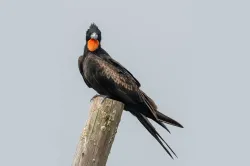
Black-capped Hemispingus Basic Information
| Scientific Name |
Kleinothraupis atropileus
|
| Status |
LC
Least Concern
|
| Size |
14-15 cm (6-6 inch)
|
| Colors |
|
| Type |
|
| Family |
Tanagers |
Introduction
The Black-capped Hemispingus (Kleinothraupis atropileus) is a fascinating and elusive member of the tanager family, Thraupidae. Often found darting through the dense, mist-laden canopies of the high Andes, this small perching bird is a prized sighting for neotropical birdwatchers. Despite its relatively small size, the species commands attention with its striking plumage and energetic foraging habits. Historically classified within the genus Hemispingus, recent taxonomic revisions have moved it to Kleinothraupis, reflecting a deeper understanding of its evolutionary lineage. These birds are primarily found in humid mountain forests, where they occupy the middle and upper levels of the foliage. Their presence is often revealed by their soft, high-pitched vocalizations rather than visual contact, as they are expert at blending into the mossy, shadowed environments of the cloud forest. Studying this species provides invaluable insights into the biodiversity of the Andean slopes, a region currently under pressure from environmental changes. Understanding the ecology of the Black-capped Hemispingus is essential for broader conservation efforts aimed at protecting the fragile high-altitude ecosystems they call home.
Physical Appearance
Measuring between 14 and 15 cm in length, the Black-capped Hemispingus is a compact and agile perching bird. Its most distinctive feature is, as the common name implies, its bold black crown, which contrasts sharply with its vibrant yellow underparts. The back and wings are typically a deep olive-green or grayish-olive, providing excellent camouflage against the lichen-covered branches of its habitat. The face often features a bold, pale supercilium or eye-stripe, which adds to its expressive appearance. The bill is dark, slender, and well-adapted for gleaning insects from leaves and crevices. Both males and females share similar coloration, though subtle differences in intensity may exist depending on the specific subspecies and geographical range. The overall build is slender, typical of active insectivores that spend their lives constantly moving through dense vegetation. Their plumage is soft and dense, an adaptation that helps them maintain body temperature in the cool, humid air of the high-altitude cloud forests. When seen in the wild, the flash of yellow against the dark forest backdrop is often the first indication of their presence, making them a beautiful subject for nature photography.
Habitat
The Black-capped Hemispingus is endemic to the humid montane forests of the Andes Mountains, stretching across countries like Colombia, Ecuador, Peru, and Bolivia. They prefer high-elevation environments, typically inhabiting cloud forests between 1,800 and 3,000 meters above sea level. These forests are characterized by constant mist, high rainfall, and an abundance of epiphytes, mosses, and ferns. The birds are rarely seen in open areas, preferring the dense, tangled understory or the mid-canopy layer where they can forage in relative safety from aerial predators. Their reliance on intact, old-growth forest makes them sensitive indicators of habitat quality, as they are seldom found in fragmented or highly disturbed landscapes.
Diet
As an active insectivore, the diet of the Black-capped Hemispingus consists primarily of a wide variety of small arthropods. They are frequently observed gleaning insects, spiders, and larvae from the undersides of leaves and within clumps of moss or bromeliads. Occasionally, they may supplement their protein-rich diet with small fruits or berries found in the canopy. Their foraging strategy is highly energetic; they move rapidly along branches, pausing only briefly to inspect potential food sources. By consuming large quantities of insects, these birds play a critical role in controlling pest populations within the delicate cloud forest ecosystem, effectively serving as natural forest managers.
Breeding and Nesting
The breeding biology of the Black-capped Hemispingus remains somewhat mysterious due to the inaccessible nature of their high-altitude habitats. Generally, breeding occurs during the wetter months when food resources such as insects are most abundant. They typically construct cup-shaped nests made of moss, lichen, and fine rootlets, carefully hidden within dense foliage or thick tangles of epiphytes to protect them from predators. Both parents are believed to participate in the feeding of the nestlings, which require a steady supply of protein-rich insects for rapid growth. The pair bond is often strong, with both individuals defending a small territory around the nesting site. The clutch size is typically small, reflecting the high-investment strategy common among many tropical bird species that face significant pressure from nest predation.
Behavior
Behaviorally, the Black-capped Hemispingus is a highly social bird, frequently seen traveling in small, active groups or as part of mixed-species foraging flocks. These flocks are a common feature of Andean birding, where various species move through the forest together to increase foraging efficiency and predator detection. The Black-capped Hemispingus is remarkably agile, often hanging upside down to reach insects hidden in leaf clusters. They are vocal birds, communicating with their flock members through thin, high-pitched chips and trills. Despite their social nature, they remain wary and will quickly retreat into the deepest parts of the canopy if they sense a potential threat nearby.
Conservation Status
-
LC
Least Concern
The Black-capped Hemispingus is currently classified as a species of Least Concern by the IUCN, although this status is largely due to its wide geographical range. Despite this, local populations face significant threats from ongoing deforestation, climate change, and the fragmentation of the Andean cloud forests. Because they are highly specialized to these specific high-altitude conditions, they are particularly vulnerable to shifts in temperature and humidity. Protecting large, contiguous corridors of montane forest is vital to ensuring the long-term survival of this species and the many other birds that share its unique habitat.
Interesting Facts
- They were formerly classified in the genus Hemispingus before being moved to Kleinothraupis.
- They often participate in mixed-species flocks to improve foraging success.
- Their diet is heavily reliant on arthropods found in mossy epiphytes.
- They are expert at camouflage, making them difficult to spot despite their bright yellow coloring.
- Their high-altitude habitat is often shrouded in mist for most of the year.
- They are known to be quite active and rarely sit still for long periods.
Tips for Birdwatchers
To successfully spot a Black-capped Hemispingus, patience and the right equipment are essential. Focus your efforts on high-elevation cloud forests during the early morning hours when bird activity is at its peak. Listen carefully for high-pitched, thin calls, as these are often the best indicator of a nearby flock. Using a high-quality pair of binoculars is a must, as these birds stay high in the canopy. Joining a local birding group or hiring a specialized guide who knows the specific vocalizations of the region will significantly increase your chances of a successful sighting. Always remain quiet and move slowly to avoid startling the active, shy members of the flock.
Conclusion
The Black-capped Hemispingus is a quintessential example of the specialized biodiversity found within the Andean cloud forests. With its distinct black-and-yellow plumage and energetic, insect-gleaning lifestyle, it represents the intricate ecological links that define these high-altitude environments. While currently stable, their reliance on pristine mountain forests makes them a sentinel for the health of the Andes. For birdwatchers, catching a glimpse of this elusive species as it moves through the mist is a rewarding experience that highlights the beauty and complexity of neotropical avian life. As we continue to study and appreciate birds like the Black-capped Hemispingus, we are reminded of the importance of conservation. Protecting their habitat is not merely about saving one species; it is about preserving the entire delicate ecosystem that supports countless organisms. Whether you are an experienced ornithologist or a casual enthusiast, understanding and respecting the Black-capped Hemispingus contributes to a deeper appreciation of the natural world and the urgent need to safeguard our planet's most fragile and diverse landscapes for future generations to enjoy and study.
Black-capped Hemispingus Distribution Map & Range
The distribution map for this species will be available soon.
We are working with our official data partners to update this information.