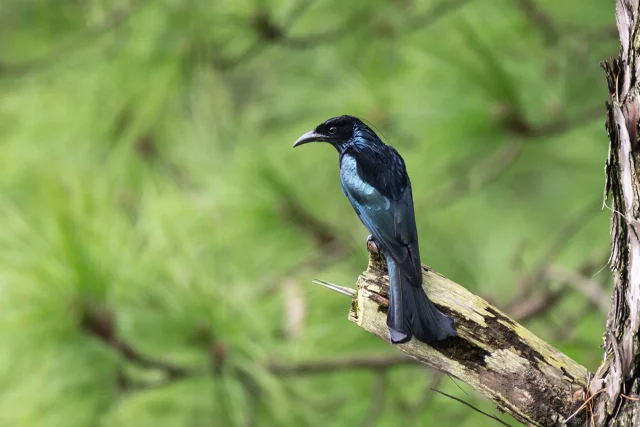
Ruby-crowned Tanager Basic Information
| Scientific Name |
Tachyphonus coronatus
|
| Status |
LC
Least Concern
|
| Size |
13-15 cm (5-6 inch)
|
| Colors |
|
| Type |
|
| Family |
Tanagers |
Introduction
The Ruby-crowned Tanager (Tachyphonus coronatus) is a captivating member of the Thraupidae family, known for its distinct elegance and striking coloration. Often found in the lush landscapes of South America, specifically within the Atlantic Forest biome, this perching bird serves as a vital indicator of forest health. Ornithologists and bird enthusiasts alike are drawn to its elusive nature and the vibrant splash of red that adorns its otherwise charcoal-grey plumage. As a species that primarily occupies the middle and lower strata of the forest, the Ruby-crowned Tanager exhibits a specialized lifestyle that has adapted perfectly to the dense vegetation. Understanding this bird requires a deep dive into its biology, ranging from its complex social interactions to its specific ecological needs. By studying the Tachyphonus coronatus, we gain broader insights into the biodiversity of the Brazilian ecosystems and the importance of preserving these avian treasures for future generations of birdwatchers and researchers who seek to document the wonders of the natural world.
Physical Appearance
Measuring between 13 and 15 centimeters, the Ruby-crowned Tanager is a small but highly recognizable perching bird. The most defining feature of the male is its deep, slate-grey to blackish body, which provides a dramatic contrast to the brilliant, flame-red crown patch that gives the species its name. This crest is often hidden or semi-concealed, becoming visible during displays or moments of excitement. In contrast, the females exhibit a more muted, brownish-grey coloration, which serves as an effective camouflage against the forest floor and understory, protecting them from predators while they are nesting or foraging. Both sexes possess a sharp, pointed bill typical of the tanager family, which is perfectly adapted for their varied diet. The wings are relatively short and rounded, enabling agile, short-distance flights through the dense foliage of their habitat. Their dark, intelligent eyes are set within a sleek head, contributing to an overall appearance of sophistication and grace that makes them a favorite among bird photographers.
Habitat
The Ruby-crowned Tanager is predominantly found in the Atlantic Forest of Brazil, extending into adjacent regions in Paraguay and Argentina. It favors humid, lowland forests, as well as the edges of primary and secondary growth forests. Unlike species that remain strictly in the high canopy, this tanager prefers the dense understory and shrub layers, where it can easily forage while remaining shielded from aerial predators. These birds are highly dependent on diverse plant structures that offer both protection and abundant food sources. As habitat fragmentation continues to pose a threat to the Atlantic Forest, the presence of the Ruby-crowned Tanager in specific woodland corridors highlights the necessity of maintaining connected, healthy ecosystems to support their survival and movement.
Diet
The diet of the Ruby-crowned Tanager is remarkably diverse, reflecting its role as an opportunistic feeder within its ecosystem. These birds primarily consume a variety of small fruits and berries, which play a crucial role in seed dispersal throughout the forest. In addition to fruit, they are active insectivores, catching small arthropods, spiders, and larvae from leaves and branches. This dual-source diet allows them to maintain high energy levels throughout the year. During the breeding season, the intake of insects often increases to provide the necessary protein for developing chicks. Their sharp, conical beaks are perfectly suited for both plucking berries from stems and gleaning insects from the intricate surfaces of tropical vegetation.
Breeding and Nesting
The breeding season for the Ruby-crowned Tanager is typically synchronized with the periods of greatest food abundance. These birds construct cup-shaped nests, skillfully weaving together plant fibers, fine grasses, and mosses to create a sturdy structure hidden deep within the dense foliage. The nest is usually placed in a sheltered fork of a branch or inside thick shrubs, providing safety from potential nest raiders. The female is primarily responsible for the incubation of the eggs, while the male remains nearby to defend the territory and assist in foraging. Once the chicks hatch, both parents participate in the demanding task of feeding the brood. Their commitment to nesting success is a testament to their parental instincts, and the young typically fledge after a few weeks of intensive care and protection by the adults.
Behavior
Ruby-crowned Tanagers are generally observed in pairs or small family groups, displaying a relatively social nature. They are active, restless birds that constantly move through the understory in search of food. While they are not typically aggressive, they will defend their immediate nesting area against intruders of their own species. One of the most interesting behavioral aspects is their vocalization; they communicate with soft, melodic chirps that keep family members in contact as they forage. When threatened or excited, the male may raise its ruby crown, a display that is as much about communication as it is about asserting dominance or attracting a mate during the courtship ritual.
Conservation Status
-
LC
Least Concern
The Ruby-crowned Tanager is currently classified as a species of Least Concern by the IUCN, though this status is highly dependent on the stability of its primary habitat. The greatest threat to this bird is the ongoing loss and fragmentation of the Atlantic Forest due to deforestation, agricultural expansion, and urbanization. While they have shown some ability to adapt to secondary forests, the degradation of their natural environment remains a critical concern. Conservation efforts focused on reforesting corridors and protecting remaining forest remnants are essential to ensuring that populations remain stable and that the species continues to thrive in its native range.
Interesting Facts
- The male's vibrant crown is often hidden and is only fully revealed during courtship or territorial displays.
- They are vital seed dispersers, helping to regenerate the forest by consuming various fruits.
- Unlike many other tanagers, they spend most of their time in the lower and middle forest strata.
- The female's dull plumage acts as vital camouflage, keeping her hidden from predators while on the nest.
- They are known to join mixed-species foraging flocks to increase their chances of finding food and avoiding predators.
- Their scientific name, Tachyphonus, is derived from Greek words meaning 'fast' and 'murderer' or 'slayer', though they are actually quite gentle.
Tips for Birdwatchers
For birdwatchers hoping to spot the Ruby-crowned Tanager, patience is the most valuable tool. Since they prefer the dense understory, scanning the lower branches of trees and thick shrubs is essential. Using high-quality binoculars with good low-light performance is recommended, as the forest interior can be quite dim. Listen for their soft, distinct vocalizations, which are often the first sign of their presence. Early morning is the best time for observation, as the birds are most active and vocal during the first few hours of daylight. Consider visiting established nature reserves within the Atlantic Forest biome, where trails provide access to their habitat while minimizing disturbance to the birds and their environment.
Conclusion
In conclusion, the Ruby-crowned Tanager is a fascinating example of the intricate beauty found within the South American avian world. From its elusive behavior and stunning physical transformation during displays to its critical role as a seed disperser, this bird is a vital component of the Atlantic Forest ecosystem. As we continue to study and appreciate the Tachyphonus coronatus, we are reminded of the fragile balance of nature and our responsibility to protect the habitats that sustain such magnificent creatures. Whether you are a professional ornithologist or a casual backyard birdwatcher, the sight of a male Ruby-crowned Tanager flashing its brilliant crown is a rewarding experience that highlights the wonder of biodiversity. By supporting conservation initiatives and promoting ethical birdwatching practices, we can ensure that this species continues to grace the forests for many years to come. Ultimately, the Ruby-crowned Tanager serves as a vibrant reminder of why we must remain dedicated to the preservation of our planet's wild spaces and the countless species that call them home.
Ruby-crowned Tanager Distribution Map & Range
The distribution map for this species will be available soon.
We are working with our official data partners to update this information.