Rusty-collared Seedeater Basic Information
| Scientific Name |
Sporophila collaris
|
| Status |
LC
Least Concern
|
| Size |
10-11 cm (4-4 inch)
|
| Colors |
|
| Type |
|
| Family |
Tanagers |
Introduction
The Rusty-collared Seedeater, scientifically known as Sporophila collaris, is a fascinating member of the Thraupidae family. These small, agile perching birds are widely recognized for their distinctive coloration and melodic presence in the open landscapes of South America. As a species that belongs to the diverse genus Sporophila—a name derived from Greek words meaning 'seed' and 'to love'—this bird is perfectly adapted to life in grasslands and marshy scrub. Birdwatchers and ornithologists often admire the Rusty-collared Seedeater not only for its striking appearance but also for its complex social interactions and seasonal movements. Despite their small stature, these birds play a vital role in their ecosystem, acting as seed dispersers and contributing to the natural balance of their environment. Understanding this species requires a look into its specific behavioral patterns, nesting habits, and the environmental pressures it faces in the wild. Whether you are an experienced birder or a nature enthusiast, the Rusty-collared Seedeater offers a captivating glimpse into the avian diversity of the Neotropics.
Physical Appearance
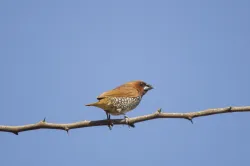
Measuring between 10 and 11 centimeters in length, the Rusty-collared Seedeater is a compact yet visually striking passerine. The primary color of the male is a sophisticated slate-grey, which covers much of the dorsal area, wings, and crown. This cool-toned plumage provides a sharp contrast to the bird's secondary color, a vibrant, rich rusty-orange or chestnut hue that adorns the collar, throat, and underparts. This distinctive 'rusty collar' is the defining feature that gives the species its common name. The beak is characteristically thick and conical, an evolutionary adaptation typical of seed-eating birds, allowing them to crack open tough husks with ease. Females and juveniles generally exhibit a more subdued coloration, typically displaying brownish-grey tones that provide excellent camouflage against the dry grasses and shrubs of their habitat. The overall silhouette is rounded, typical of the genus, with short, pointed wings and a relatively short tail that aids in quick, fluttering flights between perches. Their eyes are dark and alert, reflecting the constant vigilance required for survival in open, predator-prone environments.
Habitat
The Rusty-collared Seedeater is primarily found in the open, lowland regions of South America, particularly in countries like Argentina, Brazil, Paraguay, and Uruguay. They demonstrate a strong preference for areas with dense, low-lying vegetation, such as wet grasslands, marshes, and the periphery of gallery forests. Unlike forest-dwelling species, these birds thrive in semi-open landscapes where they can easily access seeds from grasses and herbaceous plants. They are frequently observed in flooded campos and wetlands, often perching on tall stalks of grass or small shrubs. During the non-breeding season, these birds may aggregate in larger groups, moving across seasonal floodplains in search of food and suitable micro-climates that provide shelter from the elements.
Diet
As their name implies, the diet of the Rusty-collared Seedeater consists almost exclusively of seeds. They are highly specialized granivores, equipped with a powerful, conical bill capable of handling a variety of grass seeds. They forage primarily on the ground or by clinging to the stems of tall grasses, deftly extracting seeds from the seed heads. In addition to seeds, their diet may be supplemented with small insects and spiders, particularly during the breeding season when high-protein food sources are essential for the development of nestlings. This dietary flexibility allows them to thrive in fluctuating environments where seed availability might vary throughout the year, ensuring they maintain the energy levels required for their active, high-metabolism lifestyle.
Breeding and Nesting
Breeding for the Rusty-collared Seedeater typically coincides with the period of greatest food abundance, usually during the spring and summer months. The male performs elaborate song displays to attract a mate, often perching prominently on top of a grass stem to showcase his rusty-colored plumage. Once a pair is established, the female takes the lead in constructing a small, cup-shaped nest. This structure is meticulously woven using fine grasses, rootlets, and spider silk, and is usually placed low to the ground in a dense clump of vegetation or a small shrub for protection. The female typically lays two to three pale, spotted eggs. Incubation lasts approximately two weeks, and both parents participate in feeding the altricial chicks. The nest is well-hidden, an essential strategy for survival in open grasslands where nests are vulnerable to various predators, including snakes and small mammals.
Behavior
Behaviorally, the Rusty-collared Seedeater is a social and active bird. They are often seen in small flocks, especially outside of the breeding season, moving through the grass in search of food. They possess a flight pattern that is characterized by short, rapid bursts of wingbeats followed by a slight glide. Their vocalizations are notable; males sing complex, melodic phrases that serve both to defend their territory and to attract potential mates. When threatened, they are quick to seek cover within thick vegetation, remaining motionless until the danger passes. This 'freeze' response, combined with their cryptic coloration, makes them masters of concealment in their native, open-country environments, allowing them to remain largely inconspicuous despite their bright, rusty markings.
Conservation Status
-
LC
Least Concern
The Rusty-collared Seedeater is currently classified as a species of Least Concern by the IUCN, though populations are subject to local fluctuations. Their primary threats include habitat loss due to agricultural expansion, the drainage of wetlands, and overgrazing of grasslands by livestock. Because they rely heavily on specific grass species for foraging and nesting, the degradation of these ecosystems directly impacts their survival. Conservation efforts focus on protecting key wetland areas and promoting sustainable land-use practices that maintain the integrity of their native grasslands, ensuring that these small, vibrant birds continue to thrive in the wild.
Interesting Facts
- The Rusty-collared Seedeater is part of the diverse Sporophila genus, which contains over 40 distinct species.
- Their conical beak is specifically evolved to crush seeds, but they also eat insects during the breeding season.
- Males are much more colorful than females, featuring a distinct rusty-orange collar.
- They are highly social birds and are often found in groups during the non-breeding season.
- These birds are known to be excellent mimics of other bird songs in their vicinity.
- They play a crucial role in local ecosystems by dispersing grass seeds across their range.
- The species is a popular subject for research into avian vocalization and territorial behavior in the Neotropics.
Tips for Birdwatchers
To successfully spot the Rusty-collared Seedeater, focus your efforts on early morning or late afternoon when these birds are most active. Use a high-quality pair of binoculars and scan the tops of tall grasses or marshy edges, as these are their preferred perching spots. Because they are shy and tend to fly into cover when approached, maintain a respectful distance and move slowly. If you hear a series of melodic, high-pitched songs emanating from the grass, remain still; the male may soon reveal himself on an exposed stalk. Patience is the key to observing their social interactions and feeding behaviors. Bringing a field guide specific to South American birds will also help you distinguish them from other similar Sporophila species that may share the same habitat.
Conclusion
In conclusion, the Rusty-collared Seedeater (Sporophila collaris) is a remarkable example of avian adaptation to open grassland environments. From its vibrant rusty-orange collar to its specialized conical bill, every aspect of its biology is perfectly tuned for survival in the wetlands and fields of South America. By providing essential insights into the health of these ecosystems, this bird serves as a reminder of the importance of preserving biodiversity in our rapidly changing world. Whether you are captivated by their melodic songs, their intricate nesting habits, or simply the beauty of their plumage, the Rusty-collared Seedeater remains a rewarding subject for any birder. As we continue to study and protect these small but significant members of the avian community, we gain a deeper appreciation for the delicate balance of nature. We encourage all enthusiasts to continue supporting conservation efforts that protect the habitats of these beautiful perching birds, ensuring that future generations can witness their unique behaviors in the wild. Their presence is a testament to the resilience of nature, provided we continue to act as stewards of their environment.
Rusty-collared Seedeater Distribution Map & Range
The distribution map for this species will be available soon.
We are working with our official data partners to update this information.