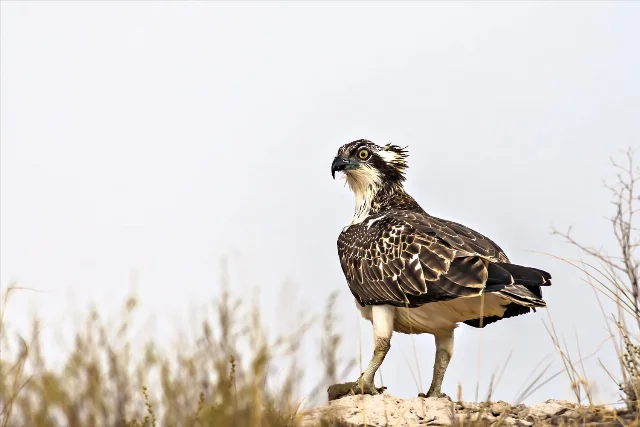
Large-billed Sparrow Distribution Map & Range
The distribution map for this species will be available soon.
We are working with our official data partners to update this information.

Sign in with your Google account to access all features


| Scientific Name | Passerculus rostratus |
|---|---|
| Status | LC Least Concern |
| Size | 14-16 cm (6-6 inch) |
| Colors |
Brown
Grey
|
| Type |
Perching Birds

|
| Family | New World sparrows |
The Large-billed Sparrow (Passerculus rostratus) is a fascinating and specialized member of the Passerellidae family, recognized for its distinct adaptation to coastal environments. Unlike many of its inland relatives, this perching bird has evolved to thrive in the harsh, saline conditions of salt marshes and coastal estuaries. Historically considered a subspecies of the Savannah Sparrow, it has garnered significant attention from ornithologists due to its unique morphological traits and specific ecological requirements. This bird serves as a crucial indicator species for the health of intertidal ecosystems, particularly along the Pacific coast of North America. Its presence is often tied to the availability of specific salt-tolerant vegetation and the integrity of marshlands. As human development continues to encroach upon coastal habitats, understanding the life history, migratory patterns, and specific needs of the Large-billed Sparrow is essential for conservation efforts. This guide provides a comprehensive overview of this remarkable avian species, exploring its physical characteristics, dietary habits, nesting behaviors, and the challenges it faces in an ever-changing environment.
The Large-billed Sparrow is a medium-sized perching bird, typically measuring between 14 and 16 centimeters in length. Its physical appearance is characterized by a robust build, which distinguishes it from other similar sparrow species found in the region. The primary color of its plumage is a dull, streaky brown, which provides excellent camouflage against the mudflats and dried marsh grasses that constitute its natural environment. Interspersed with this brown coloration are secondary shades of grey, particularly around the head and wing coverts, which help break up its outline when the bird is stationary. One of its most defining features, as the name suggests, is its disproportionately large, heavy bill. This bill is specifically adapted for foraging in coastal environments, allowing it to manipulate prey items that other sparrows might struggle to access. The underparts are generally paler, featuring prominent dark streaks that run from the throat down to the flanks. Its legs are sturdy, suitable for navigating the soft, uneven terrain of salt marshes, and its overall coloration is muted, reflecting its need to remain inconspicuous to predators while foraging in open, exposed coastal habitats.
The Large-billed Sparrow is highly specialized, almost exclusively occupying salt marshes, tidal flats, and coastal estuaries along the Pacific coast, ranging from Southern California down into northwestern Mexico. These environments are characterized by high salinity, tidal fluctuations, and specific vegetation types such as pickleweed (Salicornia). The birds rely heavily on these dense, salt-tolerant plants for both foraging and cover. They are rarely found far from these coastal zones, as they have evolved to exploit the unique resources found within these intertidal ecosystems. During the non-breeding season, they may disperse slightly along the coast, but they remain strictly tied to maritime habitats, rarely venturing into inland or mountainous regions.
As a specialized coastal forager, the diet of the Large-billed Sparrow is heavily influenced by its environment. Unlike many sparrows that feed primarily on seeds, this species includes a significant amount of animal matter in its diet, particularly during the breeding season. Its large, heavy bill is an adaptation that allows it to feed on a variety of marine invertebrates, including small crustaceans, mollusks, and various insects found in the mud and among the salt marsh vegetation. During colder months, when insect availability decreases, they shift their focus toward seeds and other plant material found in the marsh, though they remain opportunistic, taking advantage of whatever food sources are available within their saline habitat.
The breeding season of the Large-billed Sparrow is intricately linked to the tidal cycle and the growth of specific marsh vegetation. They are ground-nesters, typically constructing their nests in the dense, protective cover of salt marsh plants, which helps to conceal the nest from predators and protect the young from direct sunlight. The nest is a cup-shaped structure built from fine grasses, rootlets, and other available plant materials found within the marsh. The female is primarily responsible for the construction of the nest and the incubation of the eggs, while the male defends the territory. These birds are known to be sensitive to disturbance during the nesting phase, particularly from high tides that can threaten to flood low-lying nests. Successful reproduction depends heavily on the timing of vegetation growth and the absence of extreme environmental events, making their breeding success closely tied to the stability of their fragile coastal ecosystems.
The behavior of the Large-billed Sparrow is largely defined by its secretive nature and its adaptation to its open marsh habitat. They are often difficult to spot, as they tend to forage on the ground or within the dense lower layers of marsh vegetation, where they are well-camouflaged. When disturbed, they may fly only a short distance before dropping back into the cover of the grasses. They are generally not highly social, often foraging alone or in small, loose groups. Their vocalizations are relatively simple, consisting of buzzy or trilling songs that are used to establish territories and attract mates. Despite their elusive demeanor, they are highly vigilant, constantly monitoring their surroundings for potential threats from aerial predators like raptors or terrestrial threats that may enter the marsh.
The conservation status of the Large-billed Sparrow is a concern for ornithologists and environmentalists due to the rapid loss and degradation of salt marsh habitats. Because this species is so specialized, it is particularly vulnerable to environmental changes, including sea-level rise, coastal development, and pollution. The fragmentation of its habitat limits its ability to find suitable nesting and foraging grounds, leading to population declines in several parts of its range. Protecting remaining salt marshes and restoring degraded coastal areas are critical steps in ensuring the long-term survival of this unique sparrow.
For birdwatchers hoping to spot the Large-billed Sparrow, patience and preparation are key. Because these birds are elusive and inhabit dense vegetation, it is often best to visit salt marshes during low tide, when they are more likely to be out foraging on the exposed mudflats. Using high-quality binoculars or a spotting scope is essential, as you will likely be observing them from a distance to avoid causing them to hide. Focus your attention on areas with thick patches of pickleweed or other marsh plants. Early morning or late afternoon, when the birds are most active, provides the best opportunities. Dress appropriately for a marsh environment, and always maintain a respectful distance to ensure you do not disturb their nesting or foraging activities.
The Large-billed Sparrow (Passerculus rostratus) stands as a remarkable example of avian specialization, perfectly tuned to the demanding conditions of the Pacific coast's salt marshes. Its robust physical form, particularly its distinctive large bill, highlights the evolutionary pressures that have shaped this species to exploit a niche that few other birds can occupy. Throughout this guide, we have explored the complex relationship between this sparrow and its fragile environment, from its dietary reliance on salt marsh invertebrates to the crucial role that undisturbed habitat plays in its breeding success. As we move forward, the conservation of the Large-billed Sparrow serves as a litmus test for our commitment to protecting coastal biodiversity. The challenges it faces—habitat loss, climate change, and environmental degradation—are indicative of the broader threats facing intertidal ecosystems globally. By understanding and valuing the unique life history of the Large-billed Sparrow, we take an essential step toward preserving the rich, complex, and vital ecosystems it calls home. Continued research and dedicated conservation efforts are not merely beneficial for this single species, but are critical for the health of the entire coastal network that sustains so much life, including our own.
We are working with our official data partners to update this information.
Tag:

Birds have their own beautiful world, we should not interfere in it. We should enjoy this beauty. Its beauty should be captured in the camera but be careful not to disturb them.
Tap a language to switch instantly.
Tap a language to switch instantly.