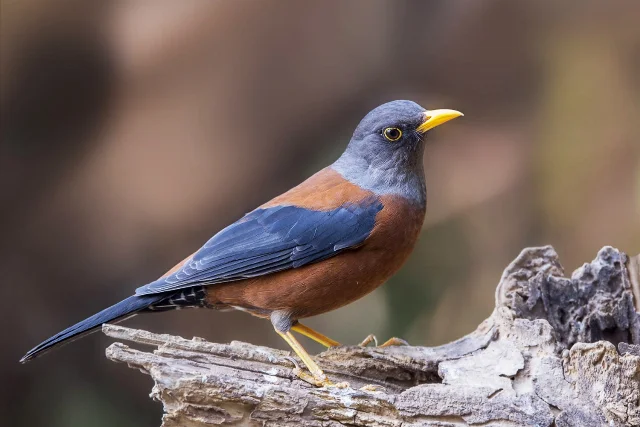
Austral Thrush Basic Information
| Scientific Name |
Turdus falcklandii
|
| Status |
LC
Least Concern
|
| Size |
25-28 cm (10-11 inch)
|
| Colors |
|
| Type |
|
| Family |
Thrushes |
Introduction
The Austral Thrush (Turdus falcklandii) is a prominent and widely recognized species within the thrush family, Turdidae. Often referred to as the Falkland Thrush, this resilient bird is native to the southern regions of South America, inhabiting diverse landscapes ranging from the lush forests of Chile and Argentina to the windswept plains of the Falkland Islands. As a quintessential member of the order Passeriformes, it is classified as a perching bird, known for its adaptability to both natural environments and human-modified landscapes. With its melodious song and distinct presence, the Austral Thrush has become a familiar companion to many, frequently observed foraging in gardens, parks, and agricultural fields. Understanding this species offers valuable insights into the ecological dynamics of the southern hemisphere's temperate zones. As ornithologists continue to study its population trends and behavioral adaptations, the Austral Thrush remains a significant indicator of environmental health within its expansive range, showcasing the remarkable evolutionary success of the genus Turdus in varying climates.
Physical Appearance
The Austral Thrush is a medium-sized bird, typically measuring between 25 and 28 cm in length, making it one of the larger members of its genus. Its plumage is characterized by a sophisticated palette, with a dominant brown coloration covering the upperparts, wings, and tail, providing excellent camouflage against soil and leaf litter. This earthy tone is beautifully contrasted by a vibrant yellow beak and distinct yellow eye-rings, which serve as key identification features for birdwatchers. The underside of the bird often displays lighter, buff-colored shades that fade into a warmer hue toward the belly. Juveniles may exhibit subtle streaking on their chests, a common trait among young thrushes that gradually fades as they reach maturity. The bird's robust build and strong legs facilitate its terrestrial foraging habits, allowing it to move efficiently across different substrates. Its overall body structure is aerodynamic yet sturdy, perfectly adapted for short, agile flights between perches or while navigating through dense shrubbery in search of food or cover.
Habitat
The Austral Thrush occupies a wide variety of habitats, demonstrating remarkable ecological plasticity. It is most commonly found in open woodlands, forest edges, and scrublands throughout southern South America. In urban and suburban settings, it has become highly synanthropic, frequently utilizing manicured gardens, city parks, and agricultural pastures where food is abundant. In the southern reaches of its range, such as the Falkland Islands, it is known to inhabit coastal areas and open grasslands, showing an ability to thrive even in harsh, exposed conditions. Its preference for areas with a mix of cover and open ground allows it to forage effectively while maintaining easy access to nesting sites and protection from predators.
Diet
The diet of the Austral Thrush is primarily omnivorous, reflecting its opportunistic foraging style. It spends a significant portion of its time on the ground, using its strong bill to probe the soil for invertebrates, including earthworms, beetles, larvae, and other small insects. Beyond its protein-rich insect diet, this species is also highly frugivorous. It consumes a variety of berries, small fruits, and seeds, which are particularly important during the colder months when insect populations decline. In residential areas, the Austral Thrush is known to visit garden feeders, showing a preference for soft fruits, and it is often seen scavenging for food scraps, further highlighting its adaptable nature.
Breeding and Nesting
The breeding season of the Austral Thrush generally coincides with the southern spring and summer months. During this time, males perform elaborate courtship displays, often accompanied by complex, flute-like songs to attract mates and establish territory. The nest is a substantial, cup-shaped structure meticulously constructed from twigs, grass, moss, and other plant fibers, often reinforced with mud for stability. These nests are typically placed in the fork of a tree, within dense shrubbery, or even on man-made structures like building ledges. The female typically lays a clutch of two to four eggs, which are pale blue with reddish-brown spots. Both parents are actively involved in the incubation process and the subsequent feeding of the chicks, working diligently to ensure the survival of their brood until they fledge.
Behavior
The Austral Thrush is primarily a diurnal bird, most active during the early morning and late afternoon hours. It is generally territorial, especially during the breeding season, when individuals may aggressively defend their nesting sites from intruders. Despite this, they are often seen foraging in loose groups during the non-breeding season. Their behavior is characterized by a mix of cautious observation and bold exploration, particularly when searching for food. When startled, they typically give a sharp, alarm-like call before taking flight to a higher perch. Their movement on the ground is distinct, characterized by quick hops followed by brief periods of stillness, during which they tilt their heads to listen for prey.
Conservation Status
-
LC
Least Concern
The Austral Thrush is currently classified as a species of Least Concern by the IUCN. Its population remains stable across its vast geographical range, which spans multiple countries and diverse ecosystems. The species has benefited significantly from human land-use changes, such as the creation of parks, gardens, and agricultural landscapes, which provide ample food and nesting opportunities. While there are no immediate threats to its survival, ongoing habitat loss and the use of pesticides in agricultural zones remain potential long-term concerns that could impact local populations if left unmonitored.
Interesting Facts
- The Austral Thrush is the national bird of the Falkland Islands.
- They are known for their beautiful, flute-like song, often heard at dawn.
- They are highly adaptable and thrive in both wild forests and urban cities.
- The bright yellow beak is a defining characteristic used to distinguish them from other thrushes.
- They often use mud to reinforce their nests, making them incredibly durable.
- These birds are known to be quite bold and may approach humans in park settings.
Tips for Birdwatchers
For birdwatchers hoping to spot the Austral Thrush, the best approach is to visit local parks or gardens during the early morning hours when the birds are most active. Because they are ground-foragers, look for them hopping across lawns or along the edges of wooded paths. If you are in a more natural environment, listen for their distinct, melodious song, which is often the first indication of their presence. Using binoculars is recommended to get a clear view of their vibrant yellow beaks and eye-rings. Patience is key; if you remain still, these birds are often curious enough to come quite close, providing excellent opportunities for photography and observation without disturbing their natural behaviors.
Conclusion
The Austral Thrush (Turdus falcklandii) stands as a testament to the adaptability and resilience of the thrush family. By successfully navigating the transition from wild, dense forests to the heart of urbanized landscapes, this species has secured its place as a common and beloved sight across southern South America. Its role as both an insectivore and a seed disperser highlights its ecological significance, while its melodious presence adds a layer of natural beauty to the environments it inhabits. For enthusiasts and casual observers alike, the Austral Thrush offers a wonderful entry point into the study of avian behavior and biology. By appreciating the unique traits of this perching bird—from its striking yellow features to its complex nesting habits—we gain a deeper understanding of the biodiversity that persists in our own backyards. As we continue to study and protect the environments that support the Austral Thrush, we ensure that future generations can continue to enjoy the song and presence of this remarkable bird. Whether you are an experienced ornithologist or a beginner birdwatcher, the Austral Thrush remains a rewarding species to monitor and admire, reminding us of the intricate connections between wildlife and the changing human landscape.
Austral Thrush Distribution Map & Range
The distribution map for this species will be available soon.
We are working with our official data partners to update this information.