Spectacled Thrush Basic Information
| Scientific Name |
Turdus nudigenis
|
| Status |
LC
Least Concern
|
| Size |
23-25 cm (9-10 inch)
|
| Colors |
|
| Type |
|
| Family |
Thrushes |
Introduction
The Spectacled Thrush, scientifically known as Turdus nudigenis, is a fascinating member of the Turdidae family, commonly categorized among perching birds. This medium-sized avian species is primarily found in the tropical regions of South America and parts of the Caribbean. Renowned for its distinct facial markings, which give it the appearance of wearing spectacles, this thrush has captured the interest of ornithologists and birdwatchers alike. Unlike some of its more elusive cousins, the Spectacled Thrush is relatively adaptable, often found in both dense forests and more anthropogenic landscapes like suburban gardens and parks. Its melodious song, characterized by a series of clear, flute-like whistles, often signals its presence long before it is visually spotted. Understanding the biology and ecological role of the Spectacled Thrush provides valuable insight into the biodiversity of the neotropical ecosystems it calls home. As a species that bridges the gap between wild habitats and human-influenced environments, it serves as an excellent subject for studying avian adaptation and urban ecological resilience in the modern age.
Physical Appearance
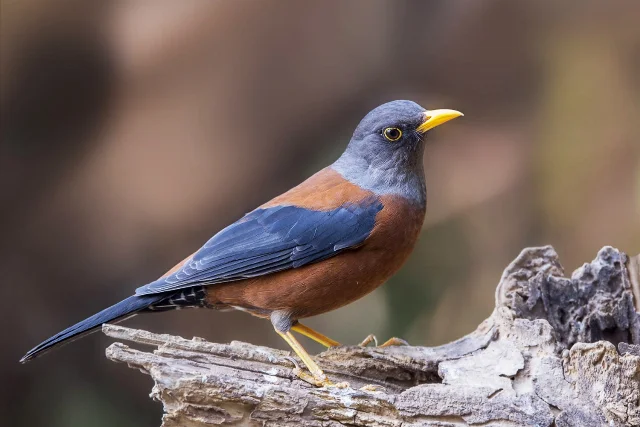
Standing at a size of 23-25 cm, the Spectacled Thrush presents an elegant and understated appearance that is perfectly suited for its environment. The bird's plumage is predominantly brown, providing effective camouflage against the bark of trees and the forest floor, where it frequently searches for food. This earthy brown coloration is complemented by subtle yellow tones, particularly around the eye-ring and the bill, which create the signature 'spectacled' look that gives the species its common name. The facial skin around the eyes is bare and yellowish, contrasting sharply with the darker, more muted tones of the head and wings. Its body is robust, typical of thrushes, with strong legs designed for hopping along branches and foraging on the ground. The underparts are usually a lighter, buffy brown, creating a soft transition from the darker back. Juveniles may show slight spotting on their breast, a common trait among young thrushes, which gradually fades as they reach adulthood. This combination of subtle coloration and distinct facial features makes them easily identifiable to those who know what to look for.
Habitat
The Spectacled Thrush exhibits a remarkable degree of environmental flexibility. While it is naturally a dweller of humid lowland forests and forest edges, it has successfully expanded its range into cultivated areas. You can frequently encounter this bird in shaded cocoa plantations, orchards, and even well-vegetated residential gardens. It prefers areas with a mix of dense canopy cover for nesting and open ground for foraging. Because it is highly adaptable, it is not strictly tied to primary rainforests. Instead, it thrives in secondary growth and fragmented landscapes, where it utilizes the diverse vegetation to remain hidden while staying close to reliable food sources. This adaptability is key to its widespread distribution across its range.
Diet
The diet of the Spectacled Thrush is omnivorous and opportunistic, reflecting its versatile nature. Primarily, it feeds on a variety of small fruits and berries, playing a crucial role in seed dispersal within its ecosystem. However, it is also a skilled forager of invertebrates. During the day, you will often see it hopping across lawns or leaf litter, using its bill to probe the soil for earthworms, insects, larvae, and small spiders. This balanced intake of plant and animal matter ensures it receives the necessary nutrients for energy-intensive activities like singing and nesting. Its ability to switch between fruit and insect sources makes it resilient even when seasonal food availability fluctuates.
Breeding and Nesting
Breeding for the Spectacled Thrush typically occurs during the wetter months, which coincide with an abundance of food for their offspring. The birds are known for their meticulous nest-building skills. They construct sturdy, cup-shaped nests using a combination of twigs, dried leaves, and mud, which acts as a binding agent to keep the structure secure. These nests are usually placed in the fork of a tree or on a sturdy branch, often well-hidden by foliage to protect against predators. The female is primarily responsible for the incubation of the eggs, which usually number between two and three. Both parents, however, are highly protective and actively participate in feeding the chicks once they hatch. The fledging period is a critical time, and the parents remain vigilant, defending their territory from intruders with characteristic vocalizations and aggressive posturing if necessary.
Behavior
Behaviorally, the Spectacled Thrush is often seen as a solitary or pair-bonded bird. It is most active during the early morning and late afternoon hours when temperatures are cooler. During these times, its melodic song echoes through its habitat, serving as a territorial claim and a mating call. When foraging, it displays a cautious yet bold demeanor, often freezing in place if it senses danger before quickly retreating to the safety of the canopy. It is not typically migratory, preferring to maintain a permanent territory year-round. Its interaction with other species is generally neutral, though it can be territorial when defending its immediate nesting site from rivals.
Conservation Status
-
LC
Least Concern
Currently, the Spectacled Thrush is classified as a species of Least Concern by major conservation organizations. Its ability to thrive in human-modified landscapes, such as agricultural areas and suburban gardens, has helped it maintain stable population numbers across its vast range. Despite this, they are still subject to the pressures of habitat loss and environmental pollution. Protecting remaining forest patches and encouraging the planting of native fruit-bearing trees in gardens can significantly support local populations, ensuring that this charming thrush continues to be a common sight for future generations.
Interesting Facts
- The Spectacled Thrush is named for the distinctive bare, yellow skin around its eyes.
- They are known for their clear, flute-like songs that are often heard at dawn.
- They are highly adaptable and frequently live in urban parks and residential gardens.
- The species plays an important role as a seed disperser for various tropical trees.
- Unlike many other bird species, they do not migrate and remain in their territory all year.
- They use mud as a key component to bind their nesting materials together for extra strength.
Tips for Birdwatchers
For birdwatchers hoping to spot the Spectacled Thrush, patience is your best tool. Because they are often found in gardens and forest edges, early morning is the optimal time to listen for their distinct, melodious calls. Instead of looking for bright colors, focus on the movement of birds on the ground or in the lower canopy. If you are in a tropical region, check near fruiting trees or areas with damp soil where they might be hunting for worms. Using a pair of binoculars with good low-light performance will help you identify the subtle yellow eye-ring that distinguishes them from other local thrush species. Keep your movements slow and minimize noise to avoid spooking them, as they are cautious creatures that prefer to remain shielded by leaves.
Conclusion
In conclusion, the Spectacled Thrush (Turdus nudigenis) is a remarkable example of avian adaptation in the neotropical region. Its ability to balance life in both pristine wild forests and human-altered landscapes makes it a unique subject for both casual birdwatchers and serious ornithological study. With its characteristic brown plumage, subtle yellow highlights, and the iconic 'spectacles' around its eyes, it is a bird that rewards the observant eye. By understanding its dietary needs, nesting habits, and behavior, we can better appreciate the ecological balance it maintains within its environment. As urban development continues to expand, the resilience of species like the Spectacled Thrush becomes increasingly important. We should strive to protect the green spaces they rely on, as these birds are not just beautiful to watch but are also vital contributors to the health of our local ecosystems. Whether you are hearing their flute-like songs at dawn or catching a glimpse of them hopping through your garden, the Spectacled Thrush is a persistent and delightful reminder of the nature that exists right in our own backyards. Protecting their habitat is a simple yet effective way to ensure the continued presence of this captivating perching bird for many years to come.
Spectacled Thrush Distribution Map & Range
The distribution map for this species will be available soon.
We are working with our official data partners to update this information.