Clay-colored Thrush Basic Information
| Scientific Name |
Turdus grayi
|
| Status |
LC
Least Concern
|
| Size |
23-26 cm (9-10 inch)
|
| Colors |
|
| Type |
|
| Family |
Thrushes |
Introduction
The Clay-colored Thrush (Turdus grayi), widely known as the Yigüirro, is a quintessential species of the neotropical landscape. As a medium-sized perching bird, it holds significant cultural importance, most notably serving as the national bird of Costa Rica. Its presence is synonymous with the onset of the rainy season, as its melodious and distinct song is often heard echoing through gardens, parks, and secondary forests during this time. Belonging to the thrush family, this bird is known for its relatively plain appearance, which belies its fascinating role in the ecosystem. It is a highly adaptable species, comfortably navigating both dense wilderness and the bustling environments of urban areas. For bird enthusiasts throughout Central and Northern South America, the Clay-colored Thrush is a familiar and cherished sight. Its ability to coexist with human development has made it one of the most well-studied and observed birds in its range. Understanding this species offers deep insight into the avian biodiversity of the tropical regions it calls home.
Physical Appearance
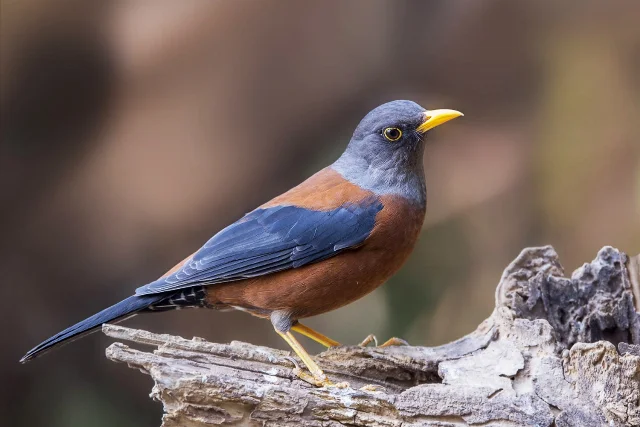
The Clay-colored Thrush is a medium-sized passerine, typically measuring between 23 and 26 centimeters in length. As its common name suggests, its primary plumage is a uniform, muted shade of clay-brown, which provides excellent camouflage against tree bark and leaf litter. This brownish coloration extends across the back, wings, and upper tail, while the underparts are slightly paler, often exhibiting a buffy or yellowish-brown wash. One of its most distinct physical features is its bill, which is a striking yellow, often contrasting sharply with the bird's otherwise subtle tones. The eyes are typically a reddish-brown color, and the legs are a dull, flesh-colored pink. There is very little sexual dimorphism in this species, meaning males and females look nearly identical, though males may appear slightly brighter during the breeding season. Juvenile birds are often spotted with darker streaks on their breast and back, providing them with extra protection as they grow. Its sleek, rounded body shape and relatively long tail are characteristic of the Turdus genus, allowing for graceful movement through the forest canopy.
Habitat
The Clay-colored Thrush is remarkably versatile, thriving in a wide variety of environments across its expansive range, which stretches from southern Texas down to northern Colombia. It is most frequently found in humid forests, forest edges, and semi-open landscapes. However, this species has successfully adapted to human-altered environments, making it a common fixture in suburban gardens, orchards, and urban parks. It prefers areas with a mix of dense shrubbery for nesting and open ground for foraging. Because it is not strictly tied to primary old-growth forests, it is often one of the first species to colonize secondary growth areas. The bird is typically found at elevations ranging from sea level up to approximately 2,500 meters, showing a high tolerance for varying temperatures and climatic conditions across its diverse geographical distribution.
Diet
The Clay-colored Thrush is an opportunistic omnivore, displaying a varied diet that shifts depending on the seasonal availability of food. Its primary sustenance consists of fruits and berries, which it consumes in large quantities, playing a vital role as a seed disperser within its ecosystem. When fruits are scarce, it turns to invertebrates, foraging on the ground for earthworms, insects, spiders, and small larvae. It is a common sight to see a Clay-colored Thrush hopping across lawns or leaf litter, using its yellow bill to probe the soil or flip over debris in search of prey. This foraging behavior is often done in a methodical, stop-and-start pattern that is characteristic of the thrush family. During the breeding season, the intake of protein-rich insects is increased to provide necessary nutrition for growing nestlings.
Breeding and Nesting
Breeding for the Clay-colored Thrush is closely tied to the arrival of the rainy season, which triggers an abundance of food for the chicks. The nesting process begins with the female constructing a sturdy, cup-shaped nest, usually positioned in a fork of a tree or a dense shrub, often near human dwellings to deter predators. The nest is meticulously crafted from mud, twigs, moss, and rootlets, providing a durable structure to support the clutch. A typical clutch consists of two to four eggs, which are pale blue or greenish with brown spots. Both parents share the responsibilities of defending the territory, though the female performs the bulk of the incubation. Once the eggs hatch after about two weeks, both adults work tirelessly to feed the nestlings a steady diet of invertebrates. The young birds fledge the nest within approximately 15 to 20 days after hatching, though they remain dependent on their parents for a short period thereafter.
Behavior
The Clay-colored Thrush is generally a solitary or pair-living bird, known for its active and inquisitive nature. It is highly territorial, particularly during the breeding season, when males will aggressively defend their chosen nesting site from intruders. One of its most famous behaviors is its complex and melodious song, which consists of a long, rambling series of whistles and trills. This song is particularly intense during the early morning hours and is believed to be a signal for the start of the rainy season. Despite their somewhat shy appearance, they are quite bold in suburban settings, often coming close to houses to forage. They are also known to engage in "anting," a behavior where they rub ants on their feathers to potentially rid themselves of parasites.
Conservation Status
-
LC
Least Concern
The Clay-colored Thrush is currently classified as a species of Least Concern by the IUCN. This status is largely due to its massive geographic range and its remarkable ability to adapt to human-modified landscapes. Unlike many tropical birds that require pristine primary forest, the Clay-colored Thrush thrives in gardens and agricultural areas. While habitat loss remains a general threat to many neotropical species, this bird's population remains stable, and it faces no immediate risk of extinction. Conservation efforts are not currently prioritized for this species, allowing scientists to focus resources on more vulnerable avian populations within the same regions.
Interesting Facts
- The Clay-colored Thrush is the official national bird of Costa Rica, known locally as the Yigüirro.
- It earned its national status because its song is traditionally associated with the arrival of the spring rains.
- Unlike many migratory birds, the Clay-colored Thrush is a permanent resident throughout most of its range.
- They are highly intelligent and have been observed learning to recognize individual humans who provide food in garden settings.
- Their nests are often reused by other smaller bird species once the thrushes have finished their breeding cycle.
- Despite being a thrush, they are much more comfortable around urban infrastructure than many of their forest-dwelling cousins.
Tips for Birdwatchers
For birdwatchers hoping to spot the Clay-colored Thrush, the best approach is to visit early in the morning when the birds are most vocal. Because they are so common in urban and suburban areas, you do not need to trek deep into the jungle to find them. Focus your attention on manicured lawns, fruit-bearing trees, and hedge rows, where they frequently forage on the ground. If you are visiting Central America, keep an ear out for their distinctive, rambling song, which is often the easiest way to locate them before seeing them. Carrying a pair of binoculars is helpful for observing their subtle plumage details and the bright yellow color of their bills. They are relatively habituated to humans, so moving slowly and maintaining a quiet presence will usually allow for excellent observation opportunities.
Conclusion
The Clay-colored Thrush is far more than just a common garden bird; it is a vital component of the neotropical ecosystem and a beloved cultural icon. Its resilience in the face of environmental change serves as a testament to the adaptability of the Turdus genus. Whether you are a casual backyard observer or a dedicated ornithologist, this bird provides endless opportunities for study and appreciation. By observing its behavior, from its industrious foraging to its soul-stirring song, one gains a deeper connection to the natural rhythms of the tropical environment. As we continue to modify our landscapes, the success of species like the Clay-colored Thrush reminds us that nature can thrive alongside us if given the opportunity. Protecting the habitats that support these birds—even small patches of garden—ensures that future generations will continue to enjoy the beautiful melodies of the Yigüirro. We encourage all bird enthusiasts to take a moment to look for this humble, brown-colored bird, as its presence is a gentle reminder of the wild beauty that exists in our very own backyards. Studying such a common species often leads to the most profound understanding of avian life and our shared environment.
Clay-colored Thrush Distribution Map & Range
The distribution map for this species will be available soon.
We are working with our official data partners to update this information.