Sooty Thrush Basic Information
| Scientific Name |
Turdus nigrescens
|
| Status |
LC
Least Concern
|
| Size |
24-26 cm (9-10 inch)
|
| Colors |
|
| Type |
|
| Family |
Thrushes |
Introduction
The Sooty Thrush (Turdus nigrescens) is a fascinating species of perching bird that belongs to the widespread thrush family, Turdidae. Often overlooked due to its somber coloration, this bird is a charismatic resident of the high-altitude regions of Central America, specifically within the highlands of Costa Rica and western Panama. As an expert in ornithology, I find the Sooty Thrush to be a remarkable example of adaptation to high-elevation cloud forests and páramo environments. Unlike its more brightly colored relatives, the Sooty Thrush possesses an understated elegance that fits perfectly into the misty, cool landscapes it calls home. Understanding this species offers valuable insights into the biodiversity of Neotropical montane ecosystems. Whether you are an avid birdwatcher or a nature enthusiast, the Sooty Thrush provides a rewarding sighting, particularly because of its habit of foraging in open areas, which makes it relatively easy to observe compared to more elusive forest-dwelling species. Throughout this guide, we will explore the nuances of its life, from its physical characteristics to its complex social behaviors and ecological importance.
Physical Appearance
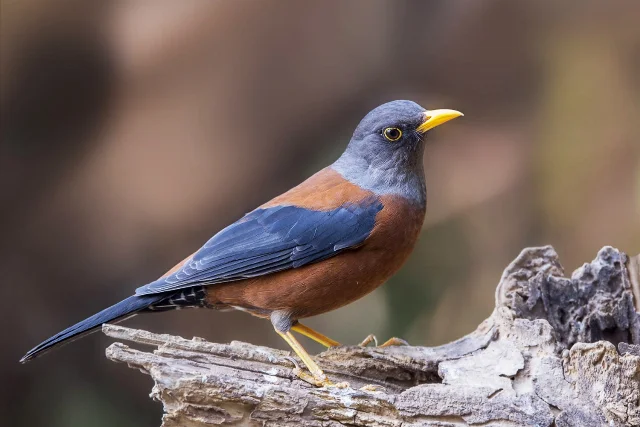
The Sooty Thrush is a medium-sized bird, typically measuring between 24 and 26 centimeters in length. As its name implies, the primary color of its plumage is a deep, smoky grey, which often appears nearly black under certain lighting conditions. The bird displays a striking contrast with its darker, almost black wings and tail, which are slightly darker than the main body plumage. One of the most distinctive features of the adult Sooty Thrush is its bright, contrasting eye-ring, which is typically a vibrant yellow or orange, making it stand out against the dark feathers of the head. Furthermore, the bill and legs are also a prominent yellow-orange color, adding a splash of brightness to an otherwise monochromatic appearance. Juveniles tend to look slightly different, often featuring streaked or mottled plumage on their underparts, which helps them blend into the dappled light of the forest undergrowth. This sexual monomorphism means that males and females generally look alike, making it difficult to distinguish between the sexes in the field without observing specific breeding behaviors.
Habitat
The Sooty Thrush is highly specialized, favoring high-altitude environments. It is primarily found in the mountain ranges of Costa Rica and western Panama, typically inhabiting elevations ranging from 2,000 to 3,500 meters above sea level. This species thrives in cool, humid conditions, commonly residing in oak forests, cloud forests, and the edges of the high-altitude páramo. It is frequently seen in areas where the forest transitions into open scrubland or pastures, which provide ample foraging opportunities. The Sooty Thrush is well-adapted to these misty, often chilly environments, utilizing the dense vegetation of the cloud forest for shelter while venturing into more open, anthropogenic landscapes to feed.
Diet
The diet of the Sooty Thrush is varied and opportunistic, fitting for its role as an omnivorous perching bird. It primarily feeds on a mixture of small fruits, berries, and invertebrates. During the fruit-bearing seasons, the Sooty Thrush plays a vital role in seed dispersal by consuming various montane plant species and distributing their seeds across its territory. When fruit is less abundant, the bird switches to a diet consisting of earthworms, insects, larvae, and other small invertebrates that it finds by foraging on the ground or within the leaf litter. Its habit of hopping along the forest floor and in open grassy areas makes it efficient at spotting movement in the soil, allowing it to maintain a stable caloric intake throughout the year.
Breeding and Nesting
Breeding for the Sooty Thrush generally occurs during the wetter months of the year, although timing can be influenced by local elevation and resource availability. This species is known for constructing a substantial, cup-shaped nest, which is meticulously built using a combination of moss, twigs, mud, and lined with softer materials like grasses or rootlets. The nest is typically positioned in the fork of a tree or on a sturdy branch, often well-hidden within the dense foliage of a cloud forest tree to protect it from predators. The female is primarily responsible for nest construction and incubation, laying a clutch of two to three eggs. Both parents are involved in the process of feeding the nestlings, bringing a steady supply of insects to ensure the rapid growth of the young birds until they are ready to fledge.
Behavior
The Sooty Thrush is generally a solitary bird, though it can be seen in small, loose groups, especially when food resources are concentrated. It is primarily a ground-foraging species, often observed hopping confidently across open ground or along the edges of forest trails. It is not particularly shy and can be quite inquisitive, often allowing observers to approach within a reasonable distance before flying to a nearby branch. Its song is a series of clear, melodic whistles, which are most frequently heard during the breeding season. Like many thrushes, it is territorial during the nesting period and will defend its immediate surroundings against intruders of its own or other species.
Conservation Status
-
LC
Least Concern
The Sooty Thrush is currently classified as a species of 'Least Concern' by the IUCN. While its range is somewhat restricted to the high-altitude mountain ranges of Central America, its population appears to be stable. The primary threats to this species include habitat loss due to deforestation, climate change affecting the delicate cloud forest ecosystems, and agricultural expansion. However, because it adapts well to forest edges and certain human-modified landscapes, it currently maintains a healthy presence within protected areas and national parks throughout its limited distribution in Costa Rica and Panama.
Interesting Facts
- The Sooty Thrush is closely related to the American Robin.
- Its bright yellow-orange bill and eye-ring are key diagnostic features.
- It is a vital seed disperser in high-altitude cloud forests.
- They are known to be quite bold and can often be seen near human infrastructure in the mountains.
- The bird's scientific name, Turdus nigrescens, translates roughly to 'blackish thrush'.
- They prefer cool, high-elevation environments that many other birds cannot tolerate.
Tips for Birdwatchers
For birdwatchers hoping to spot the Sooty Thrush, the best strategy is to visit high-elevation areas in Costa Rica or Panama, such as the Cerro de la Muerte or the Chiriquí highlands. Because they are often found on the ground or in low-lying bushes near forest edges, keep your eyes on the forest floor and open grassy clearings. They are relatively active throughout the day, but early morning and late afternoon are the best times to hear their melodic songs. Having a good pair of binoculars is essential, as the dark plumage can blend into the shadows of the forest. Patience is key; if you remain still near a known foraging area, these birds will often continue their business, allowing for excellent observation opportunities.
Conclusion
In conclusion, the Sooty Thrush (Turdus nigrescens) is a quintessential inhabitant of the high-altitude Neotropical montane forests. While it may not possess the vibrant colors of tropical parrots or hummingbirds, its subtle beauty and fascinating ecological role make it a species worthy of admiration. By understanding its specific habitat requirements, diet, and behavior, birdwatchers can better appreciate the complex life of this resilient perching bird. As we continue to face environmental challenges, species like the Sooty Thrush serve as important indicators of the health of our cloud forests. Their ability to thrive in these specialized environments reminds us of the importance of protecting high-elevation ecosystems. Whether you are observing them as they forage on the forest floor or hearing their melodic whistles echo through the mist, the Sooty Thrush offers a unique and rewarding experience for anyone dedicated to the study and enjoyment of avian wildlife. We hope this guide has provided you with a comprehensive overview of this remarkable thrush and inspires you to explore the beautiful highlands where it resides.
Sooty Thrush Distribution Map & Range
The distribution map for this species will be available soon.
We are working with our official data partners to update this information.