Perching Birds
avatar
Photo by Admin
Not available

Chestnut-bellied Thrush

Turdus fulviventris

Last update: 25 Jun 2026

Chestnut-bellied Thrush Basic Information

Scientific NameTurdus fulviventris
Status LC Least Concern
Size22-24 cm (9-9 inch)
Colors
Grey
Chestnut
Type
Perching Birds
type
FamilyThrushes

Introduction

The Chestnut-bellied Thrush (Turdus fulviventris) is a fascinating and elusive member of the Turdidae family, primarily found in the high-altitude regions of the Andes. As a distinct species of perching bird, it captures the interest of ornithologists and bird enthusiasts alike due to its specific ecological requirements and striking plumage. Often found in montane forests, this bird is known for its shy nature and its tendency to remain hidden within the dense canopy, making it a prized sighting for any avid birdwatcher exploring South American cloud forests.

Understanding the Chestnut-bellied Thrush requires a look into its unique role within the ecosystem. As a forest-dwelling species, it contributes to seed dispersal, playing a vital part in maintaining the health of its native environment. While it may not be as widely recognized as some of its lowland relatives, its presence is a strong indicator of a healthy, undisturbed montane ecosystem. This introduction serves to highlight the importance of studying such species, as they provide critical insights into avian evolution, adaptation to high-altitude living, and the delicate balance of tropical mountain habitats that are increasingly threatened by climate change and deforestation.

Physical Appearance

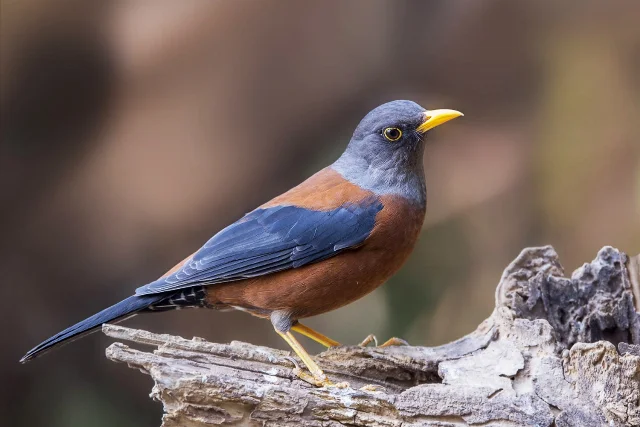
Measuring between 22 and 24 centimeters in length, the Chestnut-bellied Thrush possesses a robust build characteristic of the Turdus genus. Its physical appearance is defined by a sophisticated color palette that allows for effective camouflage within the dappled light of the forest understory. The primary color of the bird is a muted, slate-grey, which covers much of its upperparts, wings, and head. This grey coloration provides a neutral base that beautifully contrasts with the bird's namesake feature: a rich, deep chestnut hue that covers its belly and flanks. This warm coloration is the most reliable field mark for identifying the species in the wild.

Beyond its plumage, the bird features a distinct, slender bill, typically dark in color, which is perfectly adapted for foraging through leaf litter and picking fruit from branches. Its eyes are often framed by a subtle eye-ring, and its legs are strong, supporting its perching lifestyle. The wings are relatively rounded, typical of forest-dwelling thrushes, providing the necessary maneuverability for flight through dense vegetation. Juveniles may show slightly duller coloration or subtle spotting on the breast, which fades as they reach maturity, eventually displaying the solid, elegant contrast between the grey back and chestnut underparts that makes this species so visually appealing to observers.

Habitat

The Chestnut-bellied Thrush is primarily restricted to the humid montane forests of the Andes, spanning parts of Colombia, Ecuador, and Peru. These birds prefer high-altitude environments, typically ranging from 1,500 to 3,000 meters above sea level. They are most commonly encountered in the dense, moss-covered cloud forests where the humidity remains high and the vegetation is thick with epiphytes and ferns. Their habitat choice is dictated by the availability of dense cover, which provides protection from predators and shelter from the often harsh, misty weather conditions found at these elevations. Maintaining the integrity of these forest corridors is essential for the survival of the species.

Diet

As an omnivorous species, the Chestnut-bellied Thrush maintains a varied diet that shifts depending on the seasonal availability of food sources. Its primary diet consists of a wide array of small forest fruits, berries, and seeds, which it harvests directly from the branches or gathers from the forest floor. In addition to plant matter, these birds are opportunistic insectivores. They frequently forage in the leaf litter, using their bills to flip over damp leaves and debris in search of small invertebrates, such as beetles, larvae, and earthworms. This dual-feeding strategy ensures they receive the necessary protein for energy and the carbohydrates required for their daily activities.

Breeding and Nesting

The breeding season of the Chestnut-bellied Thrush is closely tied to the regional rainy cycles, which ensure a plentiful supply of food for the developing hatchlings. These birds are known for their meticulous nest-building skills. They construct cup-shaped nests, typically composed of a sturdy base of twigs, moss, and rootlets, which are then lined with mud and softer plant fibers to create a comfortable environment for the eggs. The nests are usually placed in the fork of a tree or hidden within thick tangles of vines, providing excellent concealment from potential nest predators.

Once the nest is secured, the female typically lays a clutch of two to three eggs, which are often pale blue or greenish with brown speckles. Both parents participate in the rearing process, with the female usually taking the lead on incubation while the male guards the territory and brings food to the nest. The chicks are altricial, meaning they hatch naked and helpless, requiring constant warmth and feeding. Over the course of several weeks, the parents work tirelessly to provide a high-protein diet of insects to the growing nestlings, ensuring they develop the strength and plumage necessary for their first flight from the nest.

Behavior

The Chestnut-bellied Thrush is characterized by its cautious and elusive behavior. Unlike more urban-adapted thrush species, this bird is notoriously shy, often fleeing into the dense foliage at the slightest hint of a disturbance. They are primarily solitary or found in pairs, maintaining territories that they defend through vocalizations. While they are not highly migratory, they may perform altitudinal movements in response to localized weather patterns or food shortages. Their flight is direct and somewhat labored, designed for short bursts of movement through the forest canopy rather than long-distance travel, reflecting their sedentary nature within their preferred high-altitude forest niches.

Conservation Status - LC Least Concern

Currently, the Chestnut-bellied Thrush is considered to be of 'Least Concern' on the IUCN Red List, though its population is closely linked to the health of Andean cloud forests. The primary threat to this species is habitat fragmentation caused by agricultural expansion, logging, and infrastructure development. Because they are highly specialized to specific montane environments, they have a limited capacity to adapt to degraded landscapes. Continued monitoring and the protection of primary forest reserves are essential to ensure this unique bird remains a stable part of the South American biodiversity landscape.

Interesting Facts

  1. The Chestnut-bellied Thrush is an expert at navigating the dense, misty understory of the Andes.
  2. They play a crucial role in forest regeneration by dispersing seeds of various native plants.
  3. This species is often referred to as a 'shy' bird by researchers due to its ability to vanish into foliage.
  4. Its chestnut belly serves as a diagnostic feature that separates it from similar-looking thrush species in the region.
  5. They possess a complex song that is most frequently heard during the early hours of the morning.
  6. The bird's nest is a masterwork of natural engineering, utilizing mud to bond forest materials together.

Tips for Birdwatchers

For birdwatchers hoping to spot the Chestnut-bellied Thrush, patience is the most important tool. Because this species is shy and prefers deep cover, you are unlikely to see it out in the open. Focus your efforts on the edges of trails in humid montane forests during the early morning or late afternoon, when the birds are most active. Use high-quality binoculars and practice 'pishing' or quiet listening, as their movement through the leaves often gives them away before they are seen. Avoid bright clothing and remain as still as possible to increase your chances of witnessing their natural foraging behavior.

Pro-Tip: To spot this bird in dense forest canopy, a 8x42 binoculars or telescope is highly recommended.
- [Check out our top recommended gear here]

Conclusion

In conclusion, the Chestnut-bellied Thrush (Turdus fulviventris) stands as a testament to the incredible avian diversity found within the Andean mountain ranges. Its striking appearance, characterized by the elegant transition from slate-grey to chestnut, makes it a highlight for any naturalist fortunate enough to encounter it in its natural habitat. Throughout this guide, we have explored the nuances of its physical traits, its specialized diet, and the complex nesting behaviors that ensure the survival of its next generation. These birds are not merely inhabitants of the forest; they are active participants in the ecological health of the cloud forest, contributing to the biodiversity that makes these regions so globally significant.

As we continue to navigate the challenges of a changing environment, the preservation of the high-altitude habitats required by the Chestnut-bellied Thrush becomes increasingly vital. Birdwatchers, scientists, and conservationists all play a role in advocating for the protection of these fragile ecosystems. By appreciating the beauty and the biological importance of such species, we foster a deeper connection to the natural world. May your future birding adventures bring you the patience and the luck needed to observe this magnificent thrush in the wild, and may your efforts contribute to a greater understanding and appreciation of all avian species that share our planet.

Chestnut-bellied Thrush Distribution Map & Range

The distribution map for this species will be available soon.

We are working with our official data partners to update this information.

Tag:

Share:

Previous
Next

Explore More Species in the Thrushes Family

23-25 cm
Abyssinian Ground-thrush
Geokichla piaggiae
22-24 cm
Abyssinian Thrush
Turdus abyssinicus
22-24 cm
African Thrush
Turdus pelios
25-27 cm
Alpine Thrush
Zoothera mollissima
27-30 cm
Amami Thrush
Zoothera major
Amaui
15-18 cm
Amaui
Myadestes woahensis
23-28 cm
American Robin
Turdus migratorius
Andean Slaty Thrush
22-24 cm
Andean Slaty Thrush
Turdus nigriceps
20-23 cm
Andean Solitaire
Myadestes ralloides
Ashy Thrush
21-23 cm
Ashy Thrush
Geokichla cinerea
25-28 cm
Austral Thrush
Turdus falcklandii
22-24 cm
Aztec Thrush
Ridgwayia pinicola
23-25 cm
Bare-eyed Thrush
Turdus tephronotus
Bassian Thrush
27-30 cm
Bassian Thrush
Zoothera lunulata
16-18 cm
Bicknell's Thrush
Catharus bicknelli
19-21 cm
Black Solitaire
Entomodestes coracinus
23-25 cm
Black Thrush
Turdus infuscatus
15-16 cm
Black-billed Nightingale-thrush
Catharus gracilirostris
Black-billed Thrush
23-25 cm
Black-billed Thrush
Turdus ignobilis
22-24 cm
Black-breasted Thrush
Turdus dissimilis
Black-eared Ground-thrush
20-22 cm
Black-eared Ground-thrush
Geokichla camaronensis
18-20 cm
Black-faced Solitaire
Myadestes melanops
15-16 cm
Black-headed Nightingale-thrush
Catharus mexicanus
Black-hooded Thrush
23-25 cm
Black-hooded Thrush
Turdus olivater
22-27 cm
Black-throated Thrush
Turdus atrogularis
22-25 cm
Bonin Thrush
Zoothera terrestris
Bougainville Thrush
22-24 cm
Bougainville Thrush
Zoothera atrigena
19-21 cm
Brown-backed Solitaire
Myadestes occidentalis
23-25 cm
Brown-headed Thrush
Turdus chrysolaus
Buru Thrush
20-22 cm
Buru Thrush
Geokichla dumasi
22-24 cm
Campina Thrush
Turdus arthuri
Chestnut Thrush
22-25 cm
Chestnut Thrush
Turdus rubrocanus
Chestnut-backed Thrush
20-23 cm
Chestnut-backed Thrush
Geokichla dohertyi
Chestnut-capped Thrush
20-22 cm
Chestnut-capped Thrush
Geokichla interpres
Chestnut-throated Solitaire
20-22 cm
Chestnut-throated Solitaire
Cichlopsis chubbi
27-30 cm
Chiguanco Thrush
Turdus chiguanco
23-28 cm
Chinese Blackbird
Turdus mandarinus
Chinese Thrush
24-27 cm
Chinese Thrush
Otocichla mupinensis
23-26 cm
Clay-colored Thrush
Turdus grayi
22-24 cm
Cocoa Thrush
Turdus fumigatus
23-25 cm
Comoro Thrush
Turdus bewsheri
22-25 cm
Creamy-bellied Thrush
Turdus amaurochalinus
Crossley's Ground-thrush
17-19 cm
Crossley's Ground-thrush
Geokichla crossleyi
Cuban Solitaire
20-22 cm
Cuban Solitaire
Myadestes elisabeth
24-25 cm
Dark-sided Thrush
Zoothera marginata
Dusky Thrush
23-25 cm
Dusky Thrush
Turdus eunomus
16-21 cm
Eastern Bluebird
Sialia sialis
Eastern Red-legged Thrush
24-27 cm
Eastern Red-legged Thrush
Turdus ardosiaceus
Eastern Slaty Thrush
21-23 cm
Eastern Slaty Thrush
Turdus subalaris
21-23 cm
Ecuadorian Thrush
Turdus maculirostris
Enggano Thrush
21-23 cm
Enggano Thrush
Geokichla leucolaema
Ethiopian Thrush
22-24 cm
Ethiopian Thrush
Psophocichla simensis
24-26 cm
Eurasian Blackbird
Turdus merula
Everett's Thrush
20-22 cm
Everett's Thrush
Zoothera everetti
21-23 cm
Eyebrowed Thrush
Turdus obscurus
Fawn-breasted Thrush
22-24 cm
Fawn-breasted Thrush
Zoothera machiki
22-27 cm
Fieldfare
Turdus pilaris
Finsch's Flycatcher-thrush
17-19 cm
Finsch's Flycatcher-thrush
Stizorhina finschi
Floodplain Thrush
20-22 cm
Floodplain Thrush
Turdus debilis
Forest Thrush
23-25 cm
Forest Thrush
Turdus lherminieri
Fruithunter
26-29 cm
Fruithunter
Chlamydochaera jefferyi
Geomalia
27-30 cm
Geomalia
Zoothera heinrichi
Glossy-black Thrush
24-27 cm
Glossy-black Thrush
Turdus serranus
15-16 cm
Gould's Nightingale-thrush
Catharus dryas
Grand Cayman Thrush
25-28 cm
Grand Cayman Thrush
Turdus ravidus
19-23 cm
Grandala
Grandala coelicolor
28-32 cm
Great Thrush
Turdus fuscater
25-28 cm
Green Cochoa
Cochoa viridis
Grey Ground-thrush
21-23 cm
Grey Ground-thrush
Geokichla princei
22-24 cm
Grey-backed Thrush
Turdus hortulorum
16-19 cm
Grey-cheeked Thrush
Catharus minimus
20-23 cm
Grey-sided Thrush
Turdus feae
Grey-winged Blackbird
27-29 cm
Grey-winged Blackbird
Turdus boulboul
Groundscraper Thrush
22-24 cm
Groundscraper Thrush
Psophocichla litsitsirupa
Guadalcanal Thrush
23-26 cm
Guadalcanal Thrush
Zoothera turipavae
Guianan Solitaire
18-20 cm
Guianan Solitaire
Cichlopsis gularis
20-22 cm
Hauxwell's Thrush
Turdus hauxwelli
15-18 cm
Hermit Thrush
Catharus guttatus
25-27 cm
Himalayan Forest Thrush
Zoothera salimalii
19-22 cm
Indian Blackbird
Turdus simillimus
Island Thrush
20-25 cm
Island Thrush
Turdus poliocephalus
22-24 cm
Izu Thrush
Turdus celaenops
22-24 cm
Japanese Thrush
Turdus cardis
Javan Cochoa
23-25 cm
Javan Cochoa
Cochoa azurea
Kamao
18-20 cm
Kamao
Myadestes myadestinus
22-25 cm
Karoo Thrush
Turdus smithi
20-23 cm
Kurrichane Thrush
Turdus libonyana
La Selle Thrush
23-25 cm
La Selle Thrush
Turdus swalesi
Lawrence's Thrush
19-21 cm
Lawrence's Thrush
Turdus lawrencii
26-30 cm
Long-billed Thrush
Zoothera monticola
25-27 cm
Long-tailed Thrush
Zoothera dixoni
Makira Thrush
25-28 cm
Makira Thrush
Zoothera margaretae
23-25 cm
Maranon Thrush
Turdus maranonicus
26-29 cm
Mistle Thrush
Turdus viscivorus
16-20 cm
Mountain Bluebird
Sialia currucoides
23-25 cm
Mountain Thrush
Turdus plebejus
23-25 cm
Naumann's Thrush
Turdus naumanni
New Britain Thrush
21-23 cm
New Britain Thrush
Zoothera talaseae
Northern Red-legged Thrush
24-27 cm
Northern Red-legged Thrush
Turdus plumbeus
Oberlander's Ground-thrush
19-22 cm
Oberlander's Ground-thrush
Geokichla oberlaenderi
24-26 cm
Olive Thrush
Turdus olivaceus
Olomao
18-20 cm
Olomao
Myadestes lanaiensis
Omao
17-19 cm
Omao
Myadestes obscurus
Orange Ground-thrush
21-24 cm
Orange Ground-thrush
Geokichla gurneyi
Orange-banded Thrush
20-22 cm
Orange-banded Thrush
Geokichla peronii
15-16 cm
Orange-billed Nightingale-thrush
Catharus aurantiirostris
20-23 cm
Orange-headed Thrush
Geokichla citrina
21-23 cm
Pale Thrush
Turdus pallidus
22-24 cm
Pale-breasted Thrush
Turdus leucomelas
22-24 cm
Pale-eyed Thrush
Turdus leucops
22-24 cm
Pale-vented Thrush
Turdus obsoletus
Peruvian Solitaire
19-21 cm
Peruvian Solitaire
Cichlopsis peruviana
22-23 cm
Pied Thrush
Geokichla wardii
23-26 cm
Plumbeous-backed Thrush
Turdus reevei
24-26 cm
Principe Thrush
Turdus xanthorhynchus
Puaiohi
17-19 cm
Puaiohi
Myadestes palmeri
25-28 cm
Purple Cochoa
Cochoa purpurea
Red-and-black Thrush
22-25 cm
Red-and-black Thrush
Geokichla mendeni
Red-backed Thrush
23-26 cm
Red-backed Thrush
Geokichla erythronota
Red-tailed Ant-thrush
18-20 cm
Red-tailed Ant-thrush
Neocossyphus rufus
19-23 cm
Redwing
Turdus iliacus
23-25 cm
Ring Ouzel
Turdus torquatus
15-16 cm
Ruddy-capped Nightingale-thrush
Catharus frantzii
18-20 cm
Rufous Flycatcher-thrush
Stizorhina fraseri
Rufous-backed Thrush
22-25 cm
Rufous-backed Thrush
Turdus rufopalliatus
22-25 cm
Rufous-bellied Thrush
Turdus rufiventris
19-21 cm
Rufous-brown Solitaire
Cichlopsis leucogenys
22-24 cm
Rufous-collared Thrush
Turdus rufitorques
Rufous-throated Solitaire
20-22 cm
Rufous-throated Solitaire
Myadestes genibarbis
21-25 cm
Rufous-throated Thrush
Turdus ruficollis
15-17 cm
Russet Nightingale-thrush
Catharus occidentalis
16-18 cm
Russet-backed Thrush
Catharus ustulatus
Russet-tailed Thrush
27-30 cm
Russet-tailed Thrush
Zoothera heinei
San Lucas Robin
22-25 cm
San Lucas Robin
Turdus confinis
Sao Tome Thrush
23-25 cm
Sao Tome Thrush
Turdus olivaceofuscus
27-30 cm
Scaly Thrush
Zoothera dauma
15-16 cm
Sclater's Nightingale-thrush
Catharus maculatus
Seram Thrush
22-24 cm
Seram Thrush
Geokichla joiceyi
20-23 cm
Siberian Thrush
Geokichla sibirica
Sichuan Forest Thrush
25-28 cm
Sichuan Forest Thrush
Zoothera griseiceps
19-21 cm
Slate-colored Solitaire
Myadestes unicolor
15-17 cm
Slaty-backed Nightingale-thrush
Catharus fuscater
Slaty-backed Thrush
22-24 cm
Slaty-backed Thrush
Geokichla schistacea
Somali Thrush
22-24 cm
Somali Thrush
Turdus ludoviciae
Sombre Thrush
22-25 cm
Sombre Thrush
Turdus anthracinus
20-23 cm
Song Thrush
Turdus philomelos
24-26 cm
Sooty Thrush
Turdus nigrescens
23-25 cm
Spectacled Thrush
Turdus nudigenis
Spot-winged Thrush
24-26 cm
Spot-winged Thrush
Geokichla spiloptera
Spotted Ground-thrush
20-23 cm
Spotted Ground-thrush
Geokichla guttata
Sulawesi Thrush
23-25 cm
Sulawesi Thrush
Cataponera turdoides
Sumatran Cochoa
23-25 cm
Sumatran Cochoa
Cochoa beccarii
Sunda Thrush
27-30 cm
Sunda Thrush
Zoothera andromedae
Swainson's Thrush
16-18 cm
Swainson's Thrush
Catharus swainsoni
20-22 cm
Taita Thrush
Turdus helleri
Taiwan Thrush
25-28 cm
Taiwan Thrush
Turdus niveiceps
25-29 cm
Tibetan Blackbird
Turdus maximus
20-22 cm
Tickells Thrush
Turdus unicolor
20-23 cm
Townsend's Solitaire
Myadestes townsendi
Tristan Thrush
22-24 cm
Tristan Thrush
Turdus eremita
22-24 cm
Unicolored Thrush
Turdus haplochrous
20-22 cm
Usambara Thrush
Turdus roehli
20-22 cm
Varied Solitaire
Myadestes coloratus
20-26 cm
Varied Thrush
Ixoreus naevius
Varzea Thrush
20-22 cm
Varzea Thrush
Turdus sanchezorum
16-18 cm
Veery
Catharus fuscescens
15-18 cm
Western Bluebird
Sialia mexicana
Western Red-legged Thrush
24-27 cm
Western Red-legged Thrush
Turdus rubripes
White-backed Thrush
23-25 cm
White-backed Thrush
Turdus kessleri
White-chinned Thrush
23-25 cm
White-chinned Thrush
Turdus aurantius
25-28 cm
White-collared Blackbird
Turdus albocinctus
White-eared Solitaire
19-21 cm
White-eared Solitaire
Entomodestes leucotis
White-eyed Thrush
22-24 cm
White-eyed Thrush
Turdus jamaicensis
23-25 cm
White-necked Thrush
Turdus albicollis
18-20 cm
White-tailed Ant-thrush
Neocossyphus poensis
22-24 cm
White-throated Thrush
Turdus assimilis
27-30 cm
Whites Thrush
Zoothera aurea
19-21 cm
Wood Thrush
Hylocichla mustelina
21-23 cm
Yellow-legged Thrush
Turdus flavipes
Yemen Thrush
23-25 cm
Yemen Thrush
Turdus menachensis