Great Thrush Basic Information
| Scientific Name |
Turdus fuscater
|
| Status |
LC
Least Concern
|
| Size |
28-32 cm (11-13 inch)
|
| Colors |
|
| Type |
|
| Family |
Thrushes |
Introduction
The Great Thrush (Turdus fuscater) is a prominent and charismatic member of the Turdidae family, widely recognized across the high-altitude landscapes of the Andes. As one of the largest members of the thrush genus, this bird is a staple of cloud forests and paramo ecosystems. Often found foraging in open spaces or perched conspicuously on high branches, the Great Thrush is a bird that captures the attention of both amateur birdwatchers and serious ornithologists alike. Its resilient nature allows it to thrive in diverse environments, ranging from dense, misty forests to the carefully manicured gardens of high-altitude cities like Bogota and Quito. Understanding the Great Thrush requires looking beyond its somber plumage to appreciate its complex role in the ecosystem, particularly as a seed disperser. This guide provides a comprehensive overview of this fascinating species, offering insights into its biology, behaviors, and the best ways to observe it in its natural environment.
Physical Appearance
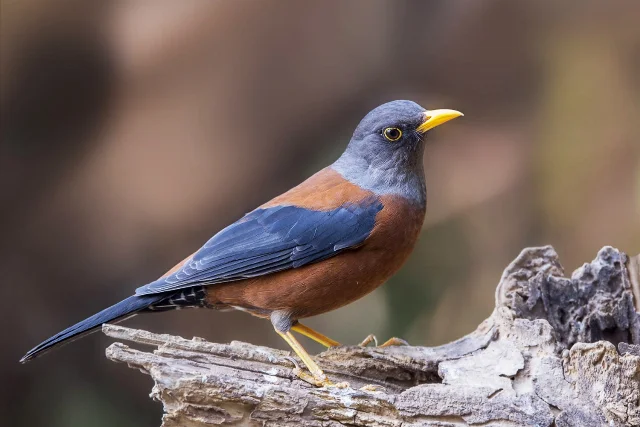
The Great Thrush is a robust and large-bodied bird, typically measuring between 28 and 32 cm in length. Its plumage is predominantly a uniform, dusky grey, which can sometimes appear almost black depending on the light conditions, particularly across the wings and tail. One of its most striking physical features is the bright, contrasting color of its bill and eye-ring, which are usually a vivid yellow or orange, adding a splash of color to its otherwise muted appearance. The legs and feet are also distinctively colored, often matching the intensity of the bill. Juveniles may show slight mottling on their chest, but adults maintain a consistent, solid coloration. This monochromatic appearance serves as an excellent camouflage against the shadowed understory of mountain forests, though their large size makes them easily distinguishable from other smaller thrush species found in the same region.
Habitat
The Great Thrush is primarily an Andean specialist, with a range that extends from Venezuela through Colombia, Ecuador, Peru, and Bolivia. It thrives in high-altitude environments, typically inhabiting areas between 2,000 and 4,000 meters above sea level. Its preferred habitats include humid montane forests, forest edges, and scrublands. Interestingly, this species has successfully adapted to human-altered landscapes, frequently occurring in suburban parks, gardens, and agricultural areas. By remaining at high elevations, the Great Thrush avoids competition with lower-elevation thrush species. Its ability to navigate both dense, moss-covered trees and open urban spaces demonstrates a high level of ecological plasticity, making it one of the most visible birds in the Andean highlands.
Diet
As an omnivorous species, the Great Thrush possesses a varied diet that changes based on seasonal availability. Its primary food source consists of small fruits and berries, which it consumes in large quantities, making it an essential seed disperser for many high-altitude plant species. When fruits are scarce, the Great Thrush shifts its focus to protein-rich food items, including earthworms, insects, larvae, and other small invertebrates. It is often seen hopping across lawns or forest floors, using its sturdy bill to probe the soil for prey. This adaptability ensures that the Great Thrush can maintain its energy levels throughout the year, regardless of the fluctuating food supplies typical of mountainous climates.
Breeding and Nesting
The breeding biology of the Great Thrush is characterized by a strong commitment to territory and nest defense. Breeding typically occurs during the wetter months when food resources are most abundant. The nest is a bulky, cup-shaped structure meticulously constructed from twigs, moss, mud, and rootlets, usually placed in the fork of a tree or a dense shrub. Females are primarily responsible for the incubation of the eggs, which usually number two to three per clutch. Both parents take an active role in feeding the nestlings, often becoming quite aggressive toward potential intruders near the nest site. Once the chicks fledge, the parents continue to provide care for a short period, ensuring the young birds learn to forage successfully before becoming fully independent members of the local population.
Behavior
The Great Thrush is known for its bold and curious demeanor, often showing little fear of humans, especially in urban environments. They are primarily ground-foragers, moving with a characteristic hopping gait while scanning for food. During the breeding season, they become highly territorial, often engaging in vocal duels or physical displays to drive away rivals. Their song is a complex, melodic series of whistles and trills, which is most frequently heard during the early morning hours. When threatened, they emit sharp, alarm calls that alert other birds in the vicinity. This species is generally solitary or found in pairs, rarely forming large flocks except when food is exceptionally abundant in a single location.
Conservation Status
-
LC
Least Concern
According to the IUCN Red List, the Great Thrush is classified as Least Concern. Its population remains stable due to its wide distribution range and its remarkable ability to adapt to human-modified landscapes. While deforestation in the Andes poses a threat to many specialized species, the Great Thrush has managed to integrate into urban settings, which provides a buffer against habitat loss. However, ongoing monitoring is still necessary to ensure that local populations remain healthy, particularly in areas where intensive land-use changes are fragmenting the native montane ecosystems.
Interesting Facts
- The Great Thrush is one of the largest members of the entire Turdidae family.
- They play a critical role in the reforestation of the Andes by dispersing seeds.
- Unlike many shy forest birds, they have adapted well to living in high-altitude cities.
- They are known to be quite territorial and will defend their nesting sites against much larger birds.
- Their song is considered one of the most pleasant sounds in the high Andean forests.
Tips for Birdwatchers
For birdwatchers hoping to spot the Great Thrush, focus your efforts on high-altitude parks or botanical gardens within the Andean region. Because they are common, you do not need to venture deep into remote wilderness to find them. Early morning is the best time for observation, as the birds are most active and vocal. Carry a pair of 8x42 binoculars to get a clear view of their distinct yellow bills against their grey plumage. If you are in a garden, look for them hopping on the grass near trees. Stay patient and quiet, and you will likely see them foraging or perching on a prominent branch, providing excellent photo opportunities.
Conclusion
In conclusion, the Great Thrush (Turdus fuscater) stands as a testament to biological resilience and evolutionary success within the challenging Andean environment. Its ability to transition seamlessly between the deep, misty cloud forests and the bustling urban centers of South America highlights its unique position as a bridge between wild and human-altered habitats. By performing the essential service of seed dispersal, this species sustains the very forests that provide it with shelter and sustenance. For birdwatchers, the Great Thrush offers an accessible and rewarding subject, providing endless opportunities to observe complex territorial behaviors and parental care. As we continue to modify our natural landscapes, species like the Great Thrush remind us of the importance of maintaining ecological connectivity. Whether you are an expert ornithologist or a casual backyard observer, the presence of the Great Thrush is a constant reminder of the vibrant biodiversity that exists in the high altitudes of the Andes. Protecting their habitat ensures that this iconic bird will continue to thrive for generations to come, enriching our natural world with its presence and song.
Great Thrush Distribution Map & Range
The distribution map for this species will be available soon.
We are working with our official data partners to update this information.