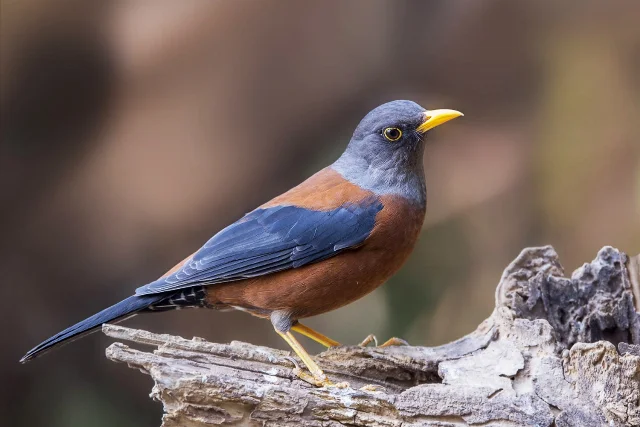
Perching Birds
avatar
Photo by Admin
Not available
Glossy-black Thrush

Glossy-black Thrush

Turdus serranus

Last update: 25 Jun 2026

Glossy-black Thrush Basic Information

Scientific NameTurdus serranus
Status LC Least Concern
Size24-27 cm (9-11 inch)
Colors
Black
Yellow
Type
Perching Birds
type
FamilyThrushes

Introduction

The Glossy-black Thrush (Turdus serranus) is a captivating member of the Turdidae family, celebrated by ornithologists and bird enthusiasts alike for its elegant appearance and elusive nature. Inhabiting the lush, high-altitude landscapes of the Andes, this perching bird serves as a vital component of its ecosystem. As a medium-sized thrush, it is often identified by its namesake plumage, which catches the light in dense cloud forests. Understanding the Glossy-black Thrush requires a deep dive into its specialized habitat preferences and its role as a seed disperser within the montane environment. Despite being relatively common in specific high-elevation pockets, it remains a bird that requires patience and keen observation to spot. Throughout this guide, we explore the intricate details of its life cycle, physical attributes, and the ecological significance of this remarkable avian species. Whether you are a seasoned birder or a nature enthusiast, the Glossy-black Thrush offers a fascinating glimpse into the biodiversity of South American mountain ranges.

Physical Appearance

Measuring between 24 and 27 cm in length, the Glossy-black Thrush is a medium-sized member of the thrush family with a robust build. Its primary coloration is a deep, velvety black, which provides the bird with its distinct name. This plumage is not merely flat; under direct sunlight, it exhibits a subtle, metallic sheen that highlights the bird's sleek silhouette. A notable secondary characteristic is its bright yellow or orange-yellow bill and matching orbital ring around the eyes, which contrast sharply against the dark feathers. These features are particularly vivid in adult males, while females may display slightly duller or brownish-black tones, aiding in camouflage within the shadows of the forest canopy. The legs and feet are typically a dark, sturdy shade, perfectly adapted for perching on thick branches. Its wings are relatively broad, allowing for agile movement through dense foliage, while its tail is long and squared, assisting in balance during foraging. Overall, the Glossy-black Thrush possesses a sophisticated and minimalist appearance that perfectly suits its mysterious, high-altitude home.

Habitat

The Glossy-black Thrush is primarily a resident of the Andean montane forests, thriving at elevations ranging from 1,500 to 3,000 meters above sea level. It favors humid cloud forests and forest edges where the vegetation is dense and moisture is abundant. These birds are rarely seen in open areas, preferring the security of the thick understory and the mid-level canopy. They are frequently found in areas with secondary growth and near ravines where fruit-bearing trees are plentiful. Their reliance on high-altitude forests makes them sensitive to habitat fragmentation, as they require specific thermal conditions provided by the cloud forest ecosystem to maintain their metabolic balance and nesting success.

Diet

As an omnivorous species, the Glossy-black Thrush maintains a diverse diet that supports its energetic lifestyle in the mountains. Its primary food sources consist of various small fruits, berries, and seeds found throughout the forest canopy. By consuming these fruits, the bird plays a crucial role in seed dispersal, helping to regenerate the montane forest flora. Additionally, during the breeding season or when fruit is scarce, it supplements its diet with small invertebrates, including earthworms, beetles, and larvae found in the leaf litter. This dual-feeding strategy allows the Glossy-black Thrush to remain resilient across different seasons, ensuring it always finds enough sustenance to survive in the competitive high-altitude environment.

Breeding and Nesting

The breeding biology of the Glossy-black Thrush is a testament to its adaptability. During the nesting season, pairs engage in elaborate displays to secure their territory. They construct bulky, cup-shaped nests, typically woven from mosses, twigs, and mud, positioned securely in the fork of a tree or on a protected ledge covered by dense vegetation. A typical clutch consists of two to three eggs, which are often pale blue with dark speckles. Both parents share the responsibility of incubating the eggs and feeding the altricial chicks once they hatch. The dense forest cover provides essential protection from predators, allowing the fledglings to develop safely. Parental care is rigorous, with the adults making numerous trips to provide protein-rich insects to the growing young until they are ready to fledge the nest after several weeks.

Behavior

The Glossy-black Thrush is generally a shy and solitary bird, though it can be seen in pairs during the breeding season. It is most active during the early morning and late afternoon, often moving through the branches with a series of quick, hopping motions. Unlike some more vocal thrushes, it is relatively quiet, though it does emit soft, melodic songs and sharp alarm calls when threatened. It is highly territorial, frequently defending its chosen patch of forest from intruders. Its behavior is characterized by a cautious nature, often freezing in place when it senses a potential predator, relying on its dark plumage to blend into the shadows.

Conservation Status - LC Least Concern

Currently, the Glossy-black Thrush is classified as Least Concern by the IUCN. However, this status does not imply that the species is free from threats. Its specialized habitat in the high Andes is increasingly vulnerable to deforestation, agricultural expansion, and the impacts of climate change. As a species that relies on stable, humid forest conditions, any significant shift in temperature or precipitation patterns could negatively affect its population density. Conservation efforts should focus on protecting remaining montane corridors and ensuring that the high-altitude forests it inhabits remain intact and connected for future generations.

Interesting Facts

  1. The Glossy-black Thrush is an important seed disperser for many high-altitude plant species.
  2. Its bright yellow bill serves as a key visual signal during courtship displays.
  3. They are known for their ability to thrive in extremely humid, mist-heavy environments.
  4. The bird often uses mud to reinforce the structural integrity of its nest.
  5. Despite their name, females are often slightly brownish rather than pure black.
  6. They are primarily found in the tropical Andes, spanning countries like Colombia, Ecuador, and Peru.

Tips for Birdwatchers

To successfully spot the Glossy-black Thrush, birdwatchers should head to high-elevation cloud forests during the early dawn hours, when the species is most active. Use high-quality binoculars to scan the mid-canopy level, as this is where they spend the majority of their time foraging. Because they are shy, moving slowly and remaining quiet is essential to avoid startling them. Focus your search on fruiting trees, as these are the most reliable spots to find them feeding. Patience is your greatest tool; wait near a quiet forest edge and listen for their subtle calls, which often precede a sighting. If you are birding in the Andes, hiring a local guide who knows the specific patches of forest preferred by this thrush will significantly increase your chances of success.

Pro-Tip: To spot this bird in dense forest canopy, a 8x42 binoculars or telescope is highly recommended.
- [Check out our top recommended gear here]

Conclusion

In conclusion, the Glossy-black Thrush (Turdus serranus) is a quintessential example of the specialized avian life found within the Andean cloud forests. From its striking black plumage and vibrant yellow bill to its essential role in maintaining the forest ecosystem through seed dispersal, this bird is a fascinating subject for any naturalist. While it is currently considered a stable species, its reliance on specific, fragile high-altitude habitats serves as a reminder of the importance of forest conservation. For birdwatchers, the challenge of locating this elusive thrush provides a rewarding experience that highlights the beauty and complexity of South American biodiversity. By studying and protecting species like the Glossy-black Thrush, we contribute to the broader understanding of mountain ecosystems and ensure that these magnificent birds continue to thrive in their natural homes. Whether you encounter one on a misty trail or simply admire its profile in a field guide, the Glossy-black Thrush remains a true gem of the avian world, embodying the quiet, resilient spirit of the high Andes.

Glossy-black Thrush Distribution Map & Range

The distribution map for this species will be available soon.

We are working with our official data partners to update this information.

Tag:

Share:

Previous
Next

Explore More Species in the Thrushes Family

23-25 cm
Abyssinian Ground-thrush
Geokichla piaggiae
22-24 cm
Abyssinian Thrush
Turdus abyssinicus
22-24 cm
African Thrush
Turdus pelios
25-27 cm
Alpine Thrush
Zoothera mollissima
27-30 cm
Amami Thrush
Zoothera major
Amaui
15-18 cm
Amaui
Myadestes woahensis
23-28 cm
American Robin
Turdus migratorius
Andean Slaty Thrush
22-24 cm
Andean Slaty Thrush
Turdus nigriceps
20-23 cm
Andean Solitaire
Myadestes ralloides
Ashy Thrush
21-23 cm
Ashy Thrush
Geokichla cinerea
25-28 cm
Austral Thrush
Turdus falcklandii
22-24 cm
Aztec Thrush
Ridgwayia pinicola
23-25 cm
Bare-eyed Thrush
Turdus tephronotus
Bassian Thrush
27-30 cm
Bassian Thrush
Zoothera lunulata
16-18 cm
Bicknell's Thrush
Catharus bicknelli
19-21 cm
Black Solitaire
Entomodestes coracinus
23-25 cm
Black Thrush
Turdus infuscatus
15-16 cm
Black-billed Nightingale-thrush
Catharus gracilirostris
Black-billed Thrush
23-25 cm
Black-billed Thrush
Turdus ignobilis
22-24 cm
Black-breasted Thrush
Turdus dissimilis
Black-eared Ground-thrush
20-22 cm
Black-eared Ground-thrush
Geokichla camaronensis
18-20 cm
Black-faced Solitaire
Myadestes melanops
15-16 cm
Black-headed Nightingale-thrush
Catharus mexicanus
Black-hooded Thrush
23-25 cm
Black-hooded Thrush
Turdus olivater
22-27 cm
Black-throated Thrush
Turdus atrogularis
22-25 cm
Bonin Thrush
Zoothera terrestris
Bougainville Thrush
22-24 cm
Bougainville Thrush
Zoothera atrigena
19-21 cm
Brown-backed Solitaire
Myadestes occidentalis
23-25 cm
Brown-headed Thrush
Turdus chrysolaus
Buru Thrush
20-22 cm
Buru Thrush
Geokichla dumasi
22-24 cm
Campina Thrush
Turdus arthuri
Chestnut Thrush
22-25 cm
Chestnut Thrush
Turdus rubrocanus
Chestnut-backed Thrush
20-23 cm
Chestnut-backed Thrush
Geokichla dohertyi
22-24 cm
Chestnut-bellied Thrush
Turdus fulviventris
Chestnut-capped Thrush
20-22 cm
Chestnut-capped Thrush
Geokichla interpres
Chestnut-throated Solitaire
20-22 cm
Chestnut-throated Solitaire
Cichlopsis chubbi
27-30 cm
Chiguanco Thrush
Turdus chiguanco
23-28 cm
Chinese Blackbird
Turdus mandarinus
Chinese Thrush
24-27 cm
Chinese Thrush
Otocichla mupinensis
23-26 cm
Clay-colored Thrush
Turdus grayi
22-24 cm
Cocoa Thrush
Turdus fumigatus
23-25 cm
Comoro Thrush
Turdus bewsheri
22-25 cm
Creamy-bellied Thrush
Turdus amaurochalinus
Crossley's Ground-thrush
17-19 cm
Crossley's Ground-thrush
Geokichla crossleyi
Cuban Solitaire
20-22 cm
Cuban Solitaire
Myadestes elisabeth
24-25 cm
Dark-sided Thrush
Zoothera marginata
Dusky Thrush
23-25 cm
Dusky Thrush
Turdus eunomus
16-21 cm
Eastern Bluebird
Sialia sialis
Eastern Red-legged Thrush
24-27 cm
Eastern Red-legged Thrush
Turdus ardosiaceus
Eastern Slaty Thrush
21-23 cm
Eastern Slaty Thrush
Turdus subalaris
21-23 cm
Ecuadorian Thrush
Turdus maculirostris
Enggano Thrush
21-23 cm
Enggano Thrush
Geokichla leucolaema
Ethiopian Thrush
22-24 cm
Ethiopian Thrush
Psophocichla simensis
24-26 cm
Eurasian Blackbird
Turdus merula
Everett's Thrush
20-22 cm
Everett's Thrush
Zoothera everetti
21-23 cm
Eyebrowed Thrush
Turdus obscurus
Fawn-breasted Thrush
22-24 cm
Fawn-breasted Thrush
Zoothera machiki
22-27 cm
Fieldfare
Turdus pilaris
Finsch's Flycatcher-thrush
17-19 cm
Finsch's Flycatcher-thrush
Stizorhina finschi
Floodplain Thrush
20-22 cm
Floodplain Thrush
Turdus debilis
Forest Thrush
23-25 cm
Forest Thrush
Turdus lherminieri
Fruithunter
26-29 cm
Fruithunter
Chlamydochaera jefferyi
Geomalia
27-30 cm
Geomalia
Zoothera heinrichi
15-16 cm
Gould's Nightingale-thrush
Catharus dryas
Grand Cayman Thrush
25-28 cm
Grand Cayman Thrush
Turdus ravidus
19-23 cm
Grandala
Grandala coelicolor
28-32 cm
Great Thrush
Turdus fuscater
25-28 cm
Green Cochoa
Cochoa viridis
Grey Ground-thrush
21-23 cm
Grey Ground-thrush
Geokichla princei
22-24 cm
Grey-backed Thrush
Turdus hortulorum
16-19 cm
Grey-cheeked Thrush
Catharus minimus
20-23 cm
Grey-sided Thrush
Turdus feae
Grey-winged Blackbird
27-29 cm
Grey-winged Blackbird
Turdus boulboul
Groundscraper Thrush
22-24 cm
Groundscraper Thrush
Psophocichla litsitsirupa
Guadalcanal Thrush
23-26 cm
Guadalcanal Thrush
Zoothera turipavae
Guianan Solitaire
18-20 cm
Guianan Solitaire
Cichlopsis gularis
20-22 cm
Hauxwell's Thrush
Turdus hauxwelli
15-18 cm
Hermit Thrush
Catharus guttatus
25-27 cm
Himalayan Forest Thrush
Zoothera salimalii
19-22 cm
Indian Blackbird
Turdus simillimus
Island Thrush
20-25 cm
Island Thrush
Turdus poliocephalus
22-24 cm
Izu Thrush
Turdus celaenops
22-24 cm
Japanese Thrush
Turdus cardis
Javan Cochoa
23-25 cm
Javan Cochoa
Cochoa azurea
Kamao
18-20 cm
Kamao
Myadestes myadestinus
22-25 cm
Karoo Thrush
Turdus smithi
20-23 cm
Kurrichane Thrush
Turdus libonyana
La Selle Thrush
23-25 cm
La Selle Thrush
Turdus swalesi
Lawrence's Thrush
19-21 cm
Lawrence's Thrush
Turdus lawrencii
26-30 cm
Long-billed Thrush
Zoothera monticola
25-27 cm
Long-tailed Thrush
Zoothera dixoni
Makira Thrush
25-28 cm
Makira Thrush
Zoothera margaretae
23-25 cm
Maranon Thrush
Turdus maranonicus
26-29 cm
Mistle Thrush
Turdus viscivorus
16-20 cm
Mountain Bluebird
Sialia currucoides
23-25 cm
Mountain Thrush
Turdus plebejus
23-25 cm
Naumann's Thrush
Turdus naumanni
New Britain Thrush
21-23 cm
New Britain Thrush
Zoothera talaseae
Northern Red-legged Thrush
24-27 cm
Northern Red-legged Thrush
Turdus plumbeus
Oberlander's Ground-thrush
19-22 cm
Oberlander's Ground-thrush
Geokichla oberlaenderi
24-26 cm
Olive Thrush
Turdus olivaceus
Olomao
18-20 cm
Olomao
Myadestes lanaiensis
Omao
17-19 cm
Omao
Myadestes obscurus
Orange Ground-thrush
21-24 cm
Orange Ground-thrush
Geokichla gurneyi
Orange-banded Thrush
20-22 cm
Orange-banded Thrush
Geokichla peronii
15-16 cm
Orange-billed Nightingale-thrush
Catharus aurantiirostris
20-23 cm
Orange-headed Thrush
Geokichla citrina
21-23 cm
Pale Thrush
Turdus pallidus
22-24 cm
Pale-breasted Thrush
Turdus leucomelas
22-24 cm
Pale-eyed Thrush
Turdus leucops
22-24 cm
Pale-vented Thrush
Turdus obsoletus
Peruvian Solitaire
19-21 cm
Peruvian Solitaire
Cichlopsis peruviana
22-23 cm
Pied Thrush
Geokichla wardii
23-26 cm
Plumbeous-backed Thrush
Turdus reevei
24-26 cm
Principe Thrush
Turdus xanthorhynchus
Puaiohi
17-19 cm
Puaiohi
Myadestes palmeri
25-28 cm
Purple Cochoa
Cochoa purpurea
Red-and-black Thrush
22-25 cm
Red-and-black Thrush
Geokichla mendeni
Red-backed Thrush
23-26 cm
Red-backed Thrush
Geokichla erythronota
Red-tailed Ant-thrush
18-20 cm
Red-tailed Ant-thrush
Neocossyphus rufus
19-23 cm
Redwing
Turdus iliacus
23-25 cm
Ring Ouzel
Turdus torquatus
15-16 cm
Ruddy-capped Nightingale-thrush
Catharus frantzii
18-20 cm
Rufous Flycatcher-thrush
Stizorhina fraseri
Rufous-backed Thrush
22-25 cm
Rufous-backed Thrush
Turdus rufopalliatus
22-25 cm
Rufous-bellied Thrush
Turdus rufiventris
19-21 cm
Rufous-brown Solitaire
Cichlopsis leucogenys
22-24 cm
Rufous-collared Thrush
Turdus rufitorques
Rufous-throated Solitaire
20-22 cm
Rufous-throated Solitaire
Myadestes genibarbis
21-25 cm
Rufous-throated Thrush
Turdus ruficollis
15-17 cm
Russet Nightingale-thrush
Catharus occidentalis
16-18 cm
Russet-backed Thrush
Catharus ustulatus
Russet-tailed Thrush
27-30 cm
Russet-tailed Thrush
Zoothera heinei
San Lucas Robin
22-25 cm
San Lucas Robin
Turdus confinis
Sao Tome Thrush
23-25 cm
Sao Tome Thrush
Turdus olivaceofuscus
27-30 cm
Scaly Thrush
Zoothera dauma
15-16 cm
Sclater's Nightingale-thrush
Catharus maculatus
Seram Thrush
22-24 cm
Seram Thrush
Geokichla joiceyi
20-23 cm
Siberian Thrush
Geokichla sibirica
Sichuan Forest Thrush
25-28 cm
Sichuan Forest Thrush
Zoothera griseiceps
19-21 cm
Slate-colored Solitaire
Myadestes unicolor
15-17 cm
Slaty-backed Nightingale-thrush
Catharus fuscater
Slaty-backed Thrush
22-24 cm
Slaty-backed Thrush
Geokichla schistacea
Somali Thrush
22-24 cm
Somali Thrush
Turdus ludoviciae
Sombre Thrush
22-25 cm
Sombre Thrush
Turdus anthracinus
20-23 cm
Song Thrush
Turdus philomelos
24-26 cm
Sooty Thrush
Turdus nigrescens
23-25 cm
Spectacled Thrush
Turdus nudigenis
Spot-winged Thrush
24-26 cm
Spot-winged Thrush
Geokichla spiloptera
Spotted Ground-thrush
20-23 cm
Spotted Ground-thrush
Geokichla guttata
Sulawesi Thrush
23-25 cm
Sulawesi Thrush
Cataponera turdoides
Sumatran Cochoa
23-25 cm
Sumatran Cochoa
Cochoa beccarii
Sunda Thrush
27-30 cm
Sunda Thrush
Zoothera andromedae
Swainson's Thrush
16-18 cm
Swainson's Thrush
Catharus swainsoni
20-22 cm
Taita Thrush
Turdus helleri
Taiwan Thrush
25-28 cm
Taiwan Thrush
Turdus niveiceps
25-29 cm
Tibetan Blackbird
Turdus maximus
20-22 cm
Tickells Thrush
Turdus unicolor
20-23 cm
Townsend's Solitaire
Myadestes townsendi
Tristan Thrush
22-24 cm
Tristan Thrush
Turdus eremita
22-24 cm
Unicolored Thrush
Turdus haplochrous
20-22 cm
Usambara Thrush
Turdus roehli
20-22 cm
Varied Solitaire
Myadestes coloratus
20-26 cm
Varied Thrush
Ixoreus naevius
Varzea Thrush
20-22 cm
Varzea Thrush
Turdus sanchezorum
16-18 cm
Veery
Catharus fuscescens
15-18 cm
Western Bluebird
Sialia mexicana
Western Red-legged Thrush
24-27 cm
Western Red-legged Thrush
Turdus rubripes
White-backed Thrush
23-25 cm
White-backed Thrush
Turdus kessleri
White-chinned Thrush
23-25 cm
White-chinned Thrush
Turdus aurantius
25-28 cm
White-collared Blackbird
Turdus albocinctus
White-eared Solitaire
19-21 cm
White-eared Solitaire
Entomodestes leucotis
White-eyed Thrush
22-24 cm
White-eyed Thrush
Turdus jamaicensis
23-25 cm
White-necked Thrush
Turdus albicollis
18-20 cm
White-tailed Ant-thrush
Neocossyphus poensis
22-24 cm
White-throated Thrush
Turdus assimilis
27-30 cm
Whites Thrush
Zoothera aurea
19-21 cm
Wood Thrush
Hylocichla mustelina
21-23 cm
Yellow-legged Thrush
Turdus flavipes
Yemen Thrush
23-25 cm
Yemen Thrush
Turdus menachensis